Syrian Farmers Increasingly Vulnerable

syria-drought-farmers-aidAs the political conflict rages on, drought-hit farmers in Syria struggle on and the aid trickling in to help is severely inadequate

In March 2011, the political situation in Syria began to unravel. Syrians took to the streets in places like Homs and Hama in an uprising against president Bashar al-Assad, who responded with mortar and grenade attacks. The intensity of the conflict only increased in subsequent months and now the political situation appears at breaking point. For example, farmers and herders in Syria are being forced to deal with political instability, recurrent drought and also the lack of funds donated to humanitarian programmes in the country.

“We are willing and able to reach many of the farming communities affected by the drought and the crisis, provided resources are made available by the donor community,” explained Abdulla Tahir Bin Yehia, the UN Food and Agriculture Organization (FAO) representative in Syria. “[But] no single donor has given us a single penny this year. Funding from the donor community is absent,” Bin Yehia said to IRIN.

Due to the political crisis, around 18,000 migrant farming families who had fled to urban centres back in 2006 and 2010 due to droughts have been forced to move back home. This has left them with no source of income and in need of humanitarian assistance to restart their agricultural and herding activities.

So despite better rainfall in 2011, many of those who returned to their farmland did not plant because they had no seeds. They are now also struggling to afford petrol for their water pumps and the limited amount of exports leaving the country. Herders on the northeastern drought-hit areas are also constrained in their movement due to the political conflict and animal fodder prices have increased due to petrol price rises.

The UN FAO states that it has supported 7,000 small herders in Hassakah, Deir-ez-Zor and Homs governorates with animal feed; 2,000 farmers in Deir-ez-Zor with seeds; and 500 women-headed families with income-generating activities in Hassakah and Idlib governorates. But as Bin Yehia points out, “this is a small number out of 65,000 households who need humanitarian assistance.”

According to IRIN, a total of nearly 300,000 households have needed “life-sustaining assistance” in the last three years. Yet due to lack of funding, less than 20 percent of them have received it.

: IRIN News.

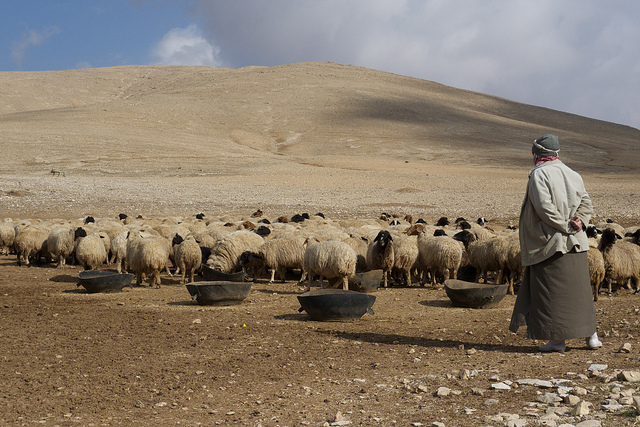
:: Image via Bombardier/flickr.

For more on Syria see:

Millions Go Hungry in Syria, Libya and Yemen

500,000 Syrians Flee Drought-Stricken Zone

Syria’s Dustbowl Attributed to Wasted Water
 

Arwa Aburawa
Arwa Aburawahttp://www.greenprophet.com
Arwa is a Muslim freelance writer who is interested in everything climate change related and how Islam can inspire more people to care for their planet and take active steps to save it while we can. She is endlessly suspicious of all politicians and their ceaseless meetings, especially as they make normal people believe that they are not part of the solution when they are the ONLY solution. Her Indian auntie is her model eco-warrier, and when Arwa is not busy helping out in the neighborhood alleyway garden, swap shopping or attempting fusion vegetarian dishes- with mixed success, she’d like to add- she can be found sipping on foraged nettle tea.
1 COMMENT

LEAVE A REPLY

Please enter your comment!
Please enter your name here

TRENDING

Slow food market Souk el Tayeb in Lebanon celebrates food and Eid El Barbara

What makes Souk El Tayeb in Lebanon remarkable is not only its insistence on local, seasonal produce, but its belief that dignity and sustainability must go hand in hand. Farmers are paid fairly. Villages are uplifted. Traditional recipes are kept alive not as nostalgia but as knowledge systems: real food is carbon-light, waste-free, and is adapted to the land.

Water conflicts in the Middle East region to watch in 2025

Rising temperatures, unpredictable rainfall, and more frequent droughts amplify existing disputes. Water scarcity can fuel unrest, as seen in Iran’s Khuzestan protests, and can undermine fragile peace deals in post-conflict states like Libya and Yemen.

Arab agricultural land is on the brink

Across the Arab world, croplands face a perfect storm of stressors. Excessive fertilizers and pesticides erode soil ecology. Poor drainage and over-irrigation drive salinization, leaving fields crusted with salt. Rising temperatures, dwindling groundwater, and more frequent sand-and-dust storms—all amplified by climate change—compound the crisis.

Types of seed banks and how they work in hot climates

You may have heard about the doomsday Svalbard Global Seed Vault but there are smaller versions of seed banks all over the world. The seed banks in the Middle East protect ancient seeds like wheat, chick peas, fava beans, and sesame.

Morocco loses half its wheat crop this year from drought

A prolonged drought in Morocco is causing serious problems...

6 Payment Processors With the Fastest Onboarding for SMBs

Get your SMB up and running fast with these 6 payment processors. Compare the quickest onboarding options to start accepting customer payments without delay.

Qatar’s climate hypocrisy rides the London Underground

Qatar remains a master of doublethink—burning gas by the megaton while selling “sustainability” to a world desperate for clean air. Wake up from your slumber people.

How Quality of Hire Shapes Modern Recruitment

A 2024 survey by Deloitte found that 76% of talent leaders now consider long-term retention and workforce contribution among their most important hiring success metrics—far surpassing time-to-fill or cost-per-hire. As the expectations for new hires deepen, companies must also confront the inherent challenges in redefining and accurately measuring hiring quality.

8 Team-Building Exercises to Start the Week Off 

Team building to change the world! The best renewable energy companies are ones that function.

Thank you, LinkedIn — and what your Jobs on the Rise report means for sustainable careers

While “green jobs” aren’t always labeled as such, many of the fastest-growing roles are directly enabling the energy transition, climate resilience, and lower-carbon systems: Number one on their list is Artificial Intelligence engineers. But what does that mean? Vibe coding Claude? 

Somali pirates steal oil tankers

The pirates often stage their heists out of Somalia, a lawless country, with a weak central government that is grappling with a violent Islamist insurgency. Using speedboats that swarm the targets, the machine-gun-toting pirates take control of merchant ships and then hold the vessels, crew and cargo for ransom.

Leopoldo Alejandro Betancourt López Turned Ocean Plastic Into Profitable Sunglasses

Few fashion accessories carry the environmental burden of sunglasses. Most frames are constructed from petroleum-based plastics and acrylic polymers that linger in landfills for centuries, shedding microplastics into soil and waterways long after they've been discarded. Leopoldo Alejandro Betancourt López, president of the Spanish eyewear brand Hawkers, saw this problem differently than most industry executives.

Why Dr. Tony Jacob Sees Texas Business Egos as Warning Signs

Everything's bigger in Texas. Except business egos.  Dr. Tony Jacob figured...

Related Articles

Popular Categories