
Understanding Cairo Beyond the Complaints

david sims cairo medieval versus modern, understanding cairoDirty, polluted, and badly managed: Understanding Cairo, The Logic of a City Out of Control goes beyond the usual rhetoric

“The Egyptian middle classes and intelligentsia, as well as a sizable slice of the foreign community, love to deplore what Cairo has become. Crowds and congestion, pollution, garbage, chaos, gridlocked traffic, horrendous architecture, and no green space, all are endlessly invoked to describe the mess that Cairo has become.”

This is how David Sims, a Cairo based urban planner and economist, puts it. And whether one reads Egyptian newspapers or publications on urban planning, this is how Egypt’s capital city is usually depicted. Sometimes part of an appeal to change just about everything, rarely is checked whether these descriptions are fact or fiction.

Sim’s book distinguishes itself from others by going beyond the usual complaining.

Instead, it tries to understand how these phenomena were created and continue. Quickly, the erroneously narratives about the necropolis or the rooftops, which would both house close to half a million people, are dealt with. And when what is told about Cairo appears to be more than just a lie, the informal settlements for example, he starts investigating them.

As such, Sims shows us that Cairo’s radical population-increase didn’t make the number of inhabitants of the formal city increase.

No, it were the “ashwa’iyyat” (informal areas) that absorbed Cairo’s growing population. The never-ending informal settlements nowadays accommodate more than ten million people and they only germinated half a century ago.

But this “order without design” is not what the governments or the elites preferred. Policy-makers always tried to stop the informality by putting laws in place and offering an alternative to cope with population growth.

They thought: “Why would you build on valuable agricultural soil when there’s so much desert to be wasted?” and launched initiatives to build new desert cities.

It didn’t work.

Forty years of heavy investments later the desert cities barely house six hundred thousand inhabitants and informal building is still thriving.

“Understanding Cairo” doesn’t limit itself to what went wrong. In the 70’s it was generally assumed that a Cairo with more than 9 million people would not function. No car would be able to move, air pollution would be intolerable and the city would be unliveable.

But with almost 20 million people it still functions. Cairo even appears to outperform similar Third World cities. Traffic goes remarkably smooth, and its housing improved overtime. But how?

Read the book and find out.

While “Understanding Cairo” isn’t about sustainability, David Sims surely grasps the concept. He in fact teaches us a valuable lesson. Without understanding a city’s dynamics one cannot create a good vision.

::Buy Understanding Cairo here

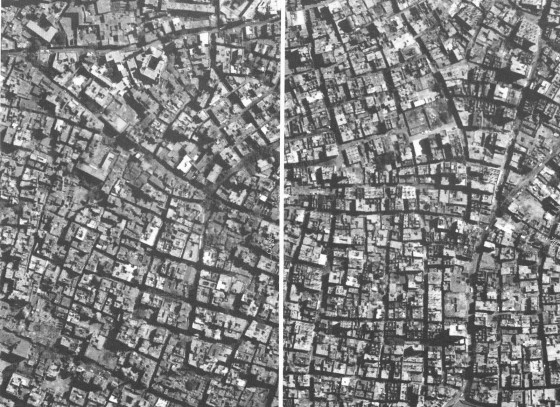
Above image:”Contrasting urban fabrics over nine hundred years. Top: the Bab al-Wazir area of historic Cairo (developed in the eleventh century); bottom Fustat Plateau area (developed in the 1980s). David Sims, Understanding Cairo, The Logic of a city out of control, p. 117″


Does Vandousselaere
Does Vandousselaerehttps://www.greenprophet.com/
On a rainy February morning Does realized that his current life as a consultant was not his dream. No, he’d rather be where the action is, and so he started hitch-hiking to Cairo - from Belgium! Not wary of a challenge, he tries to bike his already teargassed lungs through Cairo.
2 COMMENTS
  1. Euhm,

    You forget to mention why Egypt doesn’t fall in the developing nations category. Is it too rich, or too poor? And with which mayor third world cities do you compare it? I don’t have the book with me anymore, but the author wasn’t comparing it with the poorest cities in the world (so not with Port-aux-Prince or Moghadishu for example) but with important megalopolises like Bombai, Sao Paulo, etc (am just guessing them, so don’t shoot me if I get it wrong). Why would the intelligentsia want to claim Egypt to be a developing country while it isn’t?

    And the third comment, that’s of course what we all know as the environmental Kuznets curve. Cairo actually has a relative low degree of car ownership (compared to the cities mentioned above), especially in the informal areas (not in Doqqi or Mohandiseen).

  2. I love that article,
    however the comparison to other “third world” countries is a bit inacceptable for me.
    First, the term itself is a bit dodgy, but I’m not a friend of general Neusprech anyway.
    Second, Egypt with especially Cairo does not fall into this category of “developping nations” or however we name it, even if its intelligentsia wants to claim it that way sometimes.
    Third, the more a popluation develops economically the less the infrastructure should work in the medium or short term… meaning all the other “third world” cities i’ve been to, had remarkably effecient infrastructure (much btter than Cairo), since few people own cars to block the road.

    Thanks

LEAVE A REPLY

Please enter your comment!
Please enter your name here

TRENDING

Fishermen sue tire manufacturers on behalf of the salmon

A federal trial in San Francisco has brought US tire manufacturers, fishing groups, and environmental scientists into court over a chemical most drivers have never heard of — but which scientists say may be silently reshaping aquatic ecosystems.

Ethiopians are Looking to Somaliland for Red Sea Access as Global Powers Move In

Somaliland, for its part, has operated as a de facto independent state since 1991. It has its own government, elections, currency, and security forces. It’s often described as one of the more stable and democratic political systems in the region, despite never being formally recognized internationally. 

Factors That Determine the Payout of Asbestos Cases

Asbestos is found in eye shadow and talc. Know your rights of this deadly environmental hazard.

Egypt building nuclear power

Egypt is building a nuclear energy plant, expected to go online in 2026 when countries like Germany have shut down all its domestic nuclear power. The El Dabaa Nuclear Power Plant is the first nuclear power plant planned for Egypt and will be located at El Dabaa, Matrouh Governorate, Egypt, about 320 kilometers northwest of Cairo. 

More investments of 1.2 GW in Benban solar, Egypt

Egypt’s Ministry of Electricity and Renewable Energy, the Egyptian Electricity Transmission Company, and a consortium comprising Infinity Power and Hassan Allam Utilities Energy Platform signed an agreement to jointly develop solar power projects at Benban Solar, one of the world's largest solar energy parks in Egypt.

Qatar’s climate hypocrisy rides the London Underground

Qatar remains a master of doublethink—burning gas by the megaton while selling “sustainability” to a world desperate for clean air. Wake up from your slumber people.

How Quality of Hire Shapes Modern Recruitment

A 2024 survey by Deloitte found that 76% of talent leaders now consider long-term retention and workforce contribution among their most important hiring success metrics—far surpassing time-to-fill or cost-per-hire. As the expectations for new hires deepen, companies must also confront the inherent challenges in redefining and accurately measuring hiring quality.

8 Team-Building Exercises to Start the Week Off 

Team building to change the world! The best renewable energy companies are ones that function.

Thank you, LinkedIn — and what your Jobs on the Rise report means for sustainable careers

While “green jobs” aren’t always labeled as such, many of the fastest-growing roles are directly enabling the energy transition, climate resilience, and lower-carbon systems: Number one on their list is Artificial Intelligence engineers. But what does that mean? Vibe coding Claude? 

Somali pirates steal oil tankers

The pirates often stage their heists out of Somalia, a lawless country, with a weak central government that is grappling with a violent Islamist insurgency. Using speedboats that swarm the targets, the machine-gun-toting pirates take control of merchant ships and then hold the vessels, crew and cargo for ransom.

Leopoldo Alejandro Betancourt López Turned Ocean Plastic Into Profitable Sunglasses

Few fashion accessories carry the environmental burden of sunglasses. Most frames are constructed from petroleum-based plastics and acrylic polymers that linger in landfills for centuries, shedding microplastics into soil and waterways long after they've been discarded. Leopoldo Alejandro Betancourt López, president of the Spanish eyewear brand Hawkers, saw this problem differently than most industry executives.

Why Dr. Tony Jacob Sees Texas Business Egos as Warning Signs

Everything's bigger in Texas. Except business egos.  Dr. Tony Jacob figured...

Israel and America Sign Renewable Energy Cooperation Deal

Other announcements made at the conference include the Timna Renewable Energy Park, which will be a center for R&D, and the AORA Solar Thermal Module at Kibbutz Samar, the world's first commercial hybrid solar gas-turbine power plant that is already nearing completion. Solel Solar Systems announced it was beginning construction of a 50 MW solar field in Lebrija, Spain, and Brightsource Energy made a pre-conference announcement that it had inked the world's largest solar deal to date with Southern California Edison (SCE).

Related Articles

Popular Categories