
Conventional Power Plants Get Hybrid Dance Partner, the Sun

hybrid power plant turkey
Traditional power plant operators have been loathe to adopt renewables for infrastructure investment. But a new Israeli hybrid invention could make solar a realistic step forward.

While solar energy is the environmentally-friendly alternative of choice for power plants, it’s an expensive option because of the equipment and technology needed to harvest the sun’s rays. Now a Tel Aviv University researcher says that “going hybrid” is a quicker and cheaper route to cleaner electrical power. Prof. Avi Kribus has developed a technology that combines the conventional fuel used in today’s power plants with the lower pressures and temperatures of steam produced by solar power. His new “hybrid” power plant is a potentially cost-effective and realistic way to integrate solar technology into existing power plants.

“It’s complex solar technology,” he explains. The materials alone, which include pipes made from expensive metals designed to handle high pressures and temperatures, as well as fields of large mirrors needed to harvest and concentrate enough light, make the venture too costly to be widely implemented.

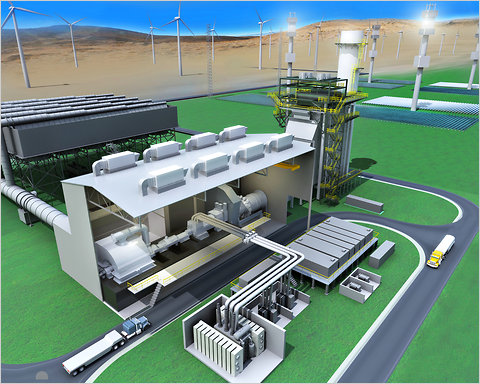
Meanwhile, earlier this summer GE announced a hybrid plant it’s building in Turkey with the California company eSolar. Pictured above.

Prof. Kribus who’s been in stealth mode for the last couple of years is considered one of Israel’s foremost solar researchers. Another worth noting is  Prof. David Faiman.

But this new technology by Prof. Kribus (links to his website) has developed a way to use conventional fuel with the lower pressures and temperatures of steam produced by solar power, allowing plants to be hybrid, replacing 25 to 50 percent of their fuel use with green energy.

His method, which will be reported in a future issue of the Solar Energy Journal, presents a potentially cost-effective and realistic way to integrate solar technology into today’s power plants.

In a solar thermal power plant, sunlight is harvested to create hot high-pressure steam, approximately 400 to 500 degrees centigrade. This solar-produced steam is then used to rotate the turbines that generate electricity. Though the environmental benefits over traditional power plants are undeniable, Prof. Kribus cautions that it is somewhat unrealistic economically for the current industry.

“We combine a gas turbine, which works on hot air and not steam, and inject the solar-produced steam into the process,” he explains. “We still need to burn fuel to heat the air, but we add steam from low-temperature solar energy, approximately 200 degrees centigrade.”

This hybrid cycle is not only highly efficient in terms of energy production, but the lowered pressure and heat requirements allow the solar part of the technology to use more cost-effective materials, such as common metals and low-cost solar collectors.

A bridge to green energy

The hybrid fuel and solar power system may not be entirely green, says Prof. Kribus, but it does offer a more realistic option for the short and medium term.

Electricity from solar thermal power plants currently costs twice as much as electricity from traditional power plants, he notes. If this doesn’t change, the technology may never be widely adopted. The researchers hope that a hybrid plant will have a comparable cost to a fuel-based power plant, making the option of replacing a large fraction of fuel with solar energy competitive and viable.

The researchers are starting a collaboration with a university in India to develop this method in more detail, and are looking for corporate partnerships that are willing to put hybrid technology into use. It’s a stepping stone that will help introduce solar energy into the industry in an accessible and affordable way, Prof. Kribus says.

Karin Kloosterman
Karin Kloostermanhttp://www.greenprophet.com
Karin Kloosterman is an award-winning journalist, innovation strategist, and founder of Green Prophet, one of the Middle East’s pioneering sustainability platforms. She has ranked in the Top 10 of Verizon innovation competitions, participated in NASA-linked challenges, and spoken worldwide on climate, food security, and future resilience. With an IoT technology patent, features in Canada’s National Post, and leadership inside teams building next-generation agricultural and planetary systems — including Mars-farming concepts — Karin operates at the intersection of storytelling, science, and systems change. She doesn’t report on the future – she helps design it. Reach out directly to [email protected]

TRENDING

Should You Invest in the Private Market?

startustartup Unlike public stock exchanges, which offer daily trading, strict...

SolCold wants to cool buildings using sunlight

For centuries people living in hot climates have tried...

Eco organization offices destroyed by Iran missile

Tel Aviv's eco organization, the Heschel Center, was impacted by an Iranian missile.

What are AWG air-water generators, and why they aren’t a golden-bullet solution (yet)

Atmospheric water generators (AWGs) sound like magic: machines that can pull drinking water out of air. The idea is mentioned in the Bible, where the elders would pray for water collected as dew on plants and the catch on turning this into a machine is in the physics. To turn invisible vapor into liquid, you must remove heat, especially the latent heat of condensation.

Jordan’s $6 Billion Aqaba–Amman Desalination Project from the Red Sea Moves Forward

In 2025, the Jordanian government signed agreements with a consortium led by Meridiam and SUEZ, alongside VINCI Construction and Orascom Construction. Under a 30-year concession agreement, the consortium will design, build, finance, operate, and maintain the system before transferring it back to the Jordanian government. The total investment is estimated at approximately $6 billion USD.

Should You Invest in the Private Market?

startustartup Unlike public stock exchanges, which offer daily trading, strict...

How to build a 100-year-company

Kongō Gumi is a Japanese construction company, purportedly founded in 578 A.D., making it the world's oldest documented company. What can we learn about building sustainable businesses from them?

From Pilot Plant to Global Stage: How Aduro Clean Technologies’ 2026 Expansion Signals a Turning Point for Chemical Recycling Investors Like Yazan Al Homsi

The company's Next Generation Process (NGP) Pilot Plant in London, Ontario, has officially moved into initial operating campaigns, generating the kind of structured, repeatable data that separates laboratory promise from commercial viability.

How AI Helps SaaS Companies Reduce Repetitive Customer Support Work

SaaS products are designed for large numbers of users with different levels of experience, and also in renewable energy.

Pulling Water from the Air

Faced with water shortage in Amman, Laurie digs up...

Turning Your Energy Consultancy into an LLC: 4 Legal Steps for Founders in Texas

If you are starting a renewable energy business in Texas, learn how to start an LLC by the books.

Tracking the Impacts of a Hydroelectric Dam Along the Tigris River

For the next two months, I'll be taking a break from my usual Green Prophet posts to report on a transnational environmental issue: the Ilısu Dam currently under construction in Turkey, and the ways it will transform life along the Tigris River.

6 Payment Processors With the Fastest Onboarding for SMBs

Get your SMB up and running fast with these 6 payment processors. Compare the quickest onboarding options to start accepting customer payments without delay.

Related Articles

Popular Categories