

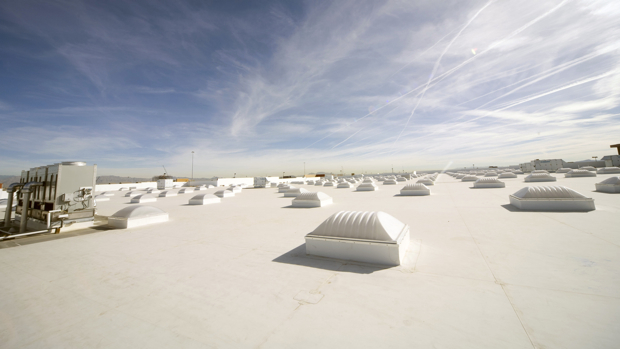
Leave the white paint in the bucket. It won’t help climate change. Add solar panels instead to “green” your home.
Stop the contractors! If you were thinking about painting the roof of your house white this winter, before winter rains start, leave the paint in the bucket: Environmentalists were advocating white, just like they offer a quick fix to climate change by getting you to change to CFL lightbulbs.
But according to a new study by Mark Jacobson from Stanford, the white roof doesn’t act like an anti-warming device, keeping your house cooler in the summer. White paint, it turns out, is a big fat waste of money.
Writing in the journal Climate, Jacobson and his research student John Ten Hoeve did report that white surfaces cooled houses, but the white roof effect also reduced cloudiness, thereby allowing more of the sun’s rays to reach the ground.
“There does not seem to be a benefit from investing in white roofs,” says Jacobson. “The most important thing is to reduce emissions of the pollutants that contribute to global warming.”
Solar panels, the team reports, are better than white paint: “The better thing to do is to put a solar panel on the roof because that not only cools the house by absorbing the sunlight to make electricity. It also offsets fossil fuel generation at power plants.”
They are dead set against any other form of quick fix or geo-engineering schemes to “fix” climate change: “With all geo-engineering approaches, you are not solving the problem but masking it. There are all kinds of consequences people are not aware of, and it doesn’t solve the problem. You are still going to have all these greenhouse gases going into the air.”
The effect of heat islands whereby buildings cover natural vegetation needs to be studied more.
Photovoltaic panels helpful
How you can upgrade your house while leaving the white paint in the bucket? One way to reduce emissions while simultaneously reducing summer air conditioning demand is to install photovoltaic panels on roofs.
Such panels not only generate electricity, reducing emissions of fossil fuels from electricity-producing power plants, but they also reduce sunlight absorbed by buildings because they convert sunlight to electricity. Because photovoltaic panels do not reflect the sunlight back to the air, unlike white roofs, reflected light is not available to be absorbed again by pollutants in the air, creating heat.
“Cooling your house with white roofs at the expense of warming the planet is not a very desirable trade-off,” Jacobson said. “A warmer planet will melt the sea ice and glaciers faster, triggering feedbacks that will lead to even greater overall warming. There are more effective methods of reducing global warming.”




Hi Maxwells,
Thanks for the comment. I am happy to have opened the discussion. This blog post reports on the research of a scientist who has published new findings. It is not an opinion article, but giving some new evidence perhaps to think about other ideas before we paint the world white. I hope it will spur more research.
Obviously, a non-climate knowledgeable, non-engineering oriented person wrote this without considering the whole, or even much of the picture. As per the above commenter, most people aren’t going to do anything, unless forced. So, the total environmental impact will be quite modest at best.
But for those who do, note
For example, that summer time cloudiness in the southwestern U.S., where these issues apply most vigorously is rare. So, most of the roof-reflected sunlight would disperse directly to outer space.
Moreover, easing summer cloudiness and therefore surface humidity in the south Atlantic and Gulf states would allow air conditioners to be more efficient.
It would also reduce the amount of latent heat released in the troposphere and atmospheric boundary layer (where we live) that occurs via converting local vapor to rainout (precipitation, i.e., summer squalls), as a counter trend to warming via reduced cloudiness. In fact, doing so would modestly shift the precipitation region northward, where it would do more good for vegetation canopies.
Even as their prices fall at 17% per year, as per Moore’s Law, a barely affordable number of PV panels (say $10K worth) would take up just a minor fraction of most home roofing.
Meanwhile, painting an average home roof in the U.S. southern states with white elastomeric paint from Home Depot or Lowe’s costs ~$500 DIY, yet is likely to cut air conditioning costs by up to 50%. BTW, installing a secure PV system is not a DIY project for most people.
So, if you can afford it, there’s little reason not to do both. If you can’t, then opt for the paint first.
Next time, consult a good scientist who can think through most consequences.
I agree that research should always be done. However, (no disrespect) I believe that this article highlights a straw man’s argument, which inaccurately represents cool roofs. The argument builds up the idea that it is proposed to immediately “paint” every single roof white to reduce global warming. Also, the crux of the argument which involves a “decreased cloudiness” seems like a stretch. I do think that this article is well written and it is very important to scientifically question anything involving a containment of global warming. The bottom line: If your home or commercial building needs a roof replacement, cool roofs bring significant benefits to the table that cannot be ignored. I think I’ll take my chances with decreased cloudiness.
Hi Andrew, I think this research opens up new questions for a more complete analysis. Maybe in some countries where there is no verdant green cover to soak up the heat white roof sealant over black might be advised to use. I hope this project leads to a more conclusive guide on how homeowners and businesses can brace against climate change.
I understand where the author is coming from. However, there are several parts of the argument that don’t hold up. The first issue is that Roof coatings should not be simply labeled as “white paint.” This is incorrect. There are products out there that act as a waterproofing material/sealer as well and carry very high warranties with them. Some are even Epoxy based. This acts to give your roof a longer life cycle and indirectly reduces landfill waste. Secondly, the article states that solar panels are a better idea. However, cool roofs or “white roofs” go hand in hand with solar panels. The hotter the solar panels get, the less efficient they become. Lastly, “white roofs” do reduce carbon emissions because AC units will not work as hard and will consume less energy.
Great article with interesting perspective about white roofs. White roofs also turn black rather quickly with particulate matter in the air, loosing their reflectivity within a year or so. However living roofs – green roofs with a biomass harvesting program can help with climate change issues by sequestering carbon. See an interesting article re living roofs and carbon sequestration here: http://breakinggroundgreenroof.com/bggreenroofs-amazing-sequestration-a-net-negative-carbon-roof/
Green roofs sound like the way to go. But I am not sure how they would work in the hot middle east where water is severely lacking. Maybe a sand roof with cactus? A brown roof? A beige roof?
I think that green roofs can survive quite well in hot weather too, if the right plant varieties are chosen!