
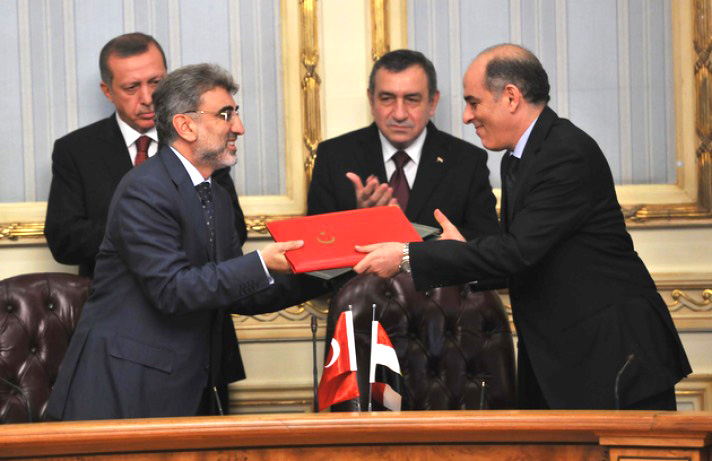


Egypt and Turkey entered into several new energy-sharing arrangements on a recent diplomatic visit to Cairo by Turkish Prime Minister Recep Tayyip Erdoğan and Energy Minister Taner Yıldız. Analysts speculate that the new alliance comes in response to a perceived Israeli-Cypriot alliance over natural gas extraction.
Oil wars are so last century. The resource with the potential to stir up most turmoil in the Mediterranean region over the next year? Natural gas. In the last week alone, the Turkish government has launched three aggressive foreign policy initiatives regarding this precious (and polluting) fuel.
It can be difficult to sift through all the news and figure out exactly what’s going on, and how each case is connected. Read on for a simple breakdown of natural gas politics in the Mediterranean — and how it’s unlikely to get simpler any time soon.
Cyprus: Complicating an already complicated situation
The Mediterranean island of Cyprus is a divided nation. The country is represented in the European Union by its Greek Cypriot government, which controls the southern part of the island. The northern part, however, has been under Turkish control since a 1974 invasion.
Turkey is the only country that recognizes the Turkish Republic of Northern Cyprus (TRNC) — but the 30,000 Turkish soldiers on the ground there attest to the fact that Turkey is determined to hold onto it.
Ever since U.S. company Noble announced the discovery of vast natural gas reserves off the Mediterranean coasts of Israel and Cyprus last year, Turkey has demanded that the TRNC benefit from any gas-drilling projects that Cyprus undertakes. No such guarantee has been given, and tensions were further raised when Cyprus entered into energy deals with Israeli companies over the new reserves. In the past few weeks, Turkish-Israeli relations have hit new lows; almost all Israeli diplomats were expelled from the country, and Turkey vowed to increase its naval presence in the eastern Mediterranean.
While other circumstances have contributed to these developments, the natural gas issue is undoubtedly stoking the flames of Turkish aggression. Just yesterday, Turkey announced that it would sign a “continental shelf delimitation” accord with the TRNC — basically, demarcate areas in the Mediterranean where Turkey and the TRNC could proceed with their own offshore oil and gas exploration projects.
Cyprus has vowed to keep negotiations over Turkey’s ascension to the EU on hold as long as it obstructs the Cypriot-Israeli drilling efforts. Today, Turkey has said it will refrain from initiating its own drilling plans so if Cyprus postpones drilling the new reserves. It seems unlikely that this tactic will defuse the situation, however.
Egypt: Cementing new diplomatic allies and enemies
In the meantime, Turkey has been using natural gas access to court a new diplomatic ally, whose interests are also stacked against Israel.
On a recent visit to Egypt, Turkish Prime Minister Erdoğan and Energy Minister Taner Yıldız met their counterparts, Egyptian Prime Minister Essam Sharaf and Energy & Electricity Minister Hassan Younis. Erdoğan invited Egypt to use the Nabucco pipeline, which is being built to carry natural gas from central Asia to Europe via Turkey, to increase its export market.
Erdoğan and Yıldız also announced that Egypt would begin exporting natural gas directly to Turkey, making it the sixth country on which Turkey relies for its gas supply.
Egypt had been supplying Israel with 40 percent of its natural gas needs until this year, when the revolution and repeated efforts to sabotage the Egypt-Israel pipeline disrupted the flow. As a result, Israel has been more and more interested in moving its supply over to its own offshore reserves — especially since the Noble discoveries last year showed that it had substantial resources. Israel is embroiled in its own ownership dispute with Lebanon over these reserves, however.
Israel has also been considering building an undersea natural gas pipeline to Greece, from which it could be sold to other European countries.
Greece: Cashing in on debt
Greece will certainly need an energy ally in coming months. The state-owned Turkish Pipeline Corporation declared on Wednesday that it would sue Greece for $300 million of unpaid gas transfers from 2008 to the present.
The bill has been outstanding for nearly one year, during which time Greece promised, but never submitted, a plan for repayment of the debt. The case will be heard in Swiss arbitration court.
A bizarre and somewhat medieval outcome may arise from this. If the Turkish Pipeline Corporation wins its case, it will be able to confiscate “belongings” of the Greek state to pay off the debt — seizing Greek ships or airplanes that land on Turkish territory, for example, as recompense until the equivalent value has been restored to Turkey.
The long view
As the Mediterranean collapses into a feudal fever over its hydrocarbon reserves, try to keep one thing in mind. If Turkey tapped into just 5 percent of its solar resource, it would have enough energy to power itself and export copious electricity to its neighbors.
Puts this whole mess in perspective, doesn’t it?
:: Globes
Read more about energy geopolitics in the Middle East:
Israel Readies Offshore Natural Gas Pipeline
Greek Cyprus Fearful Over Offshore Gas Well Drilling
Turkish Government Renews Efforts to Reduce Dependence on Foreign Energy
Image via worldbulletin




How do you figure that “tapping into 5% of its solar resources” equates to Turkey’s total energy demand? First and foremost, how much investment is needed to “tap” 5% of solar energy potential? Can turkey afford it right now? How long would it take Turkey to build such infrastructure? Who will provide credit for the project given the worldwide balance sheet deleveraging taking place? If you can answer these to questions then write a letter to Erdogan. He is one of the smartest, principled and down to earth politicians that is currently in power. And just out of curiosity, how much of its own solar resources is Israel currently “tap”ping into?
Viable energy resources while certainly a large part of any country’s foreign policy is not the most important consideration in the case of Turkey. Azerbaijan can/does supply any energy needs that Turkey does/will need. The Turkish-Egyptian maneuvering in the Mediterranean is an extension of their larger geo-political vision for the future of MENA. The worldwide geo-political and economical power is shifting away from the developed world (and Israel) towards the emerging nations/economies; arab uprising is only accelerating the MENA enclave of this transformation. Turkey is betting that Israel’s arrogance that has been exacerbated in the last 20 years if continued will result in isolation similar to that of Armenia. I am not sure that is the best path for Turkey to take, but a path nevertheless. Natural gas resources between Cypress and Israel are an insignificant part of this fiasco.