
Jews, Muslims, Christians in Israel Unite for Planet Earth

jews christians and muslims greenProviding teaching material to unite Holy Land faiths.

They’re doing in person and specifically in Israel what Green Prophet has been doing for the last four years: showing a faith based and cultural context in environmental action. Launched last year, meet the Jerusalem-based Interfaith Center working on issues like climate change.

Shema Yisrael is a statement of faith that many Jews say at bedtime, during daily prayers and in times of need. “Hear, O Israel: the Lord is our God, the Lord is one” is the first line, emphasizing the monotheistic nature of Judaism.

For Rabbi Yonatan Neril, a 30-year-old married father of one, the second line in the prayer –“Blessed is the name of God’s kingdom forever” — provides hope for the planet. Seeing environmental degradation as a spiritual problem, he has turned to leaders of the three monotheistic faiths to right our ecological wrongs.

Yonathan Neril, Eco Bible
Yonathan Neril, co-author of Eco Bible coming out November 16, 2020

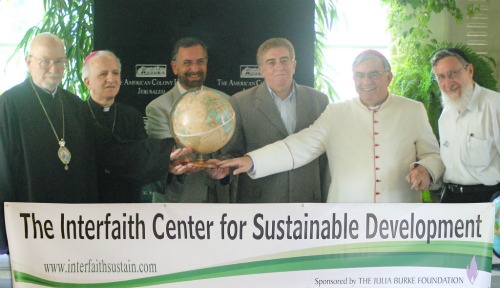
Since last year, Neril has been building the Interfaith Center for Sustainable Development in Jerusalem. The six-person non-profit organization recently held the first interfaith meeting to formulate climate change policy, which impressively resulted in commitments of support from Israel’s Chief Rabbinate, the Palestinian Ministry of Religious Affairs (Waqf), the Palestinian Sharia Courts and the assembly of the Heads of Churches of Jerusalem.

“The second verse in Shema gives me hope and inspiration that there will be balance on this planet, that God’s glorious kingdom will be blessed forever,” says Neril, who was raised near Berkeley, California, and has lived in Israel for eight years.

“This is hope in the face of what scientists are saying about what will happen in this century,” he says.

Sponsored by the Julia Burke Foundation in California, his organization divides its actions into two spheres: one dedicated to fighting climate change, the other to providing ecological-theological seminars and college-credit courses to show how faith intersects with environmental values.

Interfaith Center for Sustainable Development members have already given about 25 “green theology” seminars. The courses are available online and are also offered to eco-tourists in Israel or locals looking for spiritual environmentalism tools. For now, the courses are focused on Jewish sources, but the center is working to include resources for Islamic and Christian audiences as well.

Quelling the effects of climate change

The Interfaith Eco Forum held at Jerusalem’s American Colony Hotel in July drew about 40 people, including representatives from all three monotheistic faiths. Neril pointed out poignant reasons for bringing faith into the equation.

“The widespread human degradation of the natural world indicates that our way of life is out of balance,” he says. “This is where religions come in — to be a force for positive change in the world. And there is no better place to begin than with religious leaders here in the Holy Land.”

Religion can be a force for positive change, says Rabbi Yonatan Neril.

He sees the multi-faith paradigm in Israel as an advantage rather than as grounds for more conflict. “People of many faiths draw inspiration from their respective traditions to live sustainably, and these efforts cross-pollinate each other and encourage coexistence on our shared planet and in this land,” Neril says.

The forum attracted worldwide media attention and featured talks by Dr. Michael Kagan, the initiator of the Holy Land Climate Change Declaration endorsed in April by the Council of Religious Institutions of the Holy Land; Bishop William Shomali of the Latin Patriarchate of Jerusalem; Haj Salah Zuheika, deputy minister of the Palestinian Authority’s Ministry of Religious Affairs; and Rabbi David Rosen, the American Jewish Committee’s international director of inter-religious affairs.

Speaking for and to the Muslim people in the Holy Land, Zuheika spoke about the roots of environmental awareness in the Koran, pointing out today’s special challenges in the region.

“The earth is like our home, and those who live in the same home should know how to live together,” Shomali declared at the forum. “The main religions should study ecological issues together because we have a common destiny. We need to put all of our energies together to solve the environmental crisis, which is ethical, moral and spiritual.”

Karin Kloosterman
Karin Kloostermanhttp://www.greenprophet.com
Karin Kloosterman is an award-winning journalist, innovation strategist, and founder of Green Prophet, one of the Middle East’s pioneering sustainability platforms. She has ranked in the Top 10 of Verizon innovation competitions, participated in NASA-linked challenges, and spoken worldwide on climate, food security, and future resilience. With an IoT technology patent, features in Canada’s National Post, and leadership inside teams building next-generation agricultural and planetary systems — including Mars-farming concepts — Karin operates at the intersection of storytelling, science, and systems change. She doesn’t report on the future – she helps design it. Reach out directly to [email protected]

LEAVE A REPLY

Please enter your comment!
Please enter your name here

TRENDING

Astro uses AI to help procure land for renewable energy

For oil-rich, environmentally vigilant Gulf states, Astro isn’t just another startup story. It is a blueprint for accelerating an energy transition that is now existential, not optional.

The Science Behind How Elite Marathon Runners Train

Discover the science behind elite marathon training. Explore techniques, nutrition, and mental strategies that propel top runners to success.

Earth building with Dead Sea salt bricks

Researchers develop a brick made largely from recycled Dead Sea salt—offering a potential alternative to carbon-intensive cement.

The Christ’s thorn (sidr tree) is also a well-known folk medicine

Christ’s thorn jujube (Ziziphus spina-christi) also known as the sidr tree is a real, identifiable tree native to the Middle East, and it appears—directly or indirectly—in Islam, Judaism, and later Christian tradition. The connections between the three faiths are not theological agreements but overlapping uses, names, and symbolic associations rooted in the same landscape.

Farm To Table Israel Connects People To The Land

Farm To Table Israel is transforming the traditional dining experience into a hands-on journey.

Qatar’s climate hypocrisy rides the London Underground

Qatar remains a master of doublethink—burning gas by the megaton while selling “sustainability” to a world desperate for clean air. Wake up from your slumber people.

How Quality of Hire Shapes Modern Recruitment

A 2024 survey by Deloitte found that 76% of talent leaders now consider long-term retention and workforce contribution among their most important hiring success metrics—far surpassing time-to-fill or cost-per-hire. As the expectations for new hires deepen, companies must also confront the inherent challenges in redefining and accurately measuring hiring quality.

8 Team-Building Exercises to Start the Week Off 

Team building to change the world! The best renewable energy companies are ones that function.

Thank you, LinkedIn — and what your Jobs on the Rise report means for sustainable careers

While “green jobs” aren’t always labeled as such, many of the fastest-growing roles are directly enabling the energy transition, climate resilience, and lower-carbon systems: Number one on their list is Artificial Intelligence engineers. But what does that mean? Vibe coding Claude? 

Somali pirates steal oil tankers

The pirates often stage their heists out of Somalia, a lawless country, with a weak central government that is grappling with a violent Islamist insurgency. Using speedboats that swarm the targets, the machine-gun-toting pirates take control of merchant ships and then hold the vessels, crew and cargo for ransom.

Leopoldo Alejandro Betancourt López Turned Ocean Plastic Into Profitable Sunglasses

Few fashion accessories carry the environmental burden of sunglasses. Most frames are constructed from petroleum-based plastics and acrylic polymers that linger in landfills for centuries, shedding microplastics into soil and waterways long after they've been discarded. Leopoldo Alejandro Betancourt López, president of the Spanish eyewear brand Hawkers, saw this problem differently than most industry executives.

Why Dr. Tony Jacob Sees Texas Business Egos as Warning Signs

Everything's bigger in Texas. Except business egos.  Dr. Tony Jacob figured...

Israel and America Sign Renewable Energy Cooperation Deal

Other announcements made at the conference include the Timna Renewable Energy Park, which will be a center for R&D, and the AORA Solar Thermal Module at Kibbutz Samar, the world's first commercial hybrid solar gas-turbine power plant that is already nearing completion. Solel Solar Systems announced it was beginning construction of a 50 MW solar field in Lebrija, Spain, and Brightsource Energy made a pre-conference announcement that it had inked the world's largest solar deal to date with Southern California Edison (SCE).

Related Articles

Popular Categories