
Desertification In Egypt Is Putting Food Supplies At Risk

Egypt is losing an estimated 11,736 hectres of agricultural land every year according to UN sources

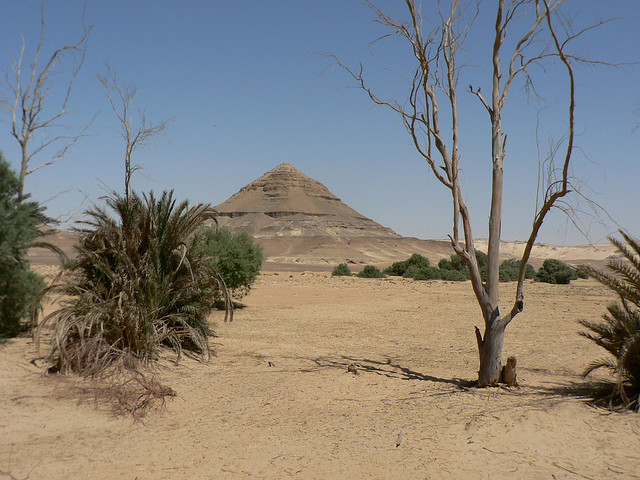
From food contaminated with human waste in Cairo due to water shortages to concerns that the country could be on the brink of famine, Egypt is facing its fair share of food problems. Now, there are reports that desertification is eating into agricultural land and putting local food production at risk. Although only 3% of Egypt’s land is cultivated, urban sprawl and construction is cutting into this precious resource which serves 85 million people.

“Desertification is the real danger everybody should pay attention to,” Abdel Rahman Attia, a professor of agriculture at Cairo University, told IRIN. “This problem is manifesting itself in a huge food gap [which] will widen even more in the future as we lose more agricultural land to desertification.”

Egypt currently imports more 60% of its food yet rising sea levels, construction and a growing population (expected to reach 123 million in 2029) mean that it may have to start importing more food to sustain its people. So far, rising sea levels have contributed to the loss of around 768,903 hectares of land and have also contaminating the land with seawater making it less productive.

Ismail Abdel Galil, the former chairman of Egypt’s Desert Research Centre, told IRIN that studies showed that just over a hectare of fertile land in the Nile Valley is lost every hour due to construction on agricultural land. Desertification caused by the shrinkage of fertile land is also contributing to water shortages – according to Egyptian officials the country’s 55.5 billion cubic metre share of Nile water is already insufficient to meet its needs.

Water scarcity looks set to worsen for Egypt as countries sharing the Nile’s water resources such as Ethiopia and Sudan seek to increase their own share and improve their water security. There was a recent diplomatic rift between Egypt and Ethiopia due to the latter’s plans to build dam which would affect the amount of water reaching Egypt (which seems to have reached a stalemate now).

Another factor thrown into the deadly mix of food production for Egypt is climate change. Whilst it is difficult to assess the full implications of a warming planet on Egypt’s food production, rising temperatures will no doubt contribute to further desertification and put its agricultural abilities under greater stress.

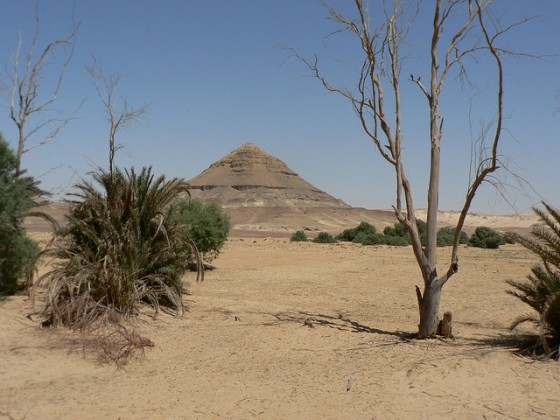
: Image via eviljohnius/flickr.

:: IRIN

For more on Egypt and Food see:

Egypt Could Be On Brink Of Famine

How Climate Change Threatens Alexandria, Casablanca, and Tunis

Water-Poor Egyptians Use Sewage For Crops Instead
 

Arwa Aburawa
Arwa Aburawahttp://www.greenprophet.com
Arwa is a Muslim freelance writer who is interested in everything climate change related and how Islam can inspire more people to care for their planet and take active steps to save it while we can. She is endlessly suspicious of all politicians and their ceaseless meetings, especially as they make normal people believe that they are not part of the solution when they are the ONLY solution. Her Indian auntie is her model eco-warrier, and when Arwa is not busy helping out in the neighborhood alleyway garden, swap shopping or attempting fusion vegetarian dishes- with mixed success, she’d like to add- she can be found sipping on foraged nettle tea.

LEAVE A REPLY

Please enter your comment!
Please enter your name here

TRENDING

How to help Gaza fishermen

The destruction of Gaza's two main aquaculture farms, along with the hatchery facility, has also left the sector unable to produce alternative aquatic foods through aquaculture. 

What is Land “COP” in Saudi Arabia and why should we care?

The UN COP events aren't only about climate change. There is a COP for the land and the meeting is happening now in Saudi Arabia.

Lebanon in a time of cholera

Cholera always sounds like an epidemic of the past, but it's becoming a public health emergency in Lebanon and Syria as the bacteria spreads.

Holding back the deserts with a saxaul tree

Africa is getting its Great Green Wall, meanwhile Saudi Arabia is also suffering from climate change-induced draught and is starting to do something about it by planting more local trees that love the desert.

Africa’s Great Green Wall works!

Africa’s Great Green Wall (GGW) programme to combat desertification in the Sahel region is not only crucial to the battle against climate change but also makes commercial sense for investors, a new study led by the Food and Agriculture Organization of the United Nations (FAO) and published in Nature Sustainability shows.

Qatar’s climate hypocrisy rides the London Underground

Qatar remains a master of doublethink—burning gas by the megaton while selling “sustainability” to a world desperate for clean air. Wake up from your slumber people.

How Quality of Hire Shapes Modern Recruitment

A 2024 survey by Deloitte found that 76% of talent leaders now consider long-term retention and workforce contribution among their most important hiring success metrics—far surpassing time-to-fill or cost-per-hire. As the expectations for new hires deepen, companies must also confront the inherent challenges in redefining and accurately measuring hiring quality.

8 Team-Building Exercises to Start the Week Off 

Team building to change the world! The best renewable energy companies are ones that function.

Thank you, LinkedIn — and what your Jobs on the Rise report means for sustainable careers

While “green jobs” aren’t always labeled as such, many of the fastest-growing roles are directly enabling the energy transition, climate resilience, and lower-carbon systems: Number one on their list is Artificial Intelligence engineers. But what does that mean? Vibe coding Claude? 

Somali pirates steal oil tankers

The pirates often stage their heists out of Somalia, a lawless country, with a weak central government that is grappling with a violent Islamist insurgency. Using speedboats that swarm the targets, the machine-gun-toting pirates take control of merchant ships and then hold the vessels, crew and cargo for ransom.

Leopoldo Alejandro Betancourt López Turned Ocean Plastic Into Profitable Sunglasses

Few fashion accessories carry the environmental burden of sunglasses. Most frames are constructed from petroleum-based plastics and acrylic polymers that linger in landfills for centuries, shedding microplastics into soil and waterways long after they've been discarded. Leopoldo Alejandro Betancourt López, president of the Spanish eyewear brand Hawkers, saw this problem differently than most industry executives.

Why Dr. Tony Jacob Sees Texas Business Egos as Warning Signs

Everything's bigger in Texas. Except business egos.  Dr. Tony Jacob figured...

Israel and America Sign Renewable Energy Cooperation Deal

Other announcements made at the conference include the Timna Renewable Energy Park, which will be a center for R&D, and the AORA Solar Thermal Module at Kibbutz Samar, the world's first commercial hybrid solar gas-turbine power plant that is already nearing completion. Solel Solar Systems announced it was beginning construction of a 50 MW solar field in Lebrija, Spain, and Brightsource Energy made a pre-conference announcement that it had inked the world's largest solar deal to date with Southern California Edison (SCE).

Related Articles

Popular Categories