
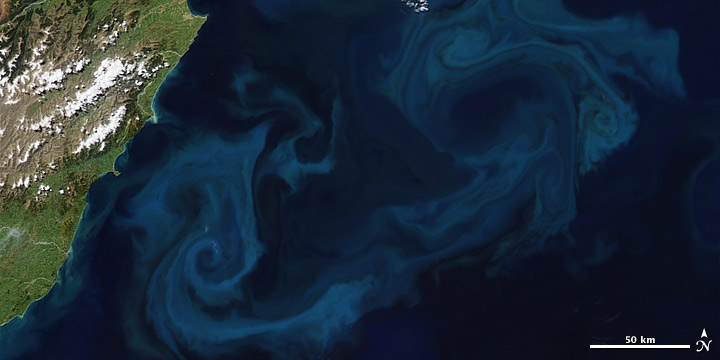

 Explosive phytoplankton “bloom” in Pacific Ocean, caused by too much CO2 infusion. Photo credit: NASA
We have written time and time again in Green Prophet about environmental dangers to the world’s seas and oceans. These dangers include pollution by plastic material, chemicals and other debris; from over-fishing; and from global warming. Global warming is causing water temperatures to rise – resulting in invasions of unwanted species like jellyfish .
But the ultimate result of all of these factors is something even more horrifying; and that is the possible “extinction” of the oceans themselves.
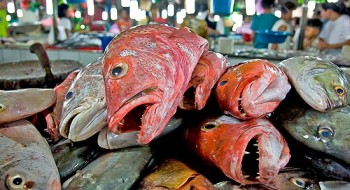 Over fishing will result in less fish in the oceans. especially predators
As a concerned reader and defender of the planet, you may react to this statement by saying: “How can the world’s oceans become extinct? After all, 70% of our planet’s surface are oceans?” Mind you, the water in the oceans will remain forever; but the question is what will be inside these waters? The future of the earth’s oceans is the focal part of studies being made by oceanographers, zoologists and other scientists in organizations such as one known as the International Programme on the State of the Ocean (IPSO) , headed by Dr. Alex Rogers, the ISPO’s Scientific Director. Dr. Rogers is also a Senior Research Fellow of the Institute of Zoology, London.
According to studies being made by IPSO, the world’s oceans have already absorbed more than 80% of the heat added to the climate system and around 33% of the carbon dioxide emitted by humans – much of this occurring during the past two decades. This has resulted in increases water temperatures, water acidity, and pollution. Over fishing, especially of predator fish species like bluefin tuna and numerous shark species could cause a drastic change in marine ecosystems. According to Dr. Rogers, the world’s oceans are in a “critical state” and could even become devoid of most marine life by the end of this century.
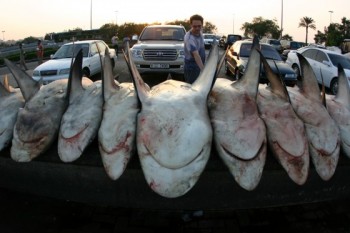 Sharks, a major marine predator, caught for soup.
With the rainforests of the Amazon and other parts of the world already under severe threat, the world’s oceans are the planet’s main source of oxygen, creating more than 50% of the world’s oxygen supply by a microscopic algae ecosystem known as phytoplankton that is under severe ecological strain.
According to Dr. Alex Rogers:
“If the Ocean goes down, it is ‘game over’ for life as we know it”
Dr. Rogers tries to remind people that global warming is just one of the threats to the world’s oceans. Over fishing is an ongoing activity that is destroying the ocean’s ecosystems by removing various species of fish that are important to maintaining the delicate balance of marine life; resulting in increases in unwanted marine life species, such as jellyfish, that now have few natural predators.
Dr. Rogers stresses that there is still a “very narrow window of opportunity” remaining to improve the condition of the world’s oceans. Some measures needed include more efforts to reduce the amount of carbon dioxide emissions that are presently being absorbed by the oceans. Another very important measure is better management of world fisheries, which includes countries like Japan changing diet preferences for foods like tuna and whale meat. And that also goes for what is known as sharks fin soup, of which more is being consumed by increasingly affluent Chinese consumers.
Read more are environmental issues of the oceans:
Must it be the End of The Line for Fish?
Is The Mediterranean Sea Harboring a Giant Plastic Garbage Patch?
David De Rothschild Sails Plastiki With Environmental Lessons to be Learned
Sharks Under Attack in the Middle East


I’m afraid the situation is a bit more serious than too much phytoplankton or saline residue from desalination. The oceans simply can no longer act as the world’s “water-fill” (ocean equivalent of landfills).
why not to try to find a method for harvesting the phytoplangton and create numerous products that can derive from it,such as food,energy ,medicines etc etc…why not to cultivate fish for food in eco-ponds using saline water that exists in huge quantities along the desert zone of the southern mediterranean sea coast! israel does it successfully in the negev desert of its south! also,israel desalinates this water to drinkable water and the saline remnants of the process(at the sea- water levels of salinity),become desert lakes for tourism development!!!