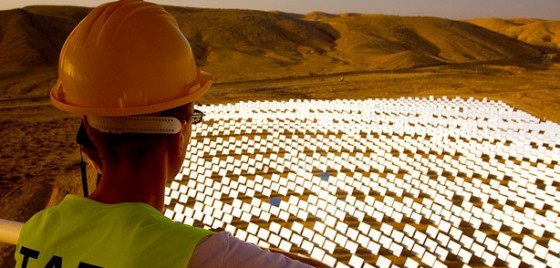
Solaris Synergy Eyes California’s Aqueduct for its Floating Solar Farms

California’s gigantic aqueduct that snakes through the entire state to irrigate farms is probably the world’s best site for developing solar on bodies of water.

According to Todd Woody at the New York Times, who asks, Could the California Aqueduct serve as a solar farm? Israel’s Solaris Synergy estimates that its floating solar system could generate two megawatts in every mile along the 400 mile length of the California Aqueduct – which would mean a staggering 800 MW solar power station if the entire length was used. Their system is already in use on the utility scale in Israel.

In land-starved Israel, Solaris Synergy looks to reservoirs, rivers, and even the ocean for hosting its solar power stations. It was named one of Israel’s top two early stage environmental technologies at this year’s Clean Tech Open IDEAS Competition.

The company estimates that the vast majority of the sun’s energy that hits the earth only falls on water surfaces. Solaris Synergy hopes to utilize that for maximum solar production at minimum cost, by siting installations on bodies of water, including industrial use water, because there is much more potential space there.

Last year it signed a contract with Mekorot, Israel’s national water company, to install the F-CPV system on one of its reclaimed water reservoirs. The pilot project involves installation of a 50KW power plant in the second quarter of 2011, with the option of expanding to 3 MW. Mekorot, which owns the majority of Israel’s more than 400 reservoirs, will initially test the system’s ability to deal with environmental factors such as wind, waves and live organisms.

Using the waterway to support the Solaris Synergy system of CPV solar generation would kill two birds with one stone.

It would help maximize the efficiency of the panels. CPV (Concentrated PhotoVoltaic) use mirrors to focus and concentrate the sun’s power. But CPV solar goes through a lot of thermal stress that wears down semiconductor material systems, accelerating breakdowns. Water can be used in CPV to cool the system, maximizing efficiency.

There is also California’s need to power the aqueduct pumps that move the huge body of water, while simultaneously reducing its greenhouse gases. One pumping station alone features more than a dozen 80,000-horsepower motors. Currently 20% of the state’s energy use goes to moving water through the state. Offsetting some of that (typically natural gas-powered) electricity with clean solar would help reduce the state’s greenhouse gases.

Image: Ecofriend

::Solaris Synergy

Related stories:
Float Solar on Water Says Israel’s Solaris Synergy
Leviathan and Solaris Synergy Imagine if the Water for the Shower Can Make the Energy Needed to Turn on the Light

TRENDING

Is your groundwater too young? New study finds risks for Parkinson’s and type of water you drink

People whose drinking water came from newer groundwater had a higher risk of developing Parkinson’s disease than those whose drinking water came from older groundwater, according to a preliminary study released March 2, 2026, that will be presented at the American Academy of Neurology’s 78th Annual Meeting taking place April 18–22, 2026, in Chicago and online.

The Saudi Startup Turning Desalination’s Toxic Waste Into Its Own Disinfectant

For millennia, the Middle East's water crisis seemed an immutable fact of geography — a region defined as much by what it lacked as by what lay beneath its sands. Today, a convergence of plummeting solar costs, advancing membrane technology, and hard-won engineering expertise is rewriting that story.

Forever chemicals banned from Europe’s drinking water

The EU is taking a bold step in making sure all European Union member states worked to monitor and reduce PFAS levels in drinking water.

Elon Musk to create Mars base station on the Moon

For those unaware, SpaceX has already shifted focus to building a self-growing city on the Moon, as we can potentially achieve that in less than 10 years, whereas Mars would take 20+ years.

Astro uses AI to help procure land for renewable energy

For oil-rich, environmentally vigilant Gulf states, Astro isn’t just another startup story. It is a blueprint for accelerating an energy transition that is now existential, not optional.

Should You Invest in the Private Market?

startustartup Unlike public stock exchanges, which offer daily trading, strict...

How to build a 100-year-company

Kongō Gumi is a Japanese construction company, purportedly founded in 578 A.D., making it the world's oldest documented company. What can we learn about building sustainable businesses from them?

From Pilot Plant to Global Stage: How Aduro Clean Technologies’ 2026 Expansion Signals a Turning Point for Chemical Recycling Investors Like Yazan Al Homsi

The company's Next Generation Process (NGP) Pilot Plant in London, Ontario, has officially moved into initial operating campaigns, generating the kind of structured, repeatable data that separates laboratory promise from commercial viability.

How AI Helps SaaS Companies Reduce Repetitive Customer Support Work

SaaS products are designed for large numbers of users with different levels of experience, and also in renewable energy.

Pulling Water from the Air

Faced with water shortage in Amman, Laurie digs up...

Turning Your Energy Consultancy into an LLC: 4 Legal Steps for Founders in Texas

If you are starting a renewable energy business in Texas, learn how to start an LLC by the books.

Tracking the Impacts of a Hydroelectric Dam Along the Tigris River

For the next two months, I'll be taking a break from my usual Green Prophet posts to report on a transnational environmental issue: the Ilısu Dam currently under construction in Turkey, and the ways it will transform life along the Tigris River.

6 Payment Processors With the Fastest Onboarding for SMBs

Get your SMB up and running fast with these 6 payment processors. Compare the quickest onboarding options to start accepting customer payments without delay.

Related Articles

Popular Categories