
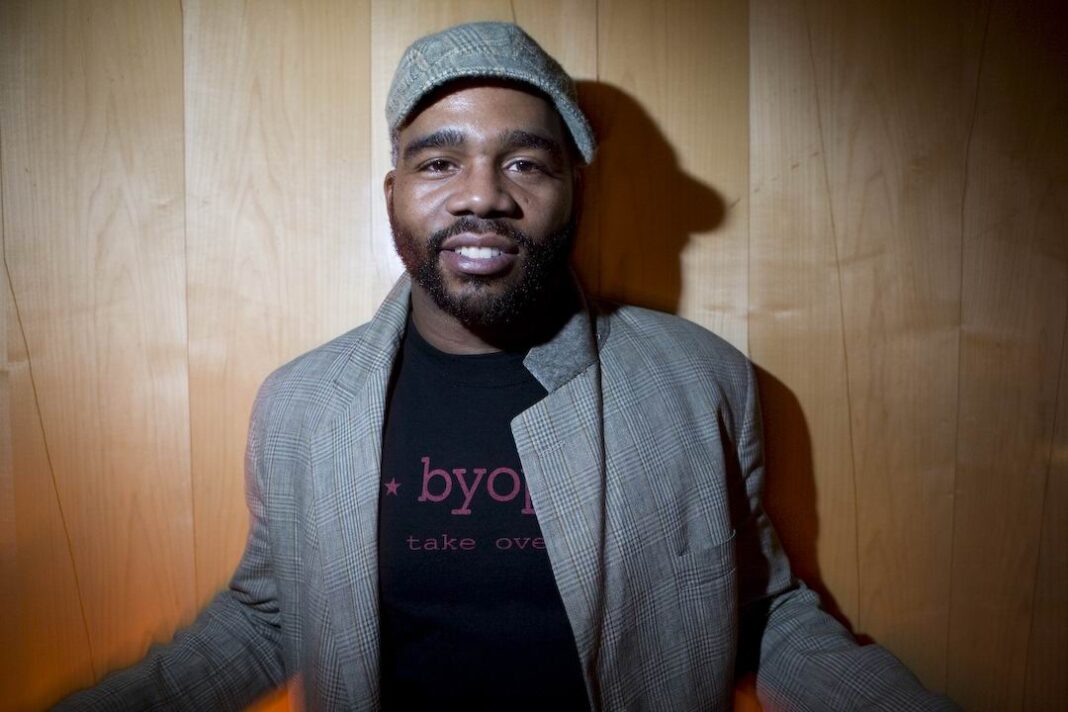
 Arwa speaks to green deen Ibrahim Abdul-Matin about his latest book ‘Green Deen’ and why he believes that Muslims need be compelled spiritually to make dramatic changes in their lives for the sake of the planet
Ibrahim Abdul-Matin is a man of many talents. As well as working as a regular sports commentator and youth organiser, he is a policy adviser for NYC Mayor Bloomberg’s office of sustainability and author of ‘Green Deen: What Islam Teaches About Protecting the Planet‘. He has been making waves on the US green scene for a decade now and his latest book, which connects his Muslim faith with his love of nature hopes to spark greater environmental awareness amongst the Muslim community. I caught up with him to speak about the influence of his father on his green ethic, what the life of an Eco-Muslim would look like, ideas for a green hajj and why Muslims need to become ambassadors for clean water.
GP: Tell us a bit about yourself. When and where were you born and how did you become more aware of environmental issues?
Ibrahim: I was born in the middle of a blizzard in Manhattan, New York on January, 1977. My mother and father were recent converts to mainstream Islam and lived in Queens. We eventually moved to Brooklyn and I remember thinking the entire world was a sea of concrete buildings. My father took my brother and I when we were little kids to hike on Bear Mountain – which is just an hour north of NYC- that day, we saw the beauty of nature, and my love of the environment has only grown ever since.
What inspired you to write the book and what has the process of putting together all that knowledge been like?
In 2008, I went to a conference called “The Dream Reborn,” in Memphis, Tennessee. This conference was a gathering of environmental justice activists. It was a beautiful group of very dedicated and inspiring people. But I was curious – what was the ordinary resident of Memphis thinking? So I ventured into the downtown area away from the conference, and met an old woman at a diner. I asked her, “what do you think of climate change?” She said, “I think it’s something democrats want me to be afraid of. Just like republicans want me to be afraid of terrorists.”
In that moment I knew that unless environmentalists found a deeper, divine, more spiritual reason for folks to become involved in the movement – they would simply see it as propaganda. Since I’m Muslim, I decided to look to my own Deen of Islam to learn more about its connection to the planet – and then tell Muslims all about it!
What response have you had about your book from the Muslim and wider community?
 Overall, very positive. I think people are intrigued about mixing the two issues – Islam and the environment. And a quick glance at the book’s introduction shows people that these two issues are in fact, very connected. I’ve heard a lot from young people who felt innately connected to the environment and knew deep down inside that Islam was a Green Deen. These young folks were very happy to see their thoughts in writing.
The negative stuff has been from the typical Islam/Muslim hater who thinks “the Earth is a Mosque” is Muslims’ attempt to turn the whole world into a mosque. It’s a ridiculous notion and frankly, it’s ignorant. Islam has beautiful teachings about harnessing the power of the sun, about treating animals well, about eating food with care, and about not wasting in general. That’s what “The Earth is a mosque,” means. It means to treat the whole world as sacred.
What core teachings does Islam offer us in terms of better caring for the environment?
First I need to give a serious shout out to my dear brother Faraz Khan in New Jersey. Faraz is a true scholar and far more capable of writing a book than I am. Faraz has been studying what Islamic scholars say about the environment for some time. It’s his work that leads to the 6 principles [Tawhid (oneness), Ayats (signs of God, Khalifah (being a steward of the Earth), Amana (our sacred trust with God), Adl (justice) and Mizan (maintaining the natural world’s delicate balance)] of a Green Deen in Islam that I cite in the book.
Why do you believe that Muslims have an important role to play in combating climate change?
Because it’s our God given duty. Allah has entrusted human beings with the planet and all that’s in it. Creation is not ours – it’s Allah’s and He has made us responsible, as the best of Creation, to take care of it. Allah has generously given us these things and that we cannot forget to be grateful. We also must serve with justice and not destroy, pillage, or hurt any of the things He has provided.
What one person or group or way of thought has inspired your Green Deen?
Definitely my father. He grew up on a farm in southern Virginia and has deep connections to the land. He’s spent the last 15 years in upstate New York and frequently takes trips into the woods, the mountains, to simply exist among Allah’s creations and praise Him. My father prays outside a lot – he says that it’s good to be reminded of what we’re a part of and who to be thankful to.
What do you think is holding back Muslims from doing more for the planet (particularly in the Muslim world)? And what can be done to tackle these constraints?
I think it’s the same reason as the old woman in Memphis. Muslims need to feel compelled spiritually to make dramatic changes in their lives. They need to feel like Allah has commanded them to do something – that’s what “Green Deen” is about. I argue that Allah has told us that protecting the planet is a major priority in our practice of Islam.
If you could get Muslims to do one thing for the environment, what would it be?
Become advocates for worldwide clean water. Muslims need to pay attention to and get involved in issues that don’t just affect them – but affect everyone. We are stewards of the Earth. Not just stewards of Muslims. Water is every creature’s most basic need for survival. Our Prophet (peace be upon him) taught us to not waste water while making wudu, even if we live next to a flowing river. Our Holy City of Mecca exists because of the Well of Zamzam.
Nearly one billion people on Earth do not have access to clean water! Every 20 seconds a child dies from a water-related disease. Bottled water companies are on a mission to privatize water – tragedy if this happens!- and even more people would be left without drinking water if a cost becomes attached to it. From now on, whenever someone asks you, a Muslim, why you follow Islam or asks you about terrorism, start talking about water. Join clean water campaigns. Pressure the UN, the WHO, and other international organizations to make this a REAL priority.
Do you think it is fair to say that all the major faiths are just discovering the green roots in their religions and the need to take environmental action?
I wouldn’t say they are “just” discovering this – I think Christians, Jews, Muslims, Buddhists, Hindus, everyone has known for quite some time that humans have a responsibility to take care of the Earth. It’s just that now, today, the crisis is becoming more and more apparent. People world wide are “Going Green” so faith communities are feeling the pressure – rightly so – to get involved.
There are certain environmental activists who argue that the practice of Hajj (air travel) and the Muslim world’s dependence on oil is incompatible with green principles. Would you agree?
I think the environmental challenges created by Hajj are the same as most big cities face every day. The carbon emissions from the traffic is huge. The waste left behind from food packaging is huge. But guess what – there’s hope. The Saudi government is building a train that will transport passengers during hajj rituals. They are also considering a ban on plastic water bottles. Every person that goes to Hajj gets a Qur’an when leaving, how about everyone gets a reusable water bottle when arriving? I think that would be amazing.
What would the daily life of a green Muslim be like? How would they live, socialize, travel, etc?
It would be 50% looking back and 50% looking forward. What I mean is that our Prophet (peace be upon him) and his sahaba (companions of the Prophet) led a very Green existence. They knew how to live off the land, they ate little meat which they sacrificed themselves and never depended on a factory farming system. They lived minimally, not defining themselves based on their material possessions, but rather on their closeness to Allah.
By looking forward I mean by becoming involved in environmental innovation. Finding the new, clean energy technology that will be usable by the entire world. Choosing to use “Energy from Heaven” such as wind over “Energy from Hell” such as oil and coal. This would mean demanding that our elected officials begin focusing on harnessing the power of the sun and the wind and not allowing coal mining companies to ruin entire communities and eco-systems just to get the coal that powers our homes.
And pray. Green Muslims need to pray. Our five times a day are in synch with the rhythm of the Earth. The more we pray, the more in tune we are with the planet.
Update 2023: Green Prophet is sorry to hear about the untimely passing of Ibrahim Abdul-Matin whose death was announced in June, 2023 at age 46.
For more on Green Muslims see:
Interview with Naqa’a: Saudi Women Fighting For The Environment
From Rockstars to Recycling: Interview with Kristiane Backer – An Eco-Muslimah


Really fine sentiments expressed about Islam and its Greenery towards Muslims. Your sentiments are worth sentimental and I really believe that Islam is indeed a giver of real life true way of dignified life and service to humanity. It is really green and true to the mankind.
thanks for your comment and support Aviva 🙂
I loved this interview even though I’m secular. It is important to look at the wonderful earth, and not take anything for granted.
Thank you!