
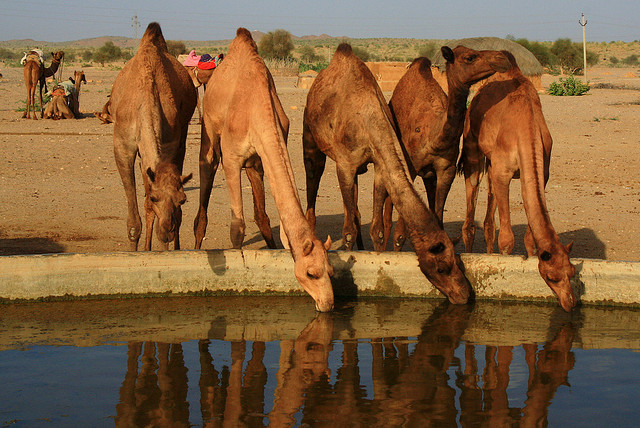

 How governments respond to water woes will determine the future stability of the Middle East.
It’s impossible to point to any one issue and claim it as the final explanation for the protests unnerving leaders in the Middle East. Weeks ago one Tunisian man set himself on fire when he was told he couldn’t sell his wares, and his fire has raged on since. But the root of today’s discontent, and the root of tomorrow’s continuing trouble, will have a close correlation with water. Siting the same document we reported on last week, Blue Peace, The Guardian reports that in time water will be of more geopolitical consequence than even oil. Because, quite frankly, we’re running out. And thirsty people can’t be stifled.
Here are a few startling facts taken from The Guardian:
- In forty years, Abu Dhabi will have completely depleted its ancient fossil water resources;
- 19/21 of Yemen’s main aquifers are no longer being replenished. That country is considering moving its capital as a result;
- In 25 years, Saudi Arabia’s water demand increased by 500%, a demand that will double again in the next 20 years;
- Within the next 30 years, Jordanians will only have 91 cubic meters of water each year, compared to the minimum average of 1,000 cubic meters considered bearable. Already, their water poverty is at 200 cubic meters;
- 1,500 desalination plants along the Gulf and Mediterranean make up for shortfalls, at high costs to energy consumption and ecosystems;
- Turkey has water, but they don’t care to share.
The unfortunate irony in many of oil-rich states, is that their economies depend largely on rising oil prices, but many of them import up to 90% of their food (like Qatar). Oil money until now has keep down political unrest since it was used to subsidize food and water, but that trend is spiraling out of control and many in the Middle East are going hungry. And they site corruption as the cause of their suffering.
Nor is desalination the catchall answer since it pours huge volumes of concentrated salt back into the waters from which it was taken, causing incredible damage to marine ecosystems.
Rising temperatures – some predict as high as 10 degrees in some places – (and therefore rising evaporation in already dry areas) and population growth combined with food shortages makes the Middle East’s future a very inhospitable place indeed.
The Guardian and the Blue Peace report both emphasize the necessity for governments to cooperate and share resources. Otherwise, riots and even greater suffering could easily become a permanent fixture of life in the region.
:: The Guardian
More on the Middle Eastern riots:
Rising Food Prices Behind Riots In Algeria and Tunisia
Jordan Joins The Food Prices as Tunisian President Steps Down
Egypt’s Conflagration is Advanced Warning for an Unsustainable World
image via plusgood



Ms. Laylin,
This is a very interesting article that is so important because of its relevance today. I am especially interested in the relationships between human-induced environmental changes and the results these changes have on marginalized populations and the world. With my background in environmental human rights, I am of course concerned with the welfare of the people of the region and the environmental destruction, such as marshland and marine life disappearance. I appreciate that you recognize the negative relationships between water supply and population growth, as well as the hazardous environmental effects that desalination may result in. I feel that many Americans are disinterested in issues such as these because they think they are unaffected by them. I disagree with such beliefs, and am curious on your thoughts on the consequences that lack of clean water in the Middle East and Northern Africa may have on the relationship of the region with the United States? Do you believe that sociopolitical uprisings such as the ones occurring now, will emerge with the growing lack of water? You imply that riots in the region will induce “even greater suffering” than he demonstrations occurring now. Do you believe that they will be more violent, perhaps leading to terrorist practices, especially towards the US?
The US is working hard to forge healthy relationships with the people of the democratic movements in the region. Yet the fact that water scarcity is not a priority for US foreign policy towards the Middle East and Northern Africa will lead to long-term consequences for the US and its attempt to encourage stability there. The volatility will surely cross borders and increase conflict between nations as it already has between Palestine and Israel, and threatens to in the next 20 years between the latter and Jordan. Furthermore, could the water wars that emerge result in increased extremism by those who are marginalized, leading to a new threat of terrorism for the United States? It would be easy to blame the US, one of the most wasteful countries in terms of water, for careless water and recognition of this by extremist organizations could magnify the target on the US. I am grateful that you have taken the time to raise awareness of this issue, which I believe will have overwhelming social, political and environmental outcomes in the region and internationally.
-Azure Pallay
You are absolutely right Tafline. Cooperation in sharing natural resource use and protecting these resources will be the major deteriment of stability in the Middle East in the future.