
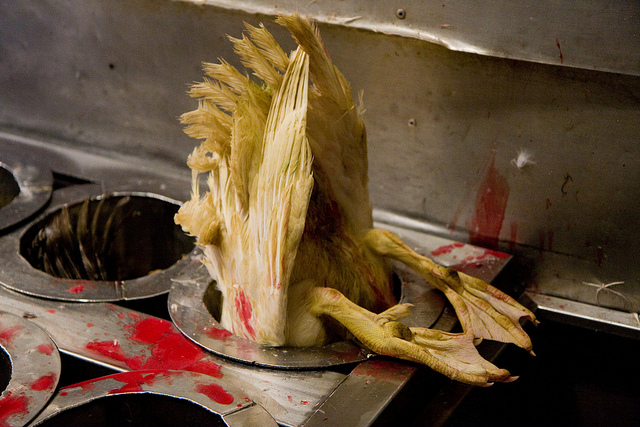

 Animal activists urge meat derived from Halal and Kosher slaughter methods, such as this chicken at the Madani Halal Slaughterhouse, to carry labeling that points out the absence of stunning beforehand.
A battle over the humanity of religious slaughter has boiled over in Europe, uniting Jews and Muslims fighting for recognition of their respective rituals. In my view any kind of factory farming deprives animals of a natural life and can result in unsafe food, such as the salmonella in these eggs, whether stunned or not.
On the other hand, Egypt demonstrated during the Muslim festival Eid in chilling detail that not all religious slaughter is humane, that it can be haram. Everything hinges, it seems, on the campaign of one animal rights group which claims that slaughter conducted without stunning causes undue suffering to animals.
Jews and Muslims are protesting a European Union law that would require kosher and halal meat to carry the label “derived from animals that have not been stunned prior to slaughter.” Members of the European Parliament passed Amendment 205 with a huge majority, which was subsequently vetoed by the EU Council of Ministers.
Representatives from Jewish and Muslim groups claim the move is discriminatory, while Compassion in World Farming activists that support the amendment suggest it is not the religious ritual they oppose, but rather the unnecessary suffering of any animals.
Abdalhamid Evans, director of the World Halal Forum Europe Project, is adamant that this amendment discriminates against religious practices that require animals to be slaughter without first being stunned. He adds that there is no scientific evidence that stunning is more humane and that if there is to be disclosure, then meat should also carry disclosure of stunning methods.
Yunus Dudhwala, who is Chairman of the Halal Monitoring Committee in Britain, shares this conviction, adding that meat carrying the label “gassed or electrocuted” would be similarly unpalatable to consumers.
Britain’s National Secular Society backs the amendment on the basis that millions of animals that are slaughtered without stunning are sold to customers who are neither Jewish nor Muslim. The labeling would protect their interests.
Simon Cohen from Schechita UK aims to fight the measure by campaigning that schechita is in fact humane.
“Our campaign is far from over, but we are making satisfactory progress, given the assault on shechita that was launched earlier this year by some members of the European Parliament,” the National quoted.
Studies conducted by Professor Temple Grandin from the University of Colorado support religious slaughter as long as it is professionally done on a calm animal.
This is obviously a very complicated and controversial subject. We would like to hear from our readers. Do you think that meat should carry labeling that describes slaughter/stunning methods? Is this a discriminatory move? Misguided activism? Please write your comments below.
:: The National
More on halal and kosher food:


Just found this article – quite a deep topic i supposed. however from research i have carried out a kosher slaughterhouse, even though doesnt stun their animals (although some religions accept some stunning methods as it is reversible so is still alright) death is very fast – for example for bovine animals, the blade used for jewish use is blessed and checked for sharpness – to them it HAS to be sharp.
I feel that when we see the end product (not knowing where it has come from) we should see the slaughter method, so that we can support it (like fair trade has its label so we know its good to support it and so on) in other words (my opinion btw) i would rather pay slightly more for a chicken that has be slaughtered by meaning of gas killing then the electrocution/water-bath method … as much research supports the ineffectiveness of unconciousness with water baths. so overall not only is it a plus for animal welfare (using gas methods for slaughter) but farmers may be able to raise prices to demand of better welfare, also it comes to note that consumers can see and decide whether they want a broiler thats been likely factory farmed and (again using the considered ineffective water bath + neck slicer) neck-sliced with full conciousness and then drowned in a scolding tank … nice.
Bring on those labels
Just found this article – quite a deep topic i supposed. however from research i have carried out a kosher slaughterhouse, even though doesnt stun their animals (although some religions accept some stunning methods as it is reversible so is still alright) death is very fast – for example for bovine animals, the blade used for jewish use is blessed and checked for sharpness – to them it HAS to be sharp.
I feel that when we see the end product (not knowing where it has come from) we should see the slaughter method, so that we can support it (like fair trade has its label so we know its good to support it and so on) in other words (my opinion btw) i would rather pay slightly more for a chicken that has be slaughtered by meaning of gas killing then the electrocution/water-bath method … as much research supports the ineffectiveness of unconciousness with water baths. so overall not only is it a plus for animal welfare (using gas methods for slaughter) but farmers may be able to raise prices to demand of better welfare, also it comes to note that consumers can see and decide whether they want a broiler thats been likely factory farmed and (again using the considered ineffective water bath)
And what do you say about Princess Alia bint al-Hussein of Jordan, the sister of King Abdullah II of Jordan, who wants to make the stunning of animals mandatory before they are slaughtered? Would you say she is discriminating against Muslims, and deviates from Islam?
http://www.theage.com.au/national/princess-weighs-into-halal-slaughter-debate-20111017-1lspt.html
Hey Peter, did you see our recent post about Princess Alia’s efforts to encourage pre-slaughter stunning?
Matt, do you think it would be more fair if meat carries the label of what methods were used to stun animals as well?
Misguided activism? Well, feminism has failed to condemn the oppression of women within Islam, so I suppose we must expect the animal rights movement to ‘overlook’ the atrocity of religious slaughter to avoid being called racist.