
Egypt To Grab Sudanese Land To Meet Its Wheat Needs

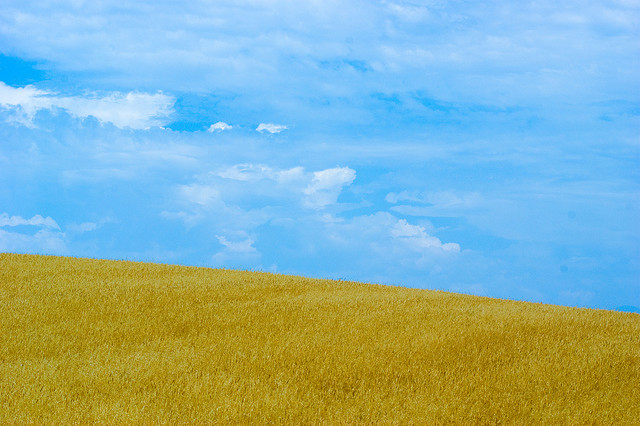
suez canal farm egyptLacking sufficient water to grow enough wheat for its burgeoning population, Egypt (above pic of Suez Canal farm) looks to other Nile Basin countries for land and water.

During the heat of this year’s scorching summer, Russia’s wheat supply took a serious hit and the country scaled back its exports. One of their main wheat importers, Egypt lacks the water to provide what is a staple for its 80 million strong population. As the population inflates and water becomes even more scarce, Egypt hopes to make its wheat supply more self-sufficient.

After recently signing an agreement with Sudan to allow private Egyptian companies to grow various cereals there, the Egyptian authorities began eyeballing other Nile basin countries as potential sources of land and water for their agricultural pursuits. Meanwhile, fifty percent of the population living within the Nile basin live below the poverty line of $1 per day. Private Egyptian companies will grow food in the Al-Gezira Region south of Khartoum, while the Egyptian government’s role is limited to technical support, according to IRIN news.

The deal signed between Egypt and Sudan in September is part of what IRIN (the United Nations news source) calls “the land-grab phenomenon” that began to take shape in 2008 (and Green Prophet’s editor Karin wrote about it here – Africa Up For Sale?). This refers to various foreign countries that are cultivating crops in African countries to support their own populations.

Egypt’s population consumes approximately 14 million tons of wheat each year but is only capable of producing roughly 60% of that amount, according to the paper, but hopes to expand its self-sufficiency to 70% by 2017. In order to produce the requisite quantities to feed its population, Egypt will need 2.1 million hectares, compared to its current 1.26 million hectares.

“…in countries where governments depended on bread subsidies to prevent social unrest, declining wheat output and increasing prices could have serious ramifications,” FAO’s senior economist Abdolreza Abbassian told IRIN.

Meanwhile, experts caution against depending too much on African countries for water, especially since the Nile basin countries are already pushing back against Egypt’s historical hegemony of the Nile River.

“Any moves…might confirm the worst fears of decision-makers in Nile basin countries that Egypt is out to grab as much water as it can for itself. This is a real dilemma,” Abdel Salam Gomaa, a leading agricultural expert, told IRIN.

“These countries are so sensitive to any talk about their share of the water of the Nile, particularly when it comes to Egypt,” he added.

Given that several Nile Basin face their own food and water shortages because of poor management and environmental degradation, Egypt’s population should not take precedence over the local population.

:: IRIN News

More food news from the Middle East:

Interview: Buying Local in Dubai With Baker & Spice’s Yael Mejia

Americans and Israelis Headed for Widespread Obesity

Syngenta: Use GMOs To Boost Turkey’s Agricultural Sector

image of a Suez Canal farm via jgmorard
Tafline Laylin
Tafline Laylinhttp://www.greenprophet.com
As a tour leader who led “eco-friendly” camping trips throughout North America, Tafline soon realized that she was instead leaving behind a trail of gas fumes, plastic bottles and Pringles. In fact, wherever she traveled – whether it was Viet Nam or South Africa or England – it became clear how inefficiently the mandate to re-think our consumer culture is reaching the general public. Born in Iran, raised in South Africa and the United States, she currently splits her time between Africa and the Middle East. Tafline can be reached at tafline (at) greenprophet (dot) com.
2 COMMENTS
  1. If Egypt had social planners with long term foresight spanning decades, it would be starting to plan moving most of the smaller towns and cities currently in the Nile Valley to the nearby desert wherever possible.

    As it is now every bit of land that is gobbled up by urban sprawl is taken from the fertile land of the Nile Valley.

    In the modern era there is no need for people to live on the shores of the River.

    The climate is the same as the nearby desert.

    They are there now due to historical reasons.

    As the years have passed Egyptians have had less and less land to farm. This continuing trend is going to soon be coupled with loss of land in the Delta due to rising Sea levels.

    Unfortunately Egypt doesn’t seem to be concerned about the rapidly increasing loss of arable land.

  2. Dear sir/madam,
    I would beg to differ with the subject of the above article,egypt has never and will never ‘Grab’ any land in any country,Egyptians are peace loving people,full of life,the population may be increasing by the day,but then again,Egypt is a blessed land with 2 seas,a river,rare tourisim,astronomical number of minerals,agriculture,,i can go on forever,but no t any enough space,so we really dont need any more land,we hv oceons of water under our deserts,or we can use appropriate tech to desalinate sea water,or we can just use pure sea water to farm,look at eretria ,or mexico,they practise seawater farming,ple be careful of such heading for your articles,as they can do a lot of damage between nations,thank you&god bless!

LEAVE A REPLY

Please enter your comment!
Please enter your name here

TRENDING

Astro uses AI to help procure land for renewable energy

For oil-rich, environmentally vigilant Gulf states, Astro isn’t just another startup story. It is a blueprint for accelerating an energy transition that is now existential, not optional.

Farm To Table Israel Connects People To The Land

Farm To Table Israel is transforming the traditional dining experience into a hands-on journey.

Sink holes from over-watering farmers’ fields

Sinkholes are rapidly appearing in Turkey’s central Anatolian farming region, particularly around Konya and Karapınar. These giant gaping holes in the ground in areas of farmland, known locally as obruk, are not random geological events. They are linked to prolonged drought, climate-driven heat stress, and heavy groundwater extraction for agriculture in one of the country’s most important breadbaskets.

Oil pollution in Basrah’s soil is 1,200% higher than it should be

Soil pollution levels in parts of Basra are 1,200% to 3,300% higher than those typically measured in cities like Toronto or New York, according to new comparative soil data. It's getting into water.

Peace hospital opens between Jordan and Israel

The proposed medical centre, described by Emek HaMaayanot Regional Council head Itamar Matiash as “a centre for cancer treatment, so that people from Jordan or further away could come and receive treatment,” would become the flagship of a wider cluster of medical, academic and innovation-based services planned for the Israeli half of the zone.

Qatar’s climate hypocrisy rides the London Underground

Qatar remains a master of doublethink—burning gas by the megaton while selling “sustainability” to a world desperate for clean air. Wake up from your slumber people.

How Quality of Hire Shapes Modern Recruitment

A 2024 survey by Deloitte found that 76% of talent leaders now consider long-term retention and workforce contribution among their most important hiring success metrics—far surpassing time-to-fill or cost-per-hire. As the expectations for new hires deepen, companies must also confront the inherent challenges in redefining and accurately measuring hiring quality.

8 Team-Building Exercises to Start the Week Off 

Team building to change the world! The best renewable energy companies are ones that function.

Thank you, LinkedIn — and what your Jobs on the Rise report means for sustainable careers

While “green jobs” aren’t always labeled as such, many of the fastest-growing roles are directly enabling the energy transition, climate resilience, and lower-carbon systems: Number one on their list is Artificial Intelligence engineers. But what does that mean? Vibe coding Claude? 

Somali pirates steal oil tankers

The pirates often stage their heists out of Somalia, a lawless country, with a weak central government that is grappling with a violent Islamist insurgency. Using speedboats that swarm the targets, the machine-gun-toting pirates take control of merchant ships and then hold the vessels, crew and cargo for ransom.

Leopoldo Alejandro Betancourt López Turned Ocean Plastic Into Profitable Sunglasses

Few fashion accessories carry the environmental burden of sunglasses. Most frames are constructed from petroleum-based plastics and acrylic polymers that linger in landfills for centuries, shedding microplastics into soil and waterways long after they've been discarded. Leopoldo Alejandro Betancourt López, president of the Spanish eyewear brand Hawkers, saw this problem differently than most industry executives.

Why Dr. Tony Jacob Sees Texas Business Egos as Warning Signs

Everything's bigger in Texas. Except business egos.  Dr. Tony Jacob figured...

Israel and America Sign Renewable Energy Cooperation Deal

Other announcements made at the conference include the Timna Renewable Energy Park, which will be a center for R&D, and the AORA Solar Thermal Module at Kibbutz Samar, the world's first commercial hybrid solar gas-turbine power plant that is already nearing completion. Solel Solar Systems announced it was beginning construction of a 50 MW solar field in Lebrija, Spain, and Brightsource Energy made a pre-conference announcement that it had inked the world's largest solar deal to date with Southern California Edison (SCE).

Related Articles

Popular Categories