Only 1 in 25 Emiratis Use Their Legs to Walk

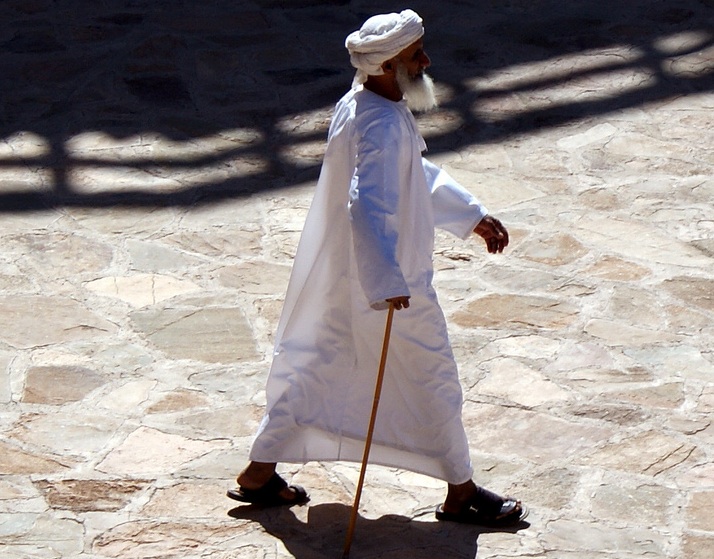
arabian man walking with stick photoLegs? Who needs them when you can drive. Maybe this is why diabetes rates in the Gulf region are among the highest in the world.

We already know about the terrible rates of road accidents in Saudi Arabia, the dangerous practice of car drifting, and the admiration for gold-plated cars. Now, a new study finds residents of the United Arab Emirates to be highly sedentary, Adam Gonn from the Media Line reports.

A mere 4% of people living in the United Arab Emirates walk on a weekly basis, a new study by an international shoe maker has found. Commissioned by South Korean shoe manufacturer RYN ahead of their forthcoming entrance into the Gulf shoe market, the study into Emiratis’ walking habits found that both UAE citizens and expatriates alike are not walking regularly enough. In spite the fact that the walking infrastructure in the United Arab Emirates is well advanced compared to most countries in the world, just 4% of residents walk on a weekly basis,” read the report.

Dubai, the economic hub of the UAE, has built extensive pedestrian-friendly infrastructure, such as air conditioned walkways connecting major sites to encourage residents to walk instead of taking the car.

Dr. M. Ashfaq Konchwalla, Consultant Orthopaedic & Sports Surgeon at Dubai’s Medcare Hospital, said residents should take the study as a warning.“Walking makes us live longer,” he told The Media Line. “Walking 150 minutes per week makes a person lose 7 percent of their body weight, which reduces risk of diseases.”

“Walking strengthens heart and is also good for the brain and the bones,” he continued. “It also helps alleviate symptoms of depression, improves fitness and enhances physical function.”

Gulf-based medical professionals say that the lack of exercise has led to a rise in lifestyle diseases such as obesity and diabetes.

“Six countries in the Middle East and North African Region are among the world’s 10 highest for diabetes prevalence, including the United Arab Emirates,” David Whiting, Epidemiologist and Public Health Specialist of the International Diabetes Federation told The Media Line. “The ageing of populations, together with socio-economic and lifestyle changes, has resulted in the dramatic increase in diabetes prevalence. To a large extent the rise in prevalence is the unintended side-effect of great success in recent years.”

Many Emiratis have stopped eating traditional foods, which are rich in fiber and plant protein, turning instead to a diet of animal protein, fried food and cream, all new ingredients in the local diet. “Over the past three decades, major social and economic changes have occurred,” Whiting said. “These include progressive urbanization, decreasing infant mortality and increasing life expectancy.”

“Rapid economic development has been associated with tremendous modification in lifestyle towards the westernized pattern reflected by changes in nutrition, less physical activity, tendency to increased obesity and more smoking,” he added.

Recent statistics from the International Diabetes Federation place the United Arab Emirates with the second worst diabetes rate in the world, with 18.7% of the population suffering from the disease. Saudi Arabia follows close behind with 16.8% of its adult population suffering from diabetes. Bahrain (15.4%) was ranked fifth, Kuwait (14.6%) seventh and Oman (13.4%) eighth.

Read more on cars and health:
Cautious Driving Saves the Environment
Saudis Have Highest Road Accident Rates in the World
Keeping Public Trains on Track

(This story was reprinted with permission by the Middle East News Source –– The Media Line)

Image via JeHu68

LEAVE A REPLY

Please enter your comment!
Please enter your name here

TRENDING

Foot-and-Mouth Disease Is Spreading Again — What That Means for Farmers, Food, and All of Us

A new wave of foot-and-mouth disease (FMD) is spreading through Europe and the Near East, and experts at the Food and Agriculture Organization (FAO) are urging countries to take urgent steps to stop it. The recent detection of an unfamiliar strain of the virus in Iraq and Bahrain has raised alarms, especially since this version, known as SAT1, is not normally found in this region.

Next EU Parliament must crack down on lobbying from ecologically-toxic industries

With policymakers in Brussels steadily eroding the EU Green Deal ahead of next month’s European elections, governments, NGOs and scientists have joined forces to counter this short-sighted political point-scoring.

Masdar and Bahrain unite on wind energy

The United Arab Emirates renewable energy company Masdar and Bapco Energies from Bahrain will co-develop up to 2GW of wind projects in the Kingdom of Bahrain, both parties announced this week. 

Arab Energy Fund commits $1 billion to energy transition and decarbonization

The Arab Energy Fund, previously known as the Arab Petroleum Investments Corporation (APICORP), has announced a significant commitment of $1 billion to drive energy transition and decarbonization efforts.

Learn earthen architecture of the Middle East

This one-month training course will use Al Ain, UAE as an open-air laboratory for participants to learn practical, hands-on methods for preserving earthen buildings and archaeological sites.

Qatar’s climate hypocrisy rides the London Underground

Qatar remains a master of doublethink—burning gas by the megaton while selling “sustainability” to a world desperate for clean air. Wake up from your slumber people.

How Quality of Hire Shapes Modern Recruitment

A 2024 survey by Deloitte found that 76% of talent leaders now consider long-term retention and workforce contribution among their most important hiring success metrics—far surpassing time-to-fill or cost-per-hire. As the expectations for new hires deepen, companies must also confront the inherent challenges in redefining and accurately measuring hiring quality.

8 Team-Building Exercises to Start the Week Off 

Team building to change the world! The best renewable energy companies are ones that function.

Thank you, LinkedIn — and what your Jobs on the Rise report means for sustainable careers

While “green jobs” aren’t always labeled as such, many of the fastest-growing roles are directly enabling the energy transition, climate resilience, and lower-carbon systems: Number one on their list is Artificial Intelligence engineers. But what does that mean? Vibe coding Claude? 

Somali pirates steal oil tankers

The pirates often stage their heists out of Somalia, a lawless country, with a weak central government that is grappling with a violent Islamist insurgency. Using speedboats that swarm the targets, the machine-gun-toting pirates take control of merchant ships and then hold the vessels, crew and cargo for ransom.

Leopoldo Alejandro Betancourt López Turned Ocean Plastic Into Profitable Sunglasses

Few fashion accessories carry the environmental burden of sunglasses. Most frames are constructed from petroleum-based plastics and acrylic polymers that linger in landfills for centuries, shedding microplastics into soil and waterways long after they've been discarded. Leopoldo Alejandro Betancourt López, president of the Spanish eyewear brand Hawkers, saw this problem differently than most industry executives.

Why Dr. Tony Jacob Sees Texas Business Egos as Warning Signs

Everything's bigger in Texas. Except business egos.  Dr. Tony Jacob figured...

Israel and America Sign Renewable Energy Cooperation Deal

Other announcements made at the conference include the Timna Renewable Energy Park, which will be a center for R&D, and the AORA Solar Thermal Module at Kibbutz Samar, the world's first commercial hybrid solar gas-turbine power plant that is already nearing completion. Solel Solar Systems announced it was beginning construction of a 50 MW solar field in Lebrija, Spain, and Brightsource Energy made a pre-conference announcement that it had inked the world's largest solar deal to date with Southern California Edison (SCE).

Related Articles

Popular Categories