

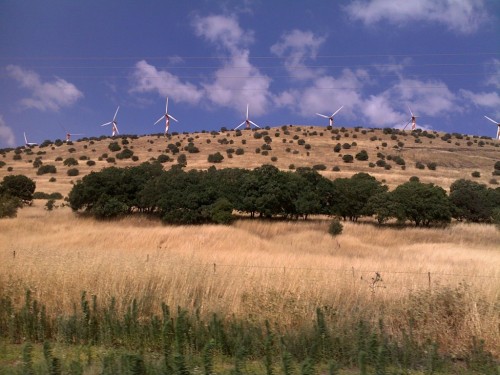
 Wind farms, like this one in the Israeli-occupied Golan Heights, may soon be common in Syria.
About 90 percent of Syria’s electric power comes from thermal power plants fueled by heavy fuel oil and natural gas; and the country is now looking into using forms of renewable energy to provide its increasing need for energy. Various projects dealing with solar and wind energy, as well as bio mass as a fuel source, were mentioned in powergenworldwide.
Syria is a member of the 145 strong International Renewable Energy Agency (IRENA) group of which a number of Middle Eastern countries now belong. Projects dealing with renewable energy in which Syria is either currently engaged in or planning to be involved in include a proposed tender for two wind turbine parks to generate a total of 130 MW; a program to install solar roofs on kindergartens attached to government buildings; the installation of two kinds of solar water heaters in both private and public buildings, including the Al Mwassat Hospital in Damascus; and the installing of photo voltaic solar panels in rural areas, which already provide about 80 kwh of electricity.Some of these renewable energy projects are being done in cooperation with international companies like the Danish Vestas wind energy company, and the German company GTZ, which is already involved in joint renewable energy projects in India and Pakistan.
Syria is also working with the Regional Centre for Renewable Energies and Energy based in Cairo; and is seeking a “common platform” for energy supply in response to climate change.
According to the Center, Syria’s new master “renewables” plan will run to 2030. The tentative targets for the end of this period are:
- 1000–1500 MW of wind power
- 250 MW of biomass based plant
- 250 MW of PV plant
- 1 MTOE per annum of solar heat
Syria has a 5 year plan in which its National Energy Research Council, associated with the country’s energy ministry, will embark on projects costing $8 million USD. Although this is a small sum, it is nevertheless a start in the renewable energy direction. The two wind farms are to be built near the cities of Al Sukhna and Al Hijana, and will be constructed in a joint project with Vesta.
Although most industrial concerns in Syria are still state owned (a carryover from when Syria patterned itself after the former Soviet Union), more privatization is occurring, in the economic atmosphere being created by the country’s present leader, Bashar al-Asssad. This already accounts for more than two dozen manufacturers of solar water heaters alone.
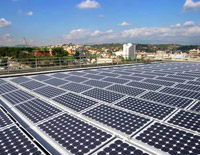
Ukranian Kvazar Solar Panels
In addition to the wind farm projects with Vesta, Syria is also turning to Spain for investment in solar energy. In May 2010, according to SANA, the Syrian news agency Syria’s Minister of Electricity Ahmad Qusai Kayala visited a number of wind and solar plants in Spain, including Iberdrola, one of Spain’s largest utility companies and Gamesa.
Another recent joint venture involves the Ukraine and Kvazar, a solar cell and panel manufacturing company which has been in discussions with Syronics, a Syrian company, for several years. The idea here is for producing solar PV panels and cells. Spanish solar energy companies are already involved in several projects in the Middle East, including a solar PV feasibility study in Abu Dhabi’s futuristic Masdar City.
All round, sounds like good clean news.
Read more on Middle East regional renewable energy:
Jordan Makes Renewable Energy Education Available to its citizens
Lebanon Looks to Smart Grids and Renewable Energy to Reduce Energy
Israel’s Electricity Grid May Never Handle Renewable Energy Goals


I was recommended this fabulous website as a result of my step-brother. I am do not selected if this placed is provided by means of him or her since who else comprehend this sort of highly accurate around this issue. You’re remarkable! Cheers!
Our dependence on fossil fuels in all aspect of our culture has to be addressed at every level and not just on transportation. The energy demands of heating and cooling our housing/shelters is significant, over and above this demand is the staggering consumption of energy used in the construction and preservation of these structures. I do have a logical, realistic, obtainable answer to this problem with the use of existing knowledge and materials. The trick is to build in volume with an assembly line process using a sturdy material that can be produced on site inexpensively.
Anyone with an understanding of energy efficient shelters knows that the absolute best design is the in-ground/earth shelter. This style of shelter maintains a consistent interior temperature between 68-70 degrees without energy use, no matter where its location or time of year. The in-ground/earth shelter has received a bad rap over the years as most of the population is uneducated in regards to this building style and unaware of the modern materials and technologies in use today. The image of a cold, dark, damp, gray, living space susceptible to Radon Gas and water damage is now a myth, probably created and sustained by those who profit from the destruction of our forests, and hold monopolies on our energy distribution. Fact is, an in-ground/earth shelter could be completely off the energy grid with its own energy source by using a combination of wind, solar, and radiant heat/cooling. It would use only a small fraction of wood if the shell was constructed of poured reinforced concrete, and today’s modern form systems can be adapted with inlays that mimic most all popular building materials used today, stone, brick, and even wood. Combined with a variety of colors this makes a visually attractive structure as well.
It is true that the popularity of such shelters are gaining interest and more are being built, but building one here or there is expensive and will never factor into the general population’s dependency on fossil fuels. The way to save cost and introduce uniformity with this style is to build subdivisions of these shelters. The self-sufficient renewable energy sources are less expensive to install when designed into the unit and built with it, as apposed to an add-on later. In some locations and depending on the season these sub-divisions would actually be creating an abundance of energy to be distributed back to the energy grid. Another important factor is to design into each unit the ability to charge an electric vehicle from the units’ renewable energy source. With the new developments in electric vehicles and a way to power them from ones residence would dramatically increase interest in them and encourage their assimilation into our modern culture.
These are not the only benefits to building sub-divisions of earth homes and even strip malls. Another major benefit would be the saving of energy with the building process itself over our now used stick-built process. The carbon footprint of creating a stick-built home is astounding, and grows larger over the years with the maintenance of the property as it deteriorates…this can be changed. No more oil base asphalt shingles to be manufactured and replaced filling our landfills, no more siding, and a drastic reduction of lumber that needs to be harvested, milled, shipped, distributed, trucked, and than built one board at a time.
I have a four-page paper explaining my ideas in debt that I would like to send through e-mail along with some illustrations for your consideration, with the hope of pursuing this with people who believe in and can help to make this idea a reality. I have read a bit of your web-site and it appears to me we have the same goals. I have not, and will not try to contact commercial builders with this as from my experience they are not much better morally than the big energy corporations, and do lack vision.
Mark