
 It’s hard to think green, when you’re thinking about your next dinner. A UN story documents the lack of protein in Egyptian children, and that a whopping 16% of all kids living there are malnourished.
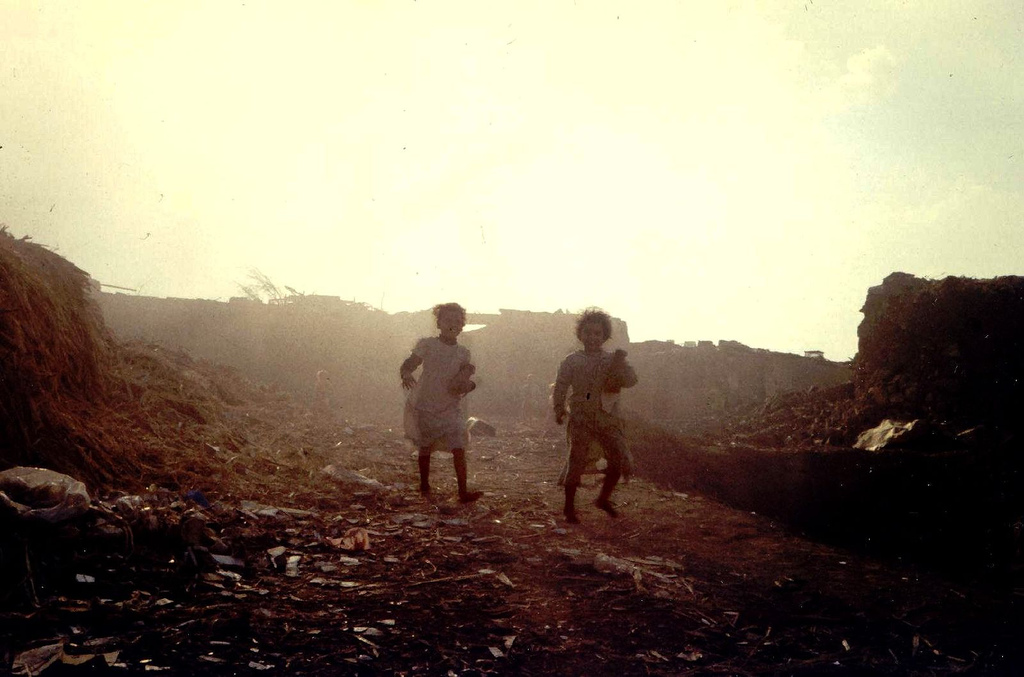
For seven-year-old Ahmed Yasser, it is normal to have just a crust of bread to munch on throughout the afternoon as he plays with other children in a narrow alley in the sprawling slum of Arab al-Maasarah, 20 km south of Cairo. “What else can the children eat?” Yasser Ali, Ahmed’s father, told IRIN (the United Nations news source). “The last time we ate protein was a month ago when a charity sent us a kilo of beef.”
Bread and other carbohydrate- and calorie-rich meals are common in Cairo’s informal settlements. Fruit, vegetables and protein-rich foods are hard to come by given high unemployment and rising food prices. Most slum-dwellers fail to give their children a balanced diet, which adversely affects both their growth and their educational progress, Mona Sadek, a researcher at the state-run National Centre for Educational Research, said.
“Most of the children in these slums suffer anaemia. They depend on cheap food, which is scarcely nutritious.”
Ahmed and his two siblings have stopped going to school because their father, a construction worker, lost his job and could no longer support them. Around 9 percent of Egypt’s workforce of 26.2 million is unemployed, according to the Central Agency for Public Mobilization and Statistics, a government research body.
Government and World Bank estimates of poverty levels among Egypt’s urban population are misleading and “grossly underestimated”, said Sarah Sabry of London University’s School of Oriental and African Studies in published in May.
“The urban poor are much more prevalent than commonly assumed. The populations of informal areas are increasing, both in absolute numbers and relative to the rest of the city’s [Cairo] population,” she stated, drawing on research for her extensive working study published in May 2009.
According to estimates by the UN Human Settlements Programme (UN-HABITAT), some 40 million, or 50 percent, of Egypt’s population of 80 million were urban dwellers in 2010. It projects that by 2025, the country would have an urbanization rate of 59 percent (57 million people out of a population of 96 million).
Controversy over poverty measurements
Sabry said there is much controversy surrounding poverty measurement methods globally and in Egypt as they are ever-changing, often subjective and tend to apply one-size-fits-all criteria – such as living on under US $1 a day.
She lists three main reasons why urban poverty in Egypt, which is largely concentrated in the capital, has been underestimated: the government’s “restrictive definition of urban areas” in the five governorates of Greater Cairo’s ever-expanding boundaries; consistent under-counting of the populations of Greater Cairo’s informal settlements by CAPMAS because of the logistical and security difficulties of surveying large slums; and the real cost of basic food and non-food items and public services for slum-dwellers being much higher than commonly recognized and “certainly much higher than the costs assumed for poverty lines”.
The study found that for many of the residents of Greater Cairo’s eight informal settlements, education is poor, malnutrition rates are high and health conditions are “often deplorable because of the lack of access to essential services”.
It said current poverty measurement methods only assess the cost of a certain minimum daily intake of calories and not whether the food is nutritious or not.
“The extent of malnutrition in urban areas in Egypt is confirmed by the estimate from a 2005 survey that about 16 percent of children were underweight. It is revealing that the rate of malnutrition among children (16 percent) is much higher than the recorded income poverty rate in urban areas (5 percent),” the study said.
“Breakfast is almost non-existent in the life of most slum children,” Mohamed el-Esma’ai, a social activist, said. “Even when they have this breakfast, it usually has nothing to do with what they should eat.”
Wellbeing index?
Sabry proposed a poverty measure beyond income alone that encompasses the many dimensions of wellbeing – such as housing quality, access to basic infrastructure and services and the quality of work people are engaged in. In addition, she called for more comprehensive surveys of Cairo’s informal settlements in order to truly ascertain the level of poverty within them.
The danger of underestimating urban poverty was that policymakers would not appropriately address the issues faced by this fast growing population and direct necessary funding to them, Sabri’s study said.
Amin Hanafi, a 51-year-old scrap metal dealer from Arab al-Maasarah, provides his three children with food that fulfils their calorific needs but does not qualify as nutritious.“We aren’t rich enough to give the children special food. They eat whatever others eat,” said Hanafi, who earns about 200 Egyptian pounds (US$36) a month.
More green and not so green news from Egypt:
Red Sea Oil Spill Worse Than Reported
Egypt Builds Climate Change Plan
Egypt Government to Invest in Wind
Above image via Ahron