
Qatar's Green Building Council Rallies Community Leaders

Qatar's Green Building Council (QGBC) founder and chairman Eng. Issa M. Al MohannadiQatar’s Green Building Council (QGBC) founder and chairman Eng. Issa M. Al Mohannadi will speak at the “Planet and Profit in Partnership” on April 11, 2010, another in a series of conferences that teach Qatari leaders about sustainable building practices.

It remains to be seen whether Qataris will pursue development projects like Urjuan that pay little heed to the country’s environmental constraints or if more modest, conservation voices will be heard instead. Founded by Eng. Issa M. Al Mohannadi, with support from honorary president Her Highness Sheikha Mozah Bint Nosser Al Missned and the Qatar Foundation for Education, Science, and Community Development, Qatar’s Green Building Council (QGBC) was officially launched in July last year.  A non-profit and independent organization that mirrors other green building councils around the world, QGBC is designed to promote and reward sustainable building practices.  And they have been busy.

On the 7th of April, they hosted ‘The Importance of Green Buildings for the Future of Qatar’ at the W Hotel, Doha, Qatar and tomorrow they will host ‘Planet and Profit in Partnership’ at the Grand Hyatt also in Doha.  These conferences are a part of the larger aim to “influence government policy, share knowledge and information, organize events and workshops, develop or adapt rating tools, and create green building networks.”  By soliciting collaboration from all sectors of society and sharing valuable knowledge, Qatar’s leaders demonstrate that sustainable development is not only necessary, but also achievable.
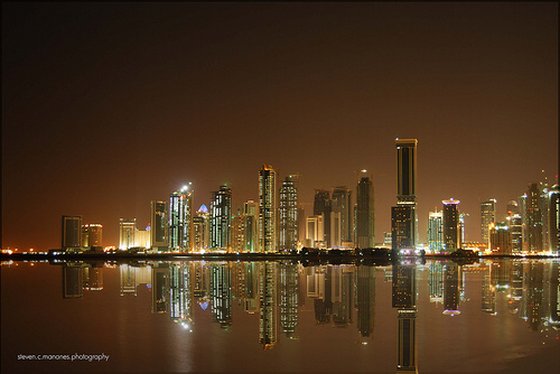
qatar sustainable development doha skyline

The QGBC has real potential to shape how Qatar uses its burgeoning oil and gas wealth.  According to the World Green Building Council (WGBC), to which Qatar has submitted its application for membership, buildings produce up to 40% of global carbon dioxide emissions.  Green buildings can reduce these emissions by 35%.  Moreover, green buildings reduce energy by 30-50%, waste by 70%, and water use by 40%.  These reductions are achieved by following stringent rating system guidelines. Examples of established and respected International guidelines include LEED (US), BREEAM (UK), and Green Star (Australia).

Eng. Issa M. Al Mohannadi says, “It is important that Qatar has its own Green Building Council because the evolution of Qatar’s green building practices will be different from other countries, climates and regions.  We need to find out what is right, and achievable, for Qatar, and we look forward to working with others as we move forward with this mission.”  In time they will finalize their own rating system, QSAS, to reflect the country’s unique approach to sustainability.

qatar sun in hands picture

Mohannadi’s concerted push to “…join the world green building movement [and] encourage builders and developers in Qatar to adopt sustainable environmental practices” is both admirable and effective.  At present, according to the WGBC, 15,000 companies worldwide operate according to green building standards, which represents nearly 50% of global construction activity.  We think these figures add up to real progress.  The QGBC’s voluntary efforts could provide both present and future Qataris with highly coveted environmental security.

More Sustainable Development News from the Middle East:
Saudi Arabia and IBM to Develop Solar-powered Desalination Plant
Syria Brainstorms on Renewable Energy at International Event
Enviromena Solar Company Awarded Enviro Prize, and Busts Arab Stereotypes


Tafline Laylin
Tafline Laylinhttp://www.greenprophet.com
As a tour leader who led “eco-friendly” camping trips throughout North America, Tafline soon realized that she was instead leaving behind a trail of gas fumes, plastic bottles and Pringles. In fact, wherever she traveled – whether it was Viet Nam or South Africa or England – it became clear how inefficiently the mandate to re-think our consumer culture is reaching the general public. Born in Iran, raised in South Africa and the United States, she currently splits her time between Africa and the Middle East. Tafline can be reached at tafline (at) greenprophet (dot) com.

LEAVE A REPLY

Please enter your comment!
Please enter your name here

TRENDING

Qatar’s climate hypocrisy rides the London Underground

Qatar remains a master of doublethink—burning gas by the megaton while selling “sustainability” to a world desperate for clean air. Wake up from your slumber people.

Images of Assomption Island development show extensive beach development

Researchers who have studied the island for decades describe it as a key ecological buffer for Aldabra, helping to protect the atoll from pollution, invasive species, and light disturbance. If Assomption’s natural systems collapse, they warn, Aldabra could be next.

Seychelles activists sue government for Qatari development on turtle nesting sites

The luxury resort now under legal challenge on Assomption Island is being developed by Assets Group, a Qatar-based real estate company that advertises the project on its own website as a collection of high-end villas and spa facilities in the Seychelles. According to multiple reports, including Mongabay and The Seychelles Nation, the developer is tied to Qatari investors and has relied on the London-based PC Agency to promote the project internationally. Environmental groups allege that Assets Group’s expansion near the UNESCO-protected Aldabra Atoll risks introducing invasive species and undermining decades of conservation work.

Iran’s water mafia and thirst for war leaves the country on brink of being dry

Iran’s Lake Urmia, once the Middle East’s largest saltwater lake, has shrunk by 90 percent due to mismanagement, dams, and drought. As Tehran pours billions into foreign conflicts, water activists face repression at home. The crisis mirrors Syria’s drought-driven unrest, showing how water scarcity can destabilize entire regions.

Life-Cycle Thinking Under Fire: Industrial Ecology Mission Amid Geopolitical Conflict

the relationship between the natural environment and industrial processes to promote sustainable development. The aim of this idea is to minimize environmental impacts and promote efficiency by integrating production and consumption development.

6 Payment Processors With the Fastest Onboarding for SMBs

Get your SMB up and running fast with these 6 payment processors. Compare the quickest onboarding options to start accepting customer payments without delay.

Qatar’s climate hypocrisy rides the London Underground

Qatar remains a master of doublethink—burning gas by the megaton while selling “sustainability” to a world desperate for clean air. Wake up from your slumber people.

How Quality of Hire Shapes Modern Recruitment

A 2024 survey by Deloitte found that 76% of talent leaders now consider long-term retention and workforce contribution among their most important hiring success metrics—far surpassing time-to-fill or cost-per-hire. As the expectations for new hires deepen, companies must also confront the inherent challenges in redefining and accurately measuring hiring quality.

8 Team-Building Exercises to Start the Week Off 

Team building to change the world! The best renewable energy companies are ones that function.

Thank you, LinkedIn — and what your Jobs on the Rise report means for sustainable careers

While “green jobs” aren’t always labeled as such, many of the fastest-growing roles are directly enabling the energy transition, climate resilience, and lower-carbon systems: Number one on their list is Artificial Intelligence engineers. But what does that mean? Vibe coding Claude? 

Somali pirates steal oil tankers

The pirates often stage their heists out of Somalia, a lawless country, with a weak central government that is grappling with a violent Islamist insurgency. Using speedboats that swarm the targets, the machine-gun-toting pirates take control of merchant ships and then hold the vessels, crew and cargo for ransom.

Leopoldo Alejandro Betancourt López Turned Ocean Plastic Into Profitable Sunglasses

Few fashion accessories carry the environmental burden of sunglasses. Most frames are constructed from petroleum-based plastics and acrylic polymers that linger in landfills for centuries, shedding microplastics into soil and waterways long after they've been discarded. Leopoldo Alejandro Betancourt López, president of the Spanish eyewear brand Hawkers, saw this problem differently than most industry executives.

Why Dr. Tony Jacob Sees Texas Business Egos as Warning Signs

Everything's bigger in Texas. Except business egos.  Dr. Tony Jacob figured...

Related Articles

Popular Categories