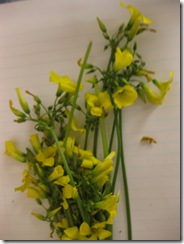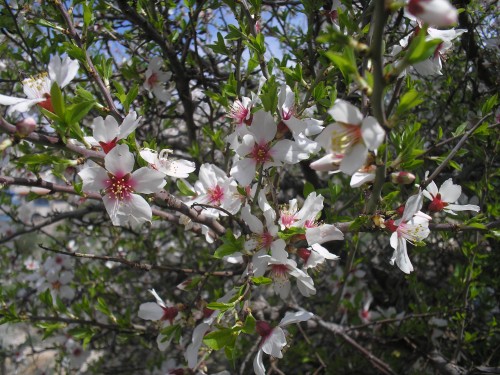

Make almond blossom liquor with arak or vodka

almond blossom

White Almond Blossoms Make A Unique Liqueur

All over the Mediterranean and Middle East, wild almond trees in fields and along highways are becoming clouds of pink and white blossom. They’re the first to bloom at winter’s end. Although rain and dark skies may return a few more times, tentative sunshine warms our faces, and we catch the delicate flowery odor of almond blooms as we stroll under the trees. Our short winter is drawing to a close.

Almond blooms fade away quickly once they have fallen off their branches, but there is a way to preserve their sweetness: make a liqueur. If you live in Israel, it might be ready for this year’s Tu B’Shvat Seder.

First, choose only from trees that have white blossoms. Those are the trees bearing sweet almonds. Pink flowers indicate trees bearing bitter almonds, which contain prussic acid. We don’t know if bitter-almond flowers are toxic as well as the fruit, but better take no chances and stick with the white sweet-almond blooms.

1. First, collect as many white almond blossoms as you can. (Pink almond blossoms are bitter and not suitable.) Spread them out on a clean surface. Check them for insects.

2. Fill a small jar with the flowers – a clean, dry, mayonnaise jar will do – and then pour arak or vodka on top till the flowers are completely covered. Add a tablespoon of sugar and stir. Replace the lid on the jar and put it away in a dark place for two weeks. If you can’t gather a lot of blossoms at once, just cover what you have with arak and continue gathering, adding more liquor and a little sugar each time, till your jar is full.

3. After two weeks, strain your liqueur and enjoy a sip. It’s exquisite.

You can use roses or lemon geraniums flowers, or any sweet-smelling edible flowers instead of almond flowers. Mint, basil, or thyme flowers, or a mixture, are a good base – if you can get enough of them.

More on trees and Tu B’Shvat:
Plant Some Shade
Eco-Rabbi: TuBishvat and the Receiving of the Torah
Celebrate Tu B’Shvat, New Year’s For Trees, Now Jewish Earth Day


Miriam Kresh
Miriam Kreshhttps://www.greenprophet.com/
Miriam Kresh is an American ex-pat living in Israel. Her love of Middle Eastern food evolved from close friendships with enthusiastic Moroccan, Tunisian and Turkish home cooks. She owns too many cookbooks and is always planning the next meal. Miriam can be reached at miriam (at) greenprophet (dot) com.
8 COMMENTS
  1. It smells great, but I think I may have poisoned myself with a tiny sip. Pretty sure I only took the white, sweet almond blossoms…

  2. It smells great, but I think I may have poisoned myself with a tiny sip. Pretty sure I only took the white, sweet almond blossoms…

Comments are closed.

TRENDING

Haman’s Fingers, A Moroccan Purim Specialty

There’s feasting at home on the night and the next day, and to make sure everyone gets good things to eat, families send out packages of treats to friends and neighbors. Traditional goodies are hamentaschen, and other treats like our chocolate nut clusters .

Make nettle dumplings, also known as nettles malfatti

Springtime foraging yields a harvest of wild greens to cook at home, like nettles. Make delicious nettles malfatti dumplings with this recipe.

Lion’s Mane Mushroom Recipe

Eyeing the mushrooms for sale in the local supermarket,...

Mandi, Fragrant Yemenite Chicken With Golden Rice

This is a luxurious recipe that requires a taste...

Simple Qatayef recipe makes fabulous nut-filled pancakes

Qatayef - also spelled katayif or qatya’if - is traditionally eaten at Ramadan (get our Ramadan vegetarian ideas here), but it’s a treat anytime. In fact, it’s a treat that’s gone through history. A recipe for qatayif appears in a tenth century Arabic cookbook by the writer Ibn Sayyar al-Warraq, who compiled recipes going back to the eighth and ninth centuries. People have been eating qatayif for a very long time.

Should You Invest in the Private Market?

startustartup Unlike public stock exchanges, which offer daily trading, strict...

How to build a 100-year-company

Kongō Gumi is a Japanese construction company, purportedly founded in 578 A.D., making it the world's oldest documented company. What can we learn about building sustainable businesses from them?

From Pilot Plant to Global Stage: How Aduro Clean Technologies’ 2026 Expansion Signals a Turning Point for Chemical Recycling Investors Like Yazan Al Homsi

The company's Next Generation Process (NGP) Pilot Plant in London, Ontario, has officially moved into initial operating campaigns, generating the kind of structured, repeatable data that separates laboratory promise from commercial viability.

How AI Helps SaaS Companies Reduce Repetitive Customer Support Work

SaaS products are designed for large numbers of users with different levels of experience, and also in renewable energy.

Pulling Water from the Air

Faced with water shortage in Amman, Laurie digs up...

Turning Your Energy Consultancy into an LLC: 4 Legal Steps for Founders in Texas

If you are starting a renewable energy business in Texas, learn how to start an LLC by the books.

Tracking the Impacts of a Hydroelectric Dam Along the Tigris River

For the next two months, I'll be taking a break from my usual Green Prophet posts to report on a transnational environmental issue: the Ilısu Dam currently under construction in Turkey, and the ways it will transform life along the Tigris River.

6 Payment Processors With the Fastest Onboarding for SMBs

Get your SMB up and running fast with these 6 payment processors. Compare the quickest onboarding options to start accepting customer payments without delay.

Related Articles

Popular Categories