

 When rain pours down on our city streets, it feels cleansing.
It looks cleansing too as the water pounds into the pavement and strips oil from the roads, small bits of plastic and paper from the sewer grates, and ice cream stains from sidewalks.
But urban rain is anything but clean and fresh, and it’s doing irreversible damage to our aquifiers, says Yaron Zinger, an Israeli engineer who has a plan that cities, people, rivers and wildlife will love.
Zinger’s system collects rainwater, cleans it, and returns it to urban aquifers.
Consisting of layers of soil and plants with deep roots, it can make water suitable for irrigating gardens, for flushing toilets, and one day even for drinking, he says.
Thirty-six-year-old Zinger, who lives on Kibbutz Palmachim on Israel’s Mediterranean coast, began thinking about the resource of rainwater while working on his PhD at Monash University in Melbourne, Australia.
Zinger was charged with the task of removing nitrogen from runoff water, a mineral that pollutes our lakes and oceans, and alongside phosphorus causes a build-up of algae that starves aquatic life of oxygen. Zinger chose to broaden the challenge.
What the rain won’t wash away
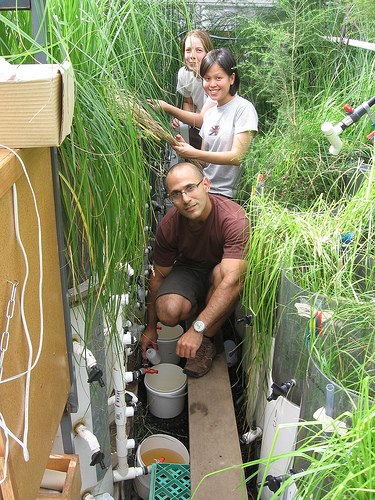
As part of a team of Australian engineers, biologists and botanists, Zinger developed a “biofilter,” a water harvesting and treatment system that collects and cleans urban rainwater – particularly storm run off, which is “polluted with heavy metals, organic and inorganic pollutants, oil and basically anything sitting on the road,” explains Zinger.
The system treats the water biologically, and then returns it to its source – allowing it to permeate the ground where it replenishes underground aquifers and wells with clean water.
The biofilter, says Zinger, can be installed near sidewalks, traffic islands and in any open area. It consists of layers of soil and plants with deep roots, which develop a bacterial population that can break down polluted matter in the runoff.
Polluted urban rainwater is a relatively undocumented issue, but it is major problem worldwide.
Pollution in the air, on our roofs, and that which is festering on the ground around factories and garages, is carried away by the rain. Given the nature of the urban environment, rather than filter through yards of soil and sand, which can cleanse the water in some manner, urban water now tends to pour through the streets, heading straight for rivers, lakes and oceans.
10% of our fish are contaminated
Once there, fish and larger organisms consume this polluted water, causing heavy metals to build up in their bodies, and they pass these along to humans when they are eaten. “Ten percent of our fish are no longer good to eat,” says Zinger of Israel’s catch.
At today’s levels of pollution the soil also can’t handle the load, and the water that does penetrate the cement and asphalt returns laden with chemicals it has carried along the way.
This water also flows straight to the sea, and with the nitrogen and phosphorus that it contains, it is “creating carpets of algae. It blocks the sun in a process called eutrophication – now happening in 50 percent of every body of water – something that can develop within five to 10 years and which is irreversible,” says Zinger, expanding: “The idea of the biofilter is to treat pollutants at the source – where it hits the ground.”
In Israel and Australia, where clean water is seriously limited, there is special concern.
Millions of dollars of research funds have been funnelled into this project from the Australian government and industry, and Zinger’s concept has already been validated in Australia, where some 10,000 units are now being put in place over the next five years.
From toilets to gardens
One project in Australia uses the biofilter to flush toilets and to water gardens, including the gardens on the Monash University campus. The system is designed to blend into the landscape.
Here in Israel, Zinger is now building an Israeli pilot plant in a new green neighborhood being constructed in Kfar Saba, just outside Tel Aviv. It is the country’s first environmentally friendly urban housing project, and the biofilter will be used to clean urban rain water runoff and recharge old and out of service water wells.
Zinger is working on the project with Kfar Saba municipality, and the Jewish National Fund, which has licensed the technology from Australia.
As the first step in Israel, Zinger plans to collect this winter’s runoff in Kfar Saba, where rainwater accounts for three million cubic meters a year. If Zinger’s biofilter works, it could save a large part of this water for human consumption.
Eventually, Zinger hopes that the “clean” rainwater will be used to flush through toilets in Israel. At some stage it might even be clean enough to drink, Zinger asserts.
One of the first to tackle rainwater
Although Israel is a rising leader in water technology, through companies such as the drip irrigation firm Netafim, the sewage treatment technology of Aqwise, or the municipal water saving solutions of Shari Arison’s Miya, no-one that Zinger knows of has thought about cleaning urban rainwater.
Zinger has presented his plan at many international conferences in recent years, and hasn’t encountered others who deal with rainwater in a similar way. “It’s a relatively new field because [until now] the water went through the soil to go back to the aquifer,” he says.
“It will work with urban runoff – from a pipe – and this winter we will give dialysis to the aquifer,” declares Zinger, who plans to officially launch the biofilter at this November’s WATEC international water technology conference hosted in Tel Aviv. And yes, he concludes, it “could work in Manhattan”.
Through his partnership with the lab in Melbourne, Zinger hopes to raise awareness about it worldwide so that people will understand the dangers, and the benefits of his solution.
(This story first appeared on ISRAEL21c – www.israel21c.org)


[…] roofs – with parapets – are common, making them seemingly ideal for this purpose. Hers would add water filtration to make the water safe to drink a crucial aspect of rainwater harvesting being innovated now by […]
Dr. Oz says US drinking water poison. How about dialysis?
http://bit.ly/2aMIxs
Giving Dialysis To Our Cities' Aquifers | Green Prophet http://bit.ly/1MnQF1
Giving Dialysis To Our Cities' Aquifers | Green Prophet http://bit.ly/1MnQF1
[…] When rain pours down on our city streets, it feels cleansing. It looks cleansing too as the water pounds into the pavement and strips oil from the roads, small bits of plastic and paper from the…Read More […]
.@greenprophet Giving Dialysis To Our Cities’ Aquifers http://j.mp/1zoJcS http://www.jewpi.com
News:: Giving Dialysis To Our Cities' Aquifers http://bit.ly/4mvbjj