

 Think Again is a series that provides fun ideas for how to reuse items in your home that you would normally throw out or recycle. Reusing is higher on the “green” food chain than recycling, because getting another use out of an object is always more effective than spending the energy to recycle it. Plus, trying to reuse can force us to be creative!
Last week we wrote about Lebanese fashion designer Ziad Ghanem who turns reclaimed clothing from second hand stores into high fashion. For those of us out there who are also inspired to do something creative with used clothing, keep on reading.
Got a bunch of old t-shirts and tank tops in the back of your closet that are stained, no longer in fashion, or just don’t fit right anymore? Are they in the back of your closet because you love them anyway and can’t bring yourself to get rid of them? This project will allow you to upcycle those items, exercise your creative muscles, and keep the nostalgic t-shirts in your life in a functional, eco-friendly way.
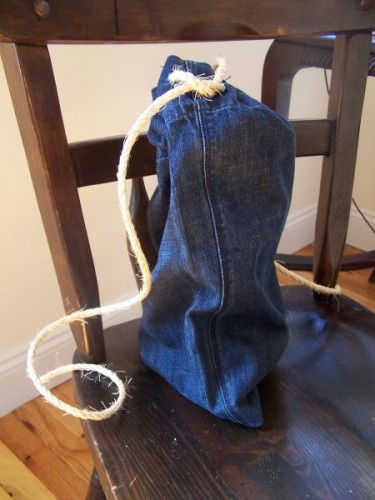
In under an hour and with some very basic tools you can transform that old garment into a drawstring bag – to be used instead of plastic bags when shopping or instead of wrapping paper when wrapping a gift.
For this project you will need:
1 garment (this can be an old t-shirt or pair of pants)
Scissors
Needle and thread
Ribbon or rope
Bobby pin or safety pin
 1. Once you’ve picked out an article of clothing to use for the project, cut it into a rectangular tube so that two sides are sewn together and two sides are open. The photo to the left shows a t-shirt (with the rope indicating the line along which you would cut the shirt) and an already cut out rectangle from an old pair of jeans. It is very important that one of the open sides have a seam.
2. Turn your rectangle inside out. (This is so that the stitching doesn’t show on your completed bag.)
3. Sew the open side of the rectangle without the seam. If you are using a t-shirt this would be the side from the top part of the shirt. If you are using a pair of jeans, it would be the side from the upper part of the pant leg. You may want to sew a double line, so that the bag is sturdy. Be sure to sew the corners well. (Don’t worry about the stitching being in a perfect line or anything – check out my messy stiches on the right and the bag still came out looking great.)
4. Turn the bag right-side out, and push out the bottom corners of your bag with your fingers.
5. Hold the seam (from the open top of your bag) with your fingers, and cut two side-by-side slits into the seam so that only one side of the two sides of the seam is cut. (Look at the photo on the left to get a better idea of what I’m talking about.) This will create a type of tube with two openings so that you can thread a piece of ribbon or rope through to serve as the drawstring. (Think of how a hooded sweatshirt works.)
6. Thread your ribbon/rope/shoelace/whatever through the seam openings using a bobby pin or safety pin to help guide it through. Pull it out through the other opening and there you go! All done!
If you do make this project, please share your photos and your experiences with us in the comments section below.
Read about other Think Again projects::
Think Again: Strike Up a Matchbox Inspired Recycled Notebook
Think Again: Cook Up Some New Ideas for Using Those Dusty Kitchen Appliances




[…] she is giving an online seminar right here on Green Prophet! Aya (aka Aya Kaya) teaches us how to turn aged t-shirts and tank tops into cloth bags that can be used in mixed ways. (For those of we about to present Christmas or Hannukah presents, […]
[…] is giving an online workshop right here on Green Prophet! Aya (aka Aya Kaya) teaches us how to turn old t-shirts and tank tops into cloth bags that can be used in multiple ways. (For those of you about to gift Christmas or Hannukah […]
very cool, got few old shirts that could turn into drawstring bags – perfect as gifts isn't it?
coool.nice idea.:) love it.
nice post
Turn old t-shirts into drawstring bags http://bit.ly/wniR5 (not with Rizzo Tees, though – you wear those)
NICE IDEA and article on T-shirts very inspiring and gives me new ideas for my own shirts! Will definitely be taking it on and remembering this next time i go to create!
MAybe i can turn some of my designs into bags!
CLICK HERE FOR COOL SHIT!
Think Again: Turn Old T-Shirts Into Drawstring Bags | Green Prophet http://tinyurl.com/yewu4on
Think Again: Turn Old T-Shirts Into Drawstring Bags | Green Prophet http://bit.ly/XXkRN
Think Again: Turn Old T-Shirts Into Drawstring Bags | Green Prophet http://bit.ly/12mvoZ
Think Again: Turn Old T-Shirts Into Drawstring Bags | Green Prophet http://bit.ly/12mvoZ
Think Again: Turn Old T-Shirts Into Drawstring Bags – Green Prophet (blog) http://bit.ly/Vhdzd
Think Again: Turn Old T-Shirts Into Drawstring Bags – Green Prophet (blog) http://bit.ly/Vhdzd
Green it! : Think Again: Turn Old T-Shirts Into Drawstring Bags http://bit.ly/q05Y1