As Turkey's Liquid Assets Run Dry, Something's Afoul With Its Plan To Sell Water

water-carrier-istanbul-turkey-photoGlobal warming and climate change, which we know is threatening the majestic cedars of Lebanon, is now having a serious effect on water resources in Turkey.

The situation is getting so bad that is really hard to believe that Turkey is the same country that only a short time ago offered to sell water to neighboring countries, especially to Israel.

Now it looks like this Aisa Minor republic may one day not have enough to satisfy it’s own increasing needs; not only for it’s industrial and agricultural sectors, but to it’s population as well.

Tourism ads once promoted Turkey as a country with a lush topography, full of fresh water lakes, and free flowing streams and rivers.

Many of its lakes, including ones like Lake Tuz (now almost a salt water marsh) and Lake Ulubat are either at dangerously low levels or are becoming polluted.

Turkey underwent a major program a few years back to build a series of dams and pumping stations on sections of the Euphrates River, from which other countries like Syria and Iraq also depend upon for fresh water.

The plan had been approved in order to ensure more available water for agricultural use, and by the time it reaches, let alone Iraq, the once mighty Euphrates is not more than a stream.

Not only humans have depended on these lakes and river, but numerous fish and animal species, including millions of migrating waterfowl that pass through Turkey annually on their way north or south.

Lake Ulubat, located in northwestern Turkey near the Straits of Marmara, has been a favorite stop over place for waterfowl for years. It has not only shrunk in size, but has become seriously polluted by both sewage and industrial waste.

Associate Professor Feza Karaer from Uludağ University’s department of Environmental Engineering was quoted as saying that the lake is in serious danger due to these factors “and is not the size it was during the 1980’s and ’90s.”

It’s not yet certain if the Turkish government is planning to build desalination plants to augment its fresh water needs. But with it’s long shorelines (it borders on three major bodies of salt water: the Black, Adrian , and Mediterranean seas) the construction of a number of desalination facilities is definitely worth considering.

And since Turkey has to share its water resources with neighboring countries, regional cooperation with other countries to build such plants might be a good idea too. It can only be hoped that efforts not being made to conserve and improver Turkey’s fresh water sources are not too little – too late.

::Circle of Blue

More on Turkey’s water:
Turkey To Export To Iraq Through Garden of Eden
Middle East Countries Partner on Water Through EMWIS
Canada Offers Grey Water Recycling To Turkey

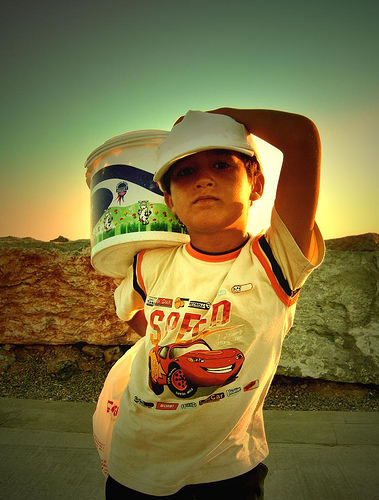
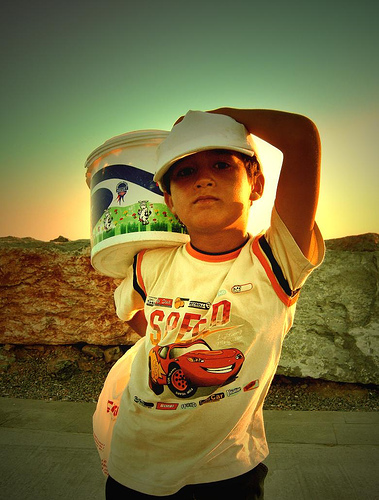
[image via kiwanc. Above picture is image of young boy, a water carrier from Istanbul, Turkey.)]

Maurice Picow
Maurice Picowhttps://www.greenprophet.com/
Maurice Picow grew up in Oklahoma City, U.S.A., where he received a B.S. Degree in Business Administration. Following graduation, Maurice embarked on a career as a real estate broker before making the decision to move to Israel. After arriving in Israel, he came involved in the insurance agency business and later in the moving and international relocation fields. Maurice became interested in writing news and commentary articles in the late 1990’s, and now writes feature articles for the The Jerusalem Post as well as being a regular contributor to Green Prophet. He has also written a non-fiction study on Islam, a two volume adventure novel, and is completing a romance novel about a forbidden love affair. Writing topics of particular interest for Green Prophet are those dealing with global warming and climate change, as well as clean technology - particularly electric cars.
2 COMMENTS

Comments are closed.

TRENDING

Forever chemicals banned from Europe’s drinking water

The EU is taking a bold step in making sure all European Union member states worked to monitor and reduce PFAS levels in drinking water.

Elon Musk to create Mars base station on the Moon

For those unaware, SpaceX has already shifted focus to building a self-growing city on the Moon, as we can potentially achieve that in less than 10 years, whereas Mars would take 20+ years.

Astro uses AI to help procure land for renewable energy

For oil-rich, environmentally vigilant Gulf states, Astro isn’t just another startup story. It is a blueprint for accelerating an energy transition that is now existential, not optional.

10 Proven Israeli Technologies to Help Somaliland Build Food, Water, and Energy Security

Israel’s water and agricultural technologies didn’t emerge from ideal conditions. They were developed under pressure: low rainfall, saline water, political isolation, lack of energy resources, and the constant need to feed a growing population with limited land. Over the years, I’ve written about many of these companies not as miracle-makers, but as problem-solvers. That’s what makes them relevant to places like Somaliland. Israel was the first country in the world to recognize Somaliland as an independent state although Ethiopia has been treating the nation as such for decades.

Sink holes from over-watering farmers’ fields

Sinkholes are rapidly appearing in Turkey’s central Anatolian farming region, particularly around Konya and Karapınar. These giant gaping holes in the ground in areas of farmland, known locally as obruk, are not random geological events. They are linked to prolonged drought, climate-driven heat stress, and heavy groundwater extraction for agriculture in one of the country’s most important breadbaskets.

Turning Your Energy Consultancy into an LLC: 4 Legal Steps for Founders in Texas

If you are starting a renewable energy business in Texas, learn how to start an LLC by the books.

Tracking the Impacts of a Hydroelectric Dam Along the Tigris River

For the next two months, I'll be taking a break from my usual Green Prophet posts to report on a transnational environmental issue: the Ilısu Dam currently under construction in Turkey, and the ways it will transform life along the Tigris River.

6 Payment Processors With the Fastest Onboarding for SMBs

Get your SMB up and running fast with these 6 payment processors. Compare the quickest onboarding options to start accepting customer payments without delay.

Qatar’s climate hypocrisy rides the London Underground

Qatar remains a master of doublethink—burning gas by the megaton while selling “sustainability” to a world desperate for clean air. Wake up from your slumber people.

How Quality of Hire Shapes Modern Recruitment

A 2024 survey by Deloitte found that 76% of talent leaders now consider long-term retention and workforce contribution among their most important hiring success metrics—far surpassing time-to-fill or cost-per-hire. As the expectations for new hires deepen, companies must also confront the inherent challenges in redefining and accurately measuring hiring quality.

8 Team-Building Exercises to Start the Week Off 

Team building to change the world! The best renewable energy companies are ones that function.

Thank you, LinkedIn — and what your Jobs on the Rise report means for sustainable careers

While “green jobs” aren’t always labeled as such, many of the fastest-growing roles are directly enabling the energy transition, climate resilience, and lower-carbon systems: Number one on their list is Artificial Intelligence engineers. But what does that mean? Vibe coding Claude? 

Somali pirates steal oil tankers

The pirates often stage their heists out of Somalia, a lawless country, with a weak central government that is grappling with a violent Islamist insurgency. Using speedboats that swarm the targets, the machine-gun-toting pirates take control of merchant ships and then hold the vessels, crew and cargo for ransom.

Related Articles

Popular Categories