
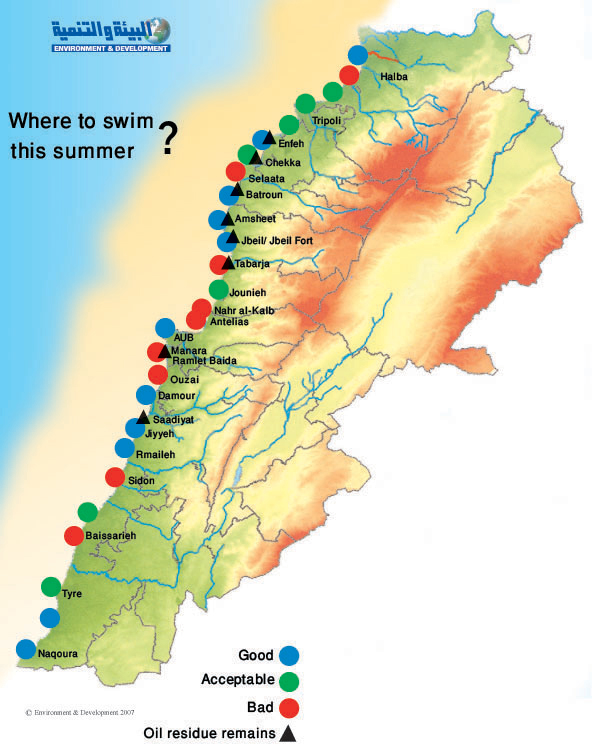


If those of us living in Israel think we have a problem with pollution and beach closures in the Mediterranean Sea, we should take a look on what’s happening north in Lebanon.
A recent article in Beirut’s English language newspaper, the Lebanese Star, noted that pollution caused by both the public and private sectors is reaching dire proportions.
According to the article, the problem seems largely ignored by much of the Lebanese public, and at least 200,000 cubic meters of untreated sewage water pours into the sea daily.
The situation is so bad, that Mr. Ali Darwhish Secretary of the Lebanese environmental organization, Greenline, said that “Lebanon is one of a few countries where nearly all sewage goes into the sea.”
Lebanon’s sea pollution woes were multiplied considerably during the 2006 war, when more than 15,000 of fuel oil spilled into the sea following the bombing of the main power station by Israel.
This incident has been considered to be the country’s environmental nightmare; but instead of it being used as a rallying point for cleaning up the country’s still damaged coastline, many people have already forgotten the incident.
Not only is nearly 60% of the country’s sewage is being poured into the sea, but also untreated waste from at least 28 different industries, according to the country’s Green Party.
Not only sewage and industrial waste, but also thousands of tons on untreated solid wastes find their way to the sea, from a number of dumping sites, on the country’s coastline.
Even before the 2006 war, it was reported by the World Bank that marine pollution in Lebanon was costing the country about $565 million a year. Many Lebanese fishermen, who used to catch thousands of tons of fish as recently as ten years ago, now say they only haul in a small fraction of their former amount.
There is only one marine reserve, a small 1.2 km pilot project located at Byblos; and established by Greenpeace. Even that small area is now threatened by pollution.
“What’s the use of having such Marine reserves if polluted wastes flows into them”, Darwish asked.
Although Lebanon is a party to the Convention for Protecting the Mediterranean Sea Against Pollution, it appears that little can be done to deal with a problem that seems to be increasing annually.
::Lebanese Star via Blogging Beirut



[…] that intends to open the eyes of the Lebanese youth to the real problems in their society. See sewage flowing into the sea, the garbage mountain at sea, the pillage of archeological ruins, the terrible traffic situation […]
[…] Darwich, environmental and agricultural specialist and general secretary of the non-government environmental organization Green Line said there are 8 major dumping sites in Lebanon, with the one near Tyre, Saida, being the most […]
[…] the Mediterranean Coast of Lebanon. Irrelevant Combinations blog shows airplane view pictures of raw sewage being dumped into the sea off the coast of Beirut. Although the weather outside may be frightful in the northern hemisphere, hearty winter types best […]