


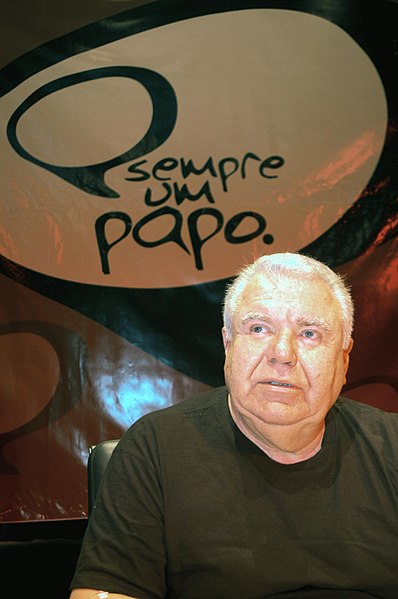
 Sitting in his favorite cafe, outside his home, Jaime Lerner opens his little black notebook. He sits and scribbles ideas while waiting for his next meeting with one of the many mayors, diplomats, governors and senators who make the pilgrimage to meet him from all over the world.
His notebook, much like Leonardo da Vinci’s Codex, is filled with wild ideas from across the entire spectrum of human experience. From rough blueprints of Dock-Dock – a tiny futuristic automobile intended to cut congestion and pollution – to sketches of a “portable street,” to the truly wild… Rap lyrics to what he calls The Sustainable Song.
The world leaders he meets every week in the little cafe in Curitiba, Brazil, come because they believe that Lerner’s notebooks, and his experience, may hold some of the solutions to the problems of climate change, and the problems that plague most modern cities.
“There is little in the architecture of a city that is more beautifully designed than a tree.”
-Jaime Lerner
Lerner is a man of innovative and brave solutions. In his days as mayor and governor, he made a deal with the local fishermen, “If he fishes fish, the money goes to him. If he fishes rubbish, bottles, glass, cans, we will buy it from him. If the conditions are bad for catching fish, he’ll catch rubbish. The more rubbish he gets, the more money he gets and the cleaner the bay gets. The cleaner the bay gets, the more fish he’ll be able to fish. It’s a win-win solution.”
Naysayers will dismiss such wild ideas. Say that they will never stand to the test of reality, and are not feasible. But Lerner has repeatedly proven that his solutions are not only feasible, but also sustainable and profitable. And while other mayors measure the pace of change in months and years, for Lerner it is measured in minutes, hours and days.
“Creativity & innovation is starting… We cannot have all the answers…”
-Jaime Lerner
“Lerner is a longtime proponent of what might be called ‘blitz urbanism’: the rapid, workable improvement that does an end run on bureaucrats and doubters,” says Newsday’s Justin Davidson. He sees stealth, as a key to transformation. “We have to do things quickly because next week we might not be here anymore. And you have to be quick to avoid your own bureaucracy. Bureaucracy is like a fungus that contaminates everything.”
As 3-time mayor of Curitiba, Lerner used this philosophy to transform his city’s main street, into a pedestrian mall in just 72 hours. Fast enough for the tractors to do their work, but not fast enough for the bureaucrats and local business owners to complain, and put a stop to his vision.
Over the next 20 years, Lerner shaped the city’s future and turned it into a shining example that is studied to this day. “We built the opera house in two months, the botanical gardens in three months, Niemeyer’s museum in five months. It wasn’t that we were chasing after records – it was necessity.”
“Creativity starts when you cut a zero from your budget”
-Jaime Lerner
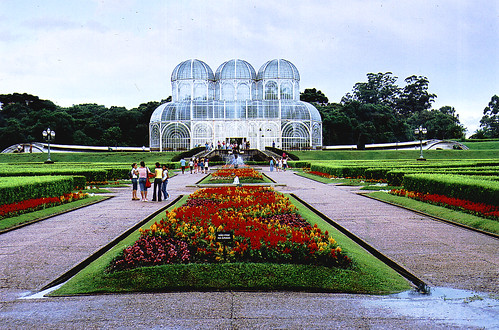
- Curitiba’s Botanical Garden (photo by Jeff Belmonte)
As a young architect in the mid-1960’s, Lerner saw his city’s population cross the 500,000 line. Soon, this third-world city, was struggling with many new problems.
“I saw things happening that I thought were wrong,” he says. “They were destroying the city’s history, opening up big roads that wiped out the whole memory of the city, planning the city just for cars.”
In 1971 he became mayor, and began implementing radical and progressive changes that changed Curitiba forever. Some of this changes are so radical, they may seem impossible… Unless you witnessed Lerner make them possible.
Curitiba is a city bordered by a floodplain, and while many wealthier cities such as New Orleans and Sacramento, have chosen to build expensive levee system, Curitiba purchased the floodplains and turned them into parks. Unable to afford tractors to mow these parks, Lerner employed ‘municipal sheep’ who keep the vegetation under control and whose wool funds children’s programs.
“We arrived to the conclusion that it was better to save an existing wood than to build a new park. So we started to save existing woods with the help of families that could take care of them. Thanks to that, the green areas indicator of Curitiba went from 0,5 square meters per citizen in 1971 to 52 square meters per citizen; while the population grew three times.”
-Jaime Lerner
The city now ranks among the world leaders in per-capita park area.
When faced with the challenge of how to service Curitiba’s slums and shanty towns, Lerner began paying people for their trash. He paid with bags full of groceries and transit passes.
The slums became much cleaner and to this day, Curitiba has one of the highest levels of garbage separation in the world.
“The car is like our mother in-law. We have to have good relationship with her, but you shouldn’t let her dictate your whole life… If the only woman in your life is your mother in-law, you have a problem.”
-Jaime Lerner
In 1988, Lerner began work on his masterpiece – the Rede Integrada de Transporte (RIT), or integrated transport system.
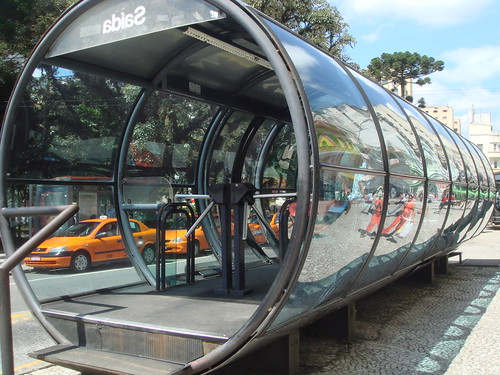
- Curitiba Bus Stop (photo by xander76)
Lerner was given Federal money to build a subway, but he discovered that a subway costs ten times the amount of a “light rail”, which, in turn, costs ten times as much as a bus system, even one with dedicated bus ways. For Lerner, the choice was clear. He would build a rapid transit system based on buses.
The Speedybus, as it is called, is a system of specially constructed Volvo buses that can carry over 270 people each. The buses run in dedicated lanes, and stop with clockwork precision in high tech bus stops which Lerner designed himself.
The result is an experience that is nothing like the bus systems we know, but is instead similar to riding a subway, at a fraction of the cost, and completed city-wide in two years.
“A sustainable city is the one that integrates housing, work and leisure, while preserving its history and investing in public transportation.”
-Jaime Lerner
So what can we learn from this? It’s a nice story, but are these kind of wild ideas applicable in a city like… Tel-Aviv?
Why not?
Curitiba is a city much bigger, with more people and poorer than Tel-Aviv. Every excuse we can come up with for why this wouldn’t work here has already been proven by Lerner to be just that… an excuse.
All it takes is a leader with a vision, and the courage to make drastic changes without fear of the short-term political fallout.
“One of the things I have learned is that we have to be committed to simplicity. There is no need to be scared of simplicity. And we can’t want to have all the answers in the world. Many cities end up putting off things because they want to understand everything. They don’t understand that innovating is about starting. Taking care of a city is a process that you start, and then give the population space to respond. There is no place in a city that can’t be better. There is no toad that can’t be a princess, no frog that can’t become a prince.”
-Jaime Lerner
I highly recommend Nitzan Horowitz’s excellent documentary called “Urban Legend” which is available online. He travels the globe, from India to Curitiba, and eventually brings Lerner to Tel-Aviv. See the video below:


[…] Karen Chernick | April 3rd, 2011 | Comment | Email this tweetmeme_url = 'http://www.greenprophet.com/2011/04/conference-sustainable-cities/'; tweetmeme_source = 'GreenProphet'; tweetmeme_service = 'awe.sm'; service_api = '0c4b6af1aba54fb228c924aab3353dbbcb348cceabf15d2a0ce7b3f7efdbeaa3'; Share “The city is not the problem, but the solution,” says architect Jaime Lerner. […]
[…] The investment made was worth NIS 100 million (about $30 million USD today). The interest in Brazil is for MIYA to get a foothold in the Latin American market. Brazil is an excellent place to start since it’s known worldwide for its investments in the environment in areas such as biofuels and transportation. […]
#bxd09 Jaime Lerner: DockDock – new urban car. Hopefully coming to a city near you? Get it in Ferrari red. http://bit.ly/Ynx8f
Very interesting, and other interesting stuff on the site, too. Green Urbanism in the Middle East. http://tinyurl.com/d6m5a6
Reading: “Brazil’s Jaime Lerner Says “Cities Are The Answer”” ( http://tinyurl.com/d6m5a6 )
Reading: “Brazil’s Jaime Lerner Says “Cities Are The Answer”” ( http://tinyurl.com/d6m5a6 )
Brazil’s Jaime Lerner Says “Cities Are The Answer,” And Provides Hope and Model For The Urban Middle East: Sitti.. http://tinyurl.com/decgnw
Brazil’s Jaime Lerner Says “Cities Are The Answer,” And Provides Hope and Model For The Urban Middle East http://ow.ly/1CMD