

For most people, solar energy conjures up images of rectangular panels on roofs or lined up in rows somewhere in the middle of the desert. And indeed, this is what we can expect to see over the next few years, as Israel begins to develop its most significant natural (and renewable) resource – the sun.
But how will the next generation of solar energy look? Could solar energy production transcend its sterile, technical image and become an element that actually enriches the landscape?
Here is a good example of how it could do just that.
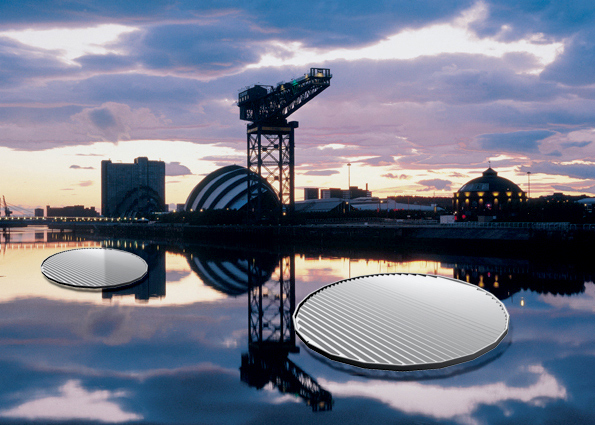
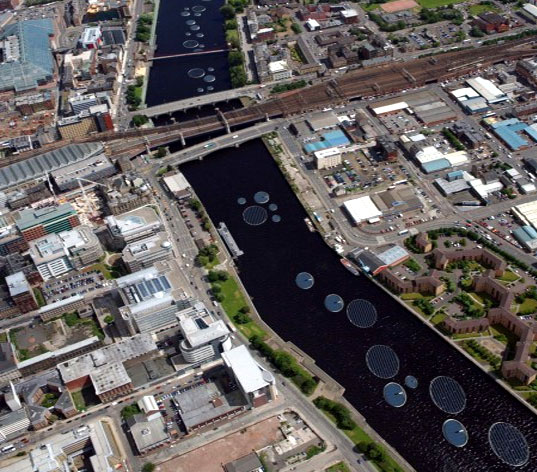
“Solar Lily Pads” by Peter Richardson of ZM Architecture, won an international design competition for its proposal to revive the Glasgow waterfront by integrating solar energy into the urban landscape. Richardson envisioned floating solar panels, tethered to the riverbed in Glasgow’s Clyde River, which would be rotated by small motors to follow the movement of the sun through the sky.
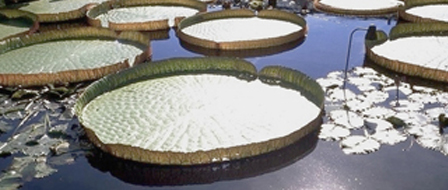
The proposal, whose form was inspired by the lily pad, has been submitted to the Glasgow city council in the hope that it will approve a trial project.
Could the idea work in Israel? Our rivers may be narrow and shady, but we have an abundance of bays, reservoirs and marinas where photovoltaic panels could be integrated into the environment in one way or another.
Take the Mediterranean coastline, for example, along which most of the country’s population lives. Unlike artificial islands (like the one proposed off Tel Aviv), offshore oil rigs or even wind turbines, floating solar collectors would not mar the landscape, and would even add to the sea view if placed close enough to the coast. Picture looking down on Haifa Bay from the Bahai Gardens and seeing a string of pearl-like solar panels floating in the distance.
Creatively designed solar panels floating in Israel’s reservoirs could not only save land, but could also transform technical facilities into interesting places that attract tourists and vacationers.
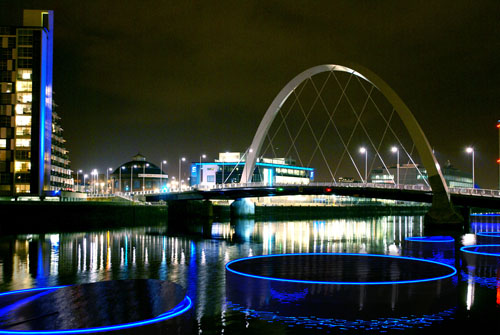 Eilat’s waterfront promenade, circa 2020?
In the past, technologies were created with built-in flaws (pollution, ugliness, noise) that we just had to live with, for lack of a better alternative.
Today, not only can we develop clean technologies that do not pollute our environment, we can actually design them so that they enrich the way we experience places.
Our decision-makers and technocrats have not yet realized this, and still relate to infrastructure as a necessary evil – something which creates negative externalities that must be minimized as much as possible. It’s our job to convince them that we can have our cake and eat it too.
Via:: Landscape + Urbanism, BBC, Inhabitat
Images Via:: ZM Architecture




Jesse!
Good Question! The answer – time will tell (i hope so)
That’s great news, about solar energy. I know about a company who builds many houses, with solar panels.
On July 14, Hamptons Luxury Homes, a company who builds large houses on Long Island, issued a press release which states that two of its employees completed a course, about “green” building, that was taught by the National Association of Home Builders.
The release is below. If you want more information about Hamptons Luxury Homes, to learn how their houses help the environment, please email or call me. My email address is [email protected]. My number is 312-943-1100.
Hamptons Luxury Homes Announces the Certified Green Professional Designation Earned by Two Telemark Professionals
July 14, 2008 8:30 AM ET
Hamptons Luxury Homes HLXH today announced that two employees of its wholly owned subsidiary, Telemark, Inc., have been awarded the Certified Green Professional designation from the National Association of Home Builders. Tim Dalene and Robert Morsch, both of Telemark, Inc. have completed the educational requirements and have been notified by the The NAHB University of Housing in Washington, DC that they have been approved for graduation.
“We are very proud of this accomplishment by Tim and Bob,” said Roy Dalene, president of Hamptons Luxury Homes. “They are both very much involved in our Hamptons Green Alliance program and as such this designation reinforces our commitment to supporting and encouraging green building practices.”
The National Association of Home Builders describes its designation in this way: the “Certified Green Professional designation recognizes builders, remodelers and other industry professionals who incorporate green building principles into homes – without driving up the cost of construction. Class work leading to the designation provides a solid background in green building methods, as well as the tools to reach consumers, from the organization leading the change to provide market-driven green building solutions to the home building industry.”
Frank Dalene, president of Telemark, Inc. said: “Telemark and Hamptons Luxury Homes have been committed to green building for many years – even before it became as popular as it is today. As a result, we have also been instrumental in bringing others in our industry together to form the Hamptons Green Alliance to further educate the consumer as well as provide a forum for members of the building and renovation industry in the Hamptons to come together and share information.”
Hamptons Luxury Homes (www.hlxhomes.com) is a regional construction services company that builds and maintains custom homes, luxury vacation homes and ultra-luxury estate homes throughout the eastern end of Long Island, New York, with its principal offices located in Bridgehampton, New York. The Company’s wholly owned subsidiary, Telemark Inc. is a nationally recognized and award winning ultra-luxury homebuilder. The Company maintains an industry leading reputation for construction of luxury vacation homes from foundation to completion, with values ranging up to $60 million. Hamptons Luxury Homes combines ultra-high quality materials with superb old-world craftsmanship to create the ultimate in luxury homes with outstanding aesthetic appeal. Already a recognized and well-established entity in the exclusive environs of the Hamptons on Long Island, the company intends to expand into similar luxury markets in the United States. The Company’s other wholly-owned subsidiaries include: Telemark Service and Maintenance, providing ongoing property management, maintenance and service; Bridgehampton Lumber Corp., supplying building material and an independent dealer of The Barden & Robeson Corporation; DWD Construction Services, Inc. which performs construction administration and advisory services in connection with the construction of homes and business development of major commercial projects. Telemark Inc. is a 50% partner in Architectural Woodwork of the Hamptons, LLC, which manufactures and installs custom millwork, custom cabinetry, custom built-ins and furniture. The Company owns a 10% interest in Northway Island Associates, Inc. that is developing a multi-facetted entertainment resort complex in St. Lawrence County, New York. DWD Construction Services is presently acting as the Owner’s Representative for Northway Island Associates.
Certain statements in this news release may contain forward-looking information within the meaning of Rule 175 under the Securities Act of 1933 and Rule 3B-6 under the Securities Exchange Act of 1934, and are subject to the safe harbor created by those rules.All statements, other than statements of fact, included in this release, including without limitation, statements regarding the potential future plans and objectives of the company, are forward-looking statements that involve risks and uncertainties.There can be no assurance that such statements will prove to be accurate and actual results and future events could differ materially from those anticipated in such statements.
Martin E. Janis & Company, Inc.
Bev Jedynak
312-943-1123
[email protected]
Copyright 2008 Business Wire