Israeli Households to Get Paid for Producing Solar Electricity

Yesterday was much like any other summer day in Israel: sunny, hot and dry.

But for Alon Tamari, CEO of SolarPower Israel, it is not one that will be forgotten in a hurry: “It’s a historical day, there’s no other way to put it.” Along with the summer heat came the long-awaited announcement that the government will be offering financial incentives to Israeli households who produce their own clean electricity via solar panels.

“The Government started speaking about it three or four years ago and we expected the regulation in one or two years,” Tamari told Green Prophet at the Cleantech 2008 exhibition. “I’ve got 700 grey hairs since then,” said Tamari, pointing to his head. Earlier in the day at Cleantech, the Public Utilities Authority confirmed that they will be offering 20-year contracts with households to buy their solar electricity from them for NIS 2.01 per Kilowatt, which means saying “goodbye” to electricity bills and “hello” to a cheque each month from the Israel Electricity Company.

Tamari and other in the Israeli solar power sector told Green Prophet that most Israelis using solar electricity to date are doing so for ideological reasons but the high cost of installing photovoltaic cells – anything from NIS 70,000 upwards for an average family – has put the brakes on growth to date. “Many people have told us in the last few months that they are just waiting for the government to sign,” said Gilad Paldi, marketing director of Go Solar, the Israeli subdivision of California-based Ronco Electric.

The latent demand could be set to be released as the financial incentives mean that investment can be returned in under 10 years from the money saved on electric bills. But there’s just one catch. The Public Utilities Authority has decided that this is a limited-offer and will not buy solar electricity for more than seven years, or a total of 50 Megawatts (50,000 Kilowatts), whichever comes sooner. If an average home uses 2 to 3 Kilowatts, I’ll leave it you do the maths with your solar-powered calculator…

:: Israeli Public Utilities Authority announcement (Hebrew).

Related Prophecies: Israel’s 12th Annual Cleantech Exhibition at Airport City and JTA Covers Cleantech and Israel-Diaspora Relations.


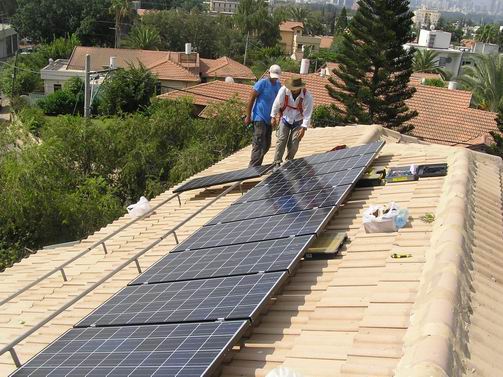
Photo: SolarPower Israel panels on a Tel Aviv roof.

Michael Green
Michael Greenhttps://www.greenprophet.com/
Born into a family of auto mechanics and engineers in east London’s urban sprawl, Michael bucked the trend and chose a bicycle instead of a car. A relative newcomer to Jerusalem, he works as a freelance journalist writing for the Jerusalem Post and other publications. Before moving to Israel, he worked for an environmental NGO in England where he developed a healthy obsession with organic vegetables and an aversion to pesticides and GMOs. Michael’s surname is pure coincidence. Michael can be reached at michael (at) greenprophet (dot) com.
4 COMMENTS
  1. Yair,

    The (guaranteed) life span of the solar panels is more than 20 years. It is normally considered to be 25-30 years.
    The other component (the inverter) is expected to be replaced in 12-15 years. Its cost is around 10% of the system, and these units are expected to be much cheaper in the future.
    Overall, it is common to chose the components (solar panel and inverter) from a known vendor with a long enough experience. Ask it from your solar system provider.

  2. Yair, you’ll have to ask the companies. But I imagine they must be durable since it takes several years for the large sums needed for the initial investment to pay off.

  3. Anybody know how long these solar panels last. In other words, will the homeowner have to replace them every ten years?
    Just seems too good to be true for Israel…

Comments are closed.

TRENDING

EU startup aiming to generate energy on moon villages

Stepping up to democratize the moon is an EU-funded company, Deep Space Energy, which has just raised more than $1 million USD as a seed fund to help it create energy generators on the moon.

Astro uses AI to help procure land for renewable energy

For oil-rich, environmentally vigilant Gulf states, Astro isn’t just another startup story. It is a blueprint for accelerating an energy transition that is now existential, not optional.

Leading Through a Dual-Energy Transition: Balancing Decarbonisation with Energy Security

Experience in one area of the energy industry isn't enough to guarantee readiness across all the others. That's where a structured program like an MBA in energy can come in. Today's advanced curricula explore energy economics, finance, policy, and strategic management alongside the technical subjects. And when pursuing an energy MBA online, professionals can skill up and retrain without having to step out of the labor market -- an important perk at a time when skilled professionals are already in short supply.

M2PV Capital Targets the American Southwest as Its Launchpad for Off-Grid EV Growth

In the American Southwest, electric vehicles face extreme heat, long travel distances, and limited grid access that expose the real infrastructure gaps behind the EV transition. M2PV Capital is building off-grid charging and power systems designed to operate independently in the region’s most demanding conditions.

What Renewable Energy Means for Long-Term Environmental Planning

In the context of American energy policy (setting the stage for the world as oil prices are in USD), the relevance of renewable energy planning is increasingly evident. Federal agencies are preparing final biofuel blending mandates under the Renewable Fuel Standard, with decisions expected early in 2026 after delays that have left investors and producers in limbo.

Turning Your Energy Consultancy into an LLC: 4 Legal Steps for Founders in Texas

If you are starting a renewable energy business in Texas, learn how to start an LLC by the books.

Tracking the Impacts of a Hydroelectric Dam Along the Tigris River

For the next two months, I'll be taking a break from my usual Green Prophet posts to report on a transnational environmental issue: the Ilısu Dam currently under construction in Turkey, and the ways it will transform life along the Tigris River.

6 Payment Processors With the Fastest Onboarding for SMBs

Get your SMB up and running fast with these 6 payment processors. Compare the quickest onboarding options to start accepting customer payments without delay.

Qatar’s climate hypocrisy rides the London Underground

Qatar remains a master of doublethink—burning gas by the megaton while selling “sustainability” to a world desperate for clean air. Wake up from your slumber people.

How Quality of Hire Shapes Modern Recruitment

A 2024 survey by Deloitte found that 76% of talent leaders now consider long-term retention and workforce contribution among their most important hiring success metrics—far surpassing time-to-fill or cost-per-hire. As the expectations for new hires deepen, companies must also confront the inherent challenges in redefining and accurately measuring hiring quality.

8 Team-Building Exercises to Start the Week Off 

Team building to change the world! The best renewable energy companies are ones that function.

Thank you, LinkedIn — and what your Jobs on the Rise report means for sustainable careers

While “green jobs” aren’t always labeled as such, many of the fastest-growing roles are directly enabling the energy transition, climate resilience, and lower-carbon systems: Number one on their list is Artificial Intelligence engineers. But what does that mean? Vibe coding Claude? 

Somali pirates steal oil tankers

The pirates often stage their heists out of Somalia, a lawless country, with a weak central government that is grappling with a violent Islamist insurgency. Using speedboats that swarm the targets, the machine-gun-toting pirates take control of merchant ships and then hold the vessels, crew and cargo for ransom.

Related Articles

Popular Categories