

Arab Spring Countries Face Increased Risk of Food Price Shocks in 2013

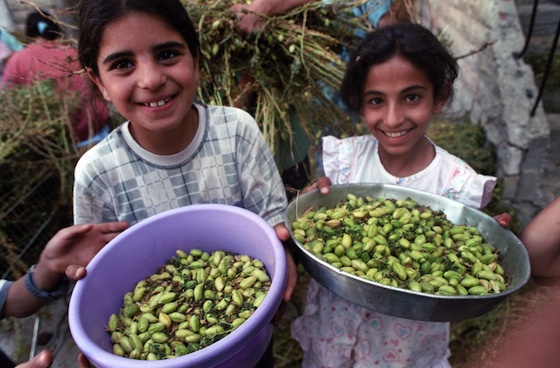
arab girls holding basket of foodAccording to the latest findings by global risk-analyser Maplecroft, Arab Spring countries are at greater risk of rising food prices in the coming year

It’s no secret that the high price of basic food staples were a contributing factor to the revolts which began in Tunisia and Egypt and sparked the ‘Arab Spring’. The protesters took to the streets waving bread and asking for equality and an end to corruption. Today, however, it seems little has changed since those protests in terms of the cost of food. According to the latest food price forecasts for 2013 by global risk-analyser Maplecroft, food prices are actually likely to rise again in the region. What’s more: countries involved in the protests around the Arab world are particularly at risk of rising food price shocks.

“The drivers of the ‘Arab Awakening’ were varied and complex and included long standing public anger at high levels of governmental corruption and oppressive tactics against populations and political opposition,” states Maplecroft CEO Alyson Warhurst. “When these factors combine with food insecurity, sparked by rising global prices, it can create an environment for social unrest and regime change.”

Back in 2007/8, a global food crisis resulted in several food riots across the region including places such as Yemen and Egypt. This year, the tenuous nature of global food security was back on the agenda due to the USA’s worst drought in 50 years and a 10% drop in production across countries from the former Soviet Union. These low crop yields have lead to to a global food price rise of 6% in July 2012. A report by Rabobank, a financial specialist in agro-commodities, estimates that price of food staples could rise by as much as 15% by June 2013, resulting in record high food prices.

“Food price forecasts for 2013 provide a worrying picture,” states Maplecroft’s Head of Maps and Indices Helen Hodge. “Although a food crisis has not emerged yet, there is potential for food related upheaval across the most vulnerable regions, including sub-Saharan Africa.” In the Middle East and North Africa region, the countries at greatest risk include Yemen, Syria and Libya (who along with Iraq are classified as ‘high risk’). Those defined as at ‘medium risk’ of food price hikes include Egypt and Tunisia.

Maplecroft explains that the region remains at elevated risk of food price fluctuations due to its heavy reliance on US and Russians crops. Whilst they are so dependent on cereal imports they wil remain vulnerable to market prices.

The Food Security Risk Index has been developed for governments, NGOs and business to help identify those countries which may be susceptible to famine and societal unrest stemming from food price fluctuations. Maplecroft reaches its results by evaluating the availability, access and stability of food supplies in 197 countries, as well as the nutritional and health status of populations, the organization states.

For more on food prices across MENA see:

Rising Food Prices Behind Riots in Algeria and Tunisia

Arab Protests Affect World Food Prices

How Climate Change Contributed to the Syrian Uprising

Image Arab girls harvesting in Bethlehem via Ryan Rodrick Beiler / Shutterstock.com

Arwa Aburawa
Arwa Aburawahttp://www.greenprophet.com
Arwa is a Muslim freelance writer who is interested in everything climate change related and how Islam can inspire more people to care for their planet and take active steps to save it while we can. She is endlessly suspicious of all politicians and their ceaseless meetings, especially as they make normal people believe that they are not part of the solution when they are the ONLY solution. Her Indian auntie is her model eco-warrier, and when Arwa is not busy helping out in the neighborhood alleyway garden, swap shopping or attempting fusion vegetarian dishes- with mixed success, she’d like to add- she can be found sipping on foraged nettle tea.

Hot this week

Farm To Table Israel Connects People To The Land

Farm To Table Israel is transforming the traditional dining...

The Lote Tree of the Utmost Boundary, explained

In Islamic tradition, there is a point where creation ends — a boundary that marks the limit of what any created being can reach. That boundary is called Sidrat al-Muntahā, often translated as “the Lote Tree of the Utmost Boundary.”

The Air Tea Kettle creates a new way to meet plants and herbalism

Air Tea is a new technology. Instead of drinking tea, you inhale herbal vapor through warm air extraction. There is no water and no combustion. The warm air releases essential oils that are often lost in hot water and digestion.

Why Health Systems Are Reaching a Turning Point

Health emerges from a continuous energy and material flow from water through food to human physiology. Technical energy systems support this cycle through water treatment, agriculture, and infrastructure.

Sustainability That Sells: How Profit and Purpose Come Together in the Hive

Whether you are a commercial grower, hobbyist beekeeper or retail equipment supplier, this system opens a new income stream with minimal environmental impact.

Topics

Farm To Table Israel Connects People To The Land

Farm To Table Israel is transforming the traditional dining...

The Lote Tree of the Utmost Boundary, explained

In Islamic tradition, there is a point where creation ends — a boundary that marks the limit of what any created being can reach. That boundary is called Sidrat al-Muntahā, often translated as “the Lote Tree of the Utmost Boundary.”

The Air Tea Kettle creates a new way to meet plants and herbalism

Air Tea is a new technology. Instead of drinking tea, you inhale herbal vapor through warm air extraction. There is no water and no combustion. The warm air releases essential oils that are often lost in hot water and digestion.

Why Health Systems Are Reaching a Turning Point

Health emerges from a continuous energy and material flow from water through food to human physiology. Technical energy systems support this cycle through water treatment, agriculture, and infrastructure.

Sustainability That Sells: How Profit and Purpose Come Together in the Hive

Whether you are a commercial grower, hobbyist beekeeper or retail equipment supplier, this system opens a new income stream with minimal environmental impact.

The Fitness App Revolution: Building the Future of Wellness Through Strategic Development

In an era where smartphones are ubiquitous and health consciousness is at an all-time high, the fitness industry has undergone a radical digital transformation. Fitness applications have moved far beyond simple pedometers, evolving into comprehensive wellness platforms that serve as personal trainers, nutritionists, and community hubs right in our pockets.

A Brief History of Basil From India to Italy

Beloved, fortunate, sweet, and royal; an herb with a long and storied history in Asia and across the world. Called by many names, basil has featured in previous Green Prophet articles, so enjoy another serving, a brief history of basil.

How Renewable Energy is Revolutionizing the Way We Power Our World

Solar has become the star of the transition thanks to modular hardware and straightforward installation. It fits dense cities and remote towns alike. Many companies are turning to rooftop arrays and carport systems - and exploring commercial solar installation as a practical way to lock in future savings.

Related Articles

Popular Categories