
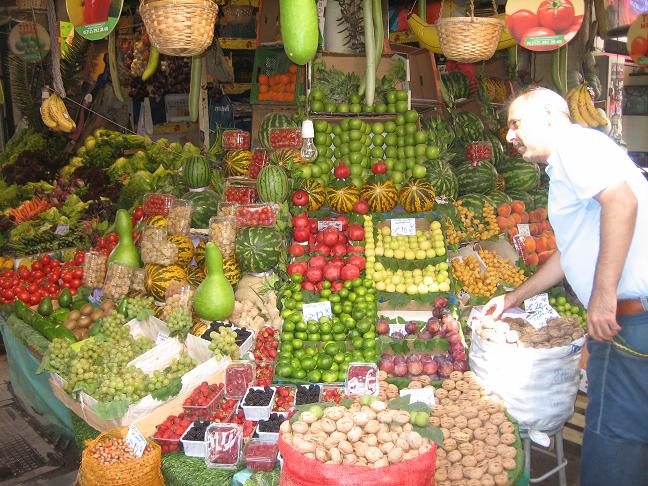

 Fresh produce stands like this one are popular all over Turkey. But these colorful displays contain a toxic blend of pesticides, according to a new Greenpeace report (in German).
Of 76 different fruits and vegetables recently evaluated, Turkish peppers contained the most excessive and dangerous amounts of pesticide chemicals, according to Food Without Pesticides, a new 26-page guide to European food released this week by Greenpeace Germany.
The rotten facts
Turkish peppers topped the list of “most contaminated” produce in the guide, with an average of 24 chemical substances found in the specimens analyzed. In second place, with an average of 10 chemical substances, were Turkish pears. Nine chemical substances were found in Turkish pears, on average, putting them at third place.
Eleven different Turkish crops were rated, using 582 samples. The guide used a green/yellow/red light system to show its ratings, with a red light meaning that more than one-third of the samples had dangerous levels of chemicals in them.
Of all 23 major fruit-and-vegetable-exporting countries that were evaluated in the report, Turkey had the highest number of crops in the “red light” category. The study was conducted using fruit taken from retail and wholesale stores in Europe in 2009 and 2010, but it is unlikely that pesticide use has declined significantly in Turkey since then.
Pregnant women, sick people, and children are especially advised to avoid food in the “red light” category, according to Greenpeace.
Impact on Turkish export market
Agriculture is a mainstay of the Turkish economy, with Turkish fruit and vegetable exports totaling $2.339 billion in 2011 alone, according to Vatan newspaper.
It’s still unclear how the Greenpeace report will affect this sector. The Food Without Pesticides guide has not been translated into English yet, but when it is, many European consumers may think twice about where the produce they buy comes from.
There are certainly potential organic produce exporters that the European market hasn’t yet tapped. Although the current situation makes it difficult to tell whether they’re still functioning, Syria has a very advanced network of organic farms that are ready to being exporting to Europe.
In the long term, the Greenpeace report will hopefully increase pressure on the Turkish government to regulate the use of pesticides more strictly within the country, and provide financial incentives to encourage more organic farming.
After all, pesticides can pose a very immediate threat to human health: just consider the case of the Dubai man who died last August after inhaling poisonous fumes from rabbit pesticide.
:: Greenpeace
Read more about pesticide use in the Middle East:
Rabbit-Killing Pesticide Kills Dubai Man Instead
15 Racing Camels in Qatar Killed By Toxic Pesticide
Former Agriculture Minister brought Carcinogenic Pesticides to Egypt


Curs Valutar Euro Azi Cumparare
Greetings! Very helpful advice within this article!
It is the little changes which will make the most significant changes.
Many thanks for sharing!
There’s no correlation between peppers, pears and grapes from other countries here. This article smacks of German racism to me. Look at the alarmist tone of the article emphasising the specific origin of the vegetables. Genetically modified products from the US could be as harmful as or most likely to be more harmful than those vegetables from Turkey.
Right, so many talk so many comments on the turkish produtcs now, as greece is still tring to recover their economy and they do steal and use turkish products from turkey and labelled under made in greece aswell,infact they will never stop doing a bad marketing on turkish produts, fact they are trying to get some pie from the cake.. been in under europian flag greece taken advantage..
as a turk, i cant deny this fact. true, the agriculture is running out because they are importing seeds from other countries(like israel) and using chemicals to get cheap&huge amount of crops.
Israel also has a really strong organic seed business, so that might not be a bad thing.
Where is the report? From which region(s) in Turkey they took the samples? How many samples did they get? Why the German Greenpeace did a test on Turkish grapes? Why the other, *international* science institutes don’t have the same data? Because none of these is answered, this article really doesn’t mean anything nor that it seems reliable in any way.
Correction: It says they took 582 samples, other questions are still unanswered. Turkey is a big country and it’s important to learn which region(s) they took their samples from. Also, this article was posted in 2012, a year later I still can’t see the data in English.
Elif, your naevity astounds me. As a person who speaks Turkish as a second language even I constantly hear the urban legends about how Turkish aubergines, peppers, tomatoes etc etc continue to grow even after they have been picked, boxed and transported. I am all for reliability of sources, but when are the Turkish population going to wake up to the fact that their local produce is poisoning them with a lot of help from the system?
“In second place, with an average of 10 chemical substances, were Turkish pears. Nine chemical substances were found in Turkish pears, on average, putting them at third place.”
Do you mean grapes had 9 pesticides/insecticides per sample? Learn how to proofread, amateur journalists…
What else could that sentence mean, Dave (though if i may proofread your comment, pears, not grapes)? Seems clear to me. Shocking figure.
Turkey a beautiful country is ignoring such important issues like pesticide/ chemical pollution and this is at the time that all EU countries are going fast to be toxic free with a very good laws and regulations called REACH. Turkey is better to follow these regulations for its food crop productions. I am working regionally on pesticides/ chemicals pollution reduction and regulations for developing countries and would like to help.
Good question, Bill! You can read more about the lingering effects of the Chernobyl meltdown on Turkish produce here: http://www.greenprophet.com/2011/07/post-chernobyl-agriculture-in-turkey-a-sign-of-whats-in-store-for-japan/
I found the article by Julia Harte very interesting.What I have also been reading about Turkey and countries east of the Ukraine is that there is a high concentration of various nuclear elements in the food (Remeber Chernobyl). I was wondering what research,if any,you have been involved with or are aware of regarding this serious issue. The one article I read talked of people being slowly cooked from the inside out as a result of this contamination. I have stopped eating apricots from this region as a result. To bad as they are soooooo good.