
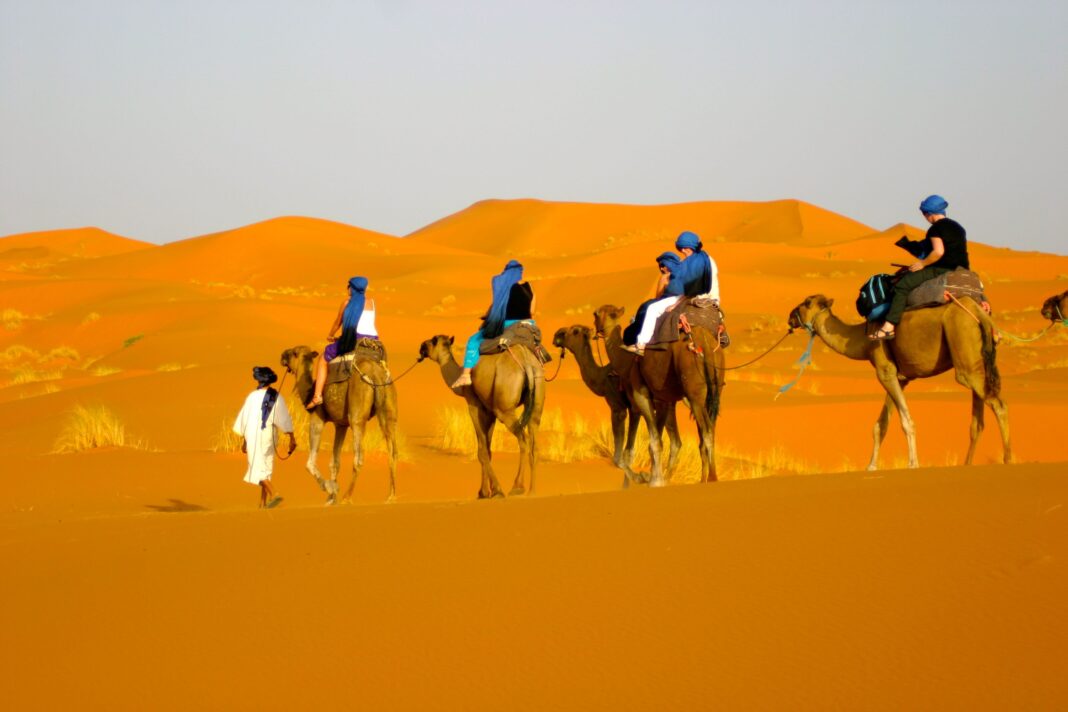

While the Arab world has close ties with their hardy camels, Australia considers their 1.2 million population of wild camels to be nothing more than pests.
Camels are valued in the Arab world for their meat, milk, and leather, but in Australia, more than one million wild Dromedary camels are considered pests. They are also a source of greenhouse gas emissions since each releases one pound of methane into the atmosphere every year. (Read about giant plumes of gurgling methane that could fast track global warming.)
While this doesn’t compare with Australia’s coal pollution, last year Daily Mail reported that the government was considering a proposal to slaughter every single animal in order to “save the planet.” Unhappy with this plan, Helen Durrant with Camel Wool Products started making beautiful apparel of camel wool in order to prove that these animals are a valuable natural resource to be cherished, not culled.
 “Camel wool has some amazing properties,” according to Helen Durrant, who is determined to demonstrate that the world’s largest population of Dromedary camels – about 1.2 million of them in the Australian outback – are not feral pests but a diverse resource. “It is light, soft, warm and luxurious,” she adds.
Baby camels have a particularly soft down that can be converted in a silky soft yarn.
“I love the feel of it in my hands and you will love to wear it,” she says. Occasionally Helen mixes camel wool with a fine merino blend or silk – both of which enhance the properties of her signature apparel including beanies, baby booties, and scarves.
In contrast with the baby’s soft down, older camels have two coats – an outer hairy coat and an inner downy coat – all of which can be used to make durable wool wall hangings, handwoven floor rugs, and tote bags.
Helen explained that her product range is small and everything she makes sells very quickly. “But as everything is hand made I cannot make [them] any faster than my hands will move,” she says.
Given that she has such a small operation, it is unlikely that Helen will have an enormous impact on the Australian government’s decision to cull the country’s burgeoning camel population, which was first brought to the country in the early 1800s. They were used to transport materials used to build a network of roads and railway tracks.
The Central Australian Camel Industry Association Inc (CACIA) was established as an alternative to government camel culling programs, and aims to “promote the sustainable development of the camel industry through the use, knowledge and well-being of camels in Australia.” In part, camels are traded with other countries including Oman and Qatar, and camel meat is processed and sold.
They also sell oil, leather and wool.
More about Camels:
15 Year Old’s Pocket Money Can’t Save Camels Killed by Plastic

Mark,
Although you may not agree with Paddy, you give your arguments little credibility by making disparaging comments on a personal level.
Attempting to discredit another person to elevate yourself simply doesn’t work.
As an outsider, I’ve reached the limit of my common sense solutions. You Australians will no doubt solve your camel problem to the best of your advantage, hopefully. Good luck.
Camels are doing huge damage to our deserts. Waterholes, wildlife and soils are being wrecked by these huge alien creatures. The current cull is the most ecologically responsible option on the table right now: I am amazed so many greens are falling for the disinformation being put about in the name of ‘saving the camels’.
I’m especially saddened to see Paddy McHugh here still spinning the same old tall tales in the hope he will drum up enough support to get his business the vast public subsidy it needs to stay afloat.
He has posted too many red herrings here to tackle them all at once, so I’ll settle for pointing out that his argument is so muddled he isn’t even internally consistent: he claims Desert Knowledge are simultaneously a ‘do nothing’ organisation while they at the same time are setting about slaughtering half a million camels: which is it Paddy? Either they ‘do nothing’ (in which case surely your fantasy camel industry’s future is secure) OR they are actively wiping your imaginary business empire’s resource. Make up your mind.
If the camel trade were really such a treasure trove then surely the likes of Paddy with his decades in the trade would have proved it by now many times over. The subsidy needed to get the camel numbers down to a level where they are not having a negative impact on our wildlife through harvest dwarfs the cost of the current cull. Fact is that for a myriad of well-understood reasons the camel industry will always be a sideshow. If Paddy were to get the vast public funding he wants it would then become just a sideshow propped up year after year by our taxes. At a time when our public services are under huge budget pressure spending our tax to make Paddy a camel baron is clearly ridiculous.
Paddy,
That makes very good sense and I hope enough Australians are reading your comment and spreading the word. Apparently only humans can be the Australian camel’s natural predator to bring back the balance of Nature.
The Australian Wild Camel and its future with the Aboriginal people
I am sure you have already heard of the camel cull that is supposed to be taking place in central Australia.
You may say camel cull and aboriginals, what’s the link…!!
60% plus of all the feral camels run on Aboriginal lands in Australia.
For years the aboriginal people have sought to find an industry that would suit their needs, expertise and social interests and the camel industry meets this and more.
Now this is being taken from them by a small group of people from Ninti One who have not long ago secured 19 million dollars to deal with the so called camel problem.
In actual fact we don’t have a problem, rather we have a gift, that if dealt with in the correct manner it would give the people on the lands a great industry, something they desperately need.
It is hard for me to explain all this in a letter, but here are just a few interesting facts.
70% of Australia’s land mass is classed arid…the camel is the perfect arid animal to harvest and develop, why aren’t we farming or harvesting them..?
We have at present 40 million cattle, 100 million sheep, goodness knows how many donkeys pigs cats and goats and allegedly 1 million camels.
My office through my web page has received over 800 separate enquires from 35 countries in the previous 24 months looking for a whole range of camel products.
Are we missing something or has Ninti One through its very clever manipulation pulled the wool over our eyes to secure this 19 million dollars to prop up their desk top operations and pay themselves large consultancy fees to produce absolutely nothing.
When Ninti One & Desert Knowledge were pushing for the funding to eradicate with the gun some 650,000 camels, I believe they thought no one would care or even notice for that matter, after all the camels roamed the ‘ out of site out of mind’ areas of this country and they saw this as a good way to secure funding to run theirs do nothing organisation.
The science for these very expensive reports is not based on credible information but scare tactics being the order of the day.
The reality is there is no way in the world they will be able to shoot that many camels and if they don’t, there is no way in the world they will reduce the camel numbers.
They have carried out some culling and the outcome of this was the spreading of Botulism, this left unchecked could have a major effect on the cattle industry.
If there is a camel problem and as I say I don’t believe there is, the only way to fix it is through the development of a commercial outcome.
I would like to see the money they have been allocated redirected into the development of the commercialisation of the Australian camel industry in which aboriginal people could play a major role.
What they are doing is morally wrong and an absurd waste of money and resources.
Once again the Aboriginal communities are going to get spat out into oblivion all because of greed and a lack of vision.
I have been involved in the camel industry and worked with aboriginal people for 35 years and I have never seen such desperation and despair as they are facing at present.
Thank you for taking the time to read this, there is a lot more to this unfolding story and I would love the opportunity to speak with you further about it.
The photos in the text give you an idea, some show how the great minds want this so called problem fixed…..and we call ourselves a clever country..!!
One of the leading vets on camel science in the world, Dr. Alex Tinson calls the camel “The Animal of the 21st Century”. Because of their huge potential in world food security……….Paddy McHugh.
…perhaps a couple hundred years isolated in Australia has left them inbred and lazy on the other hand……inbred and lazy can still be Blessed from God and beautiful…whatever. I want a camelhair sweater now…hehehe. Great job camel lady!!!
I have heard Austrailian Camels are prized for their strength and valueable as a trade commodity used for breeding in the Middle East to strengthen their somewhat inbred and lazy species of camel forefathers. Perhaps the source that told me that didnt know what he was talking about….it makes since to me though. In mosts places camels are indigenous to (at least the ones I have known) you dont find wild camels anymore…I imagine they are beautiful.
Unlike the Arab World where the desert itself has a population-limiting effect on that camel population, the Australian Outback is not a complete desert so, absent any natural predators, that camel population has exploded. So, maybe the Australians should develop a tradition of herding and using their camels similar to the Arabs. But even that won’t stop the spread of camels everywhere in Australia’s Outback. So, aside from Man, who would be their natural predator? Apparently not the dingo.