Yemen Running Dry As Water Shortage Reaches Extreme Levels in Africa and the Middle East

For years now, Green Prophet has been reporting on the growing water shortage situation in Africa and the Middle East and its economic and geopolitical implications. However, the scale of the problem and the need for urgent international coordination to secure this basic commodity is becoming more urgent today as stories and pictures from Yemen warn of an inevitable social collapse in the middle of political uncertainty.

According to a recent report from Maplecroft, the Gulf nations are among the countries with the least available water per capita. The “water stress index identifies areas of water stress by calculating the ratio of domestic, industrial and agricultural water consumption, against renewable supplies of water from precipitation, rivers and groundwater.

In a new ranking of 186 countries, the water stress index rates 17 countries as ‘extreme risk,’ with the Middle East and North African (MENA) nations of Bahrain (1), Qatar (2), Kuwait (3) Saudi Arabia (4) Libya (5), the disputed territory of Western Sahara (6), Yemen (7), Israel (8), Djibouti (9) and Jordan (10) topping the ranking.

Meanwhile, the population of the Middle East is expected to double to over 600 million in the next four decades. Add to that the changing climate change patterns expected to cause increased drought and flooding, and the water shortage situation is predicted to become more intense and permanent than past water shortages.

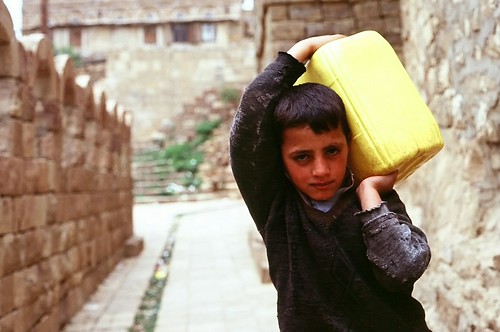
But of all counties in the region, the one coming closest to running dry is Yemen. As reported by Green Prophet recently, the food situation has been exacerbated by months of fighting to overthrow the current president Ali Abdullah Saleh. Directly linked with the food insecurity is the water shortage as agriculture is the primary use of water.  Past predictions that Yemen may be the first country to run out of water are no longer implausible. According to a report drawn up by the Washington Centre for Strategic and International Studies, within six years the city of Sana’a will have run out of water completely.

Other recent reports confirm that 19 out of the nations 21 aquifers are no longer being replenished. Consumption in the Yemeni capital exceeds by a factor of four the amount of water fed back into the underground reserves by local rainfall. Tap water is available only once every four days in Sanaa, a capital of 2 million people, while in Taiz, a southern city, tap water is available only every 20 days. Meanwhile nearly half of all Yemenis live under the poverty line set by the World Bank at $2 per day and don’t have access to proper sanitation, with more than 50 percent of children said to be malnourished.

The crisis is blamed on a number of factors, including inefficient irrigation techniques, increase in domestic consumption (the population of the region is set to double, from 24 to 48 million, over the next 17 years), corruption and poor resource management policies.

The problems created by the shortage of food and water in Yemen are exacerbated by the population’s dependence on qat, an extremely profitable crop which requires extensive irrigation and is so widespread that it takes up some 40 % of the country’s water resources.

While other “ water-deficit” counties like the UAE and Saudi Arabia can afford to invest in desalination plants, build underwater reservoirs, or buy land from other countries to secure food for their own people, in the long run these countries are as sensitive to the effects of depleting aquifers and declining home grown food production as Yemen. But time is running out faster for Yemen.


image: Flikr

Related Stories:

Syria Suffers Water Shortage- More News on Middle East Drought

In the face of “Nile-lessness” Egyptians Protest Water Shortages


Rola Tassabehji
Rola Tassabehjihttp://www.grenea.com
A global citizen, of Lebanese origin, Rola began her career in Unilever Arabia and from there moved into several roles in the marketing/communication function in Unilever, including: Brand Manager Skin Care, Unilever Arabia; Brand Development Manager, Dove, Unilever Africa, Middle East, and Turkey; and Communication Manager for Unilever North Africa and Middle East. After ten years with Unilever, she relocated to Abu Dhabi with her family and joined the team that launched INSEAD Middle East. She is currently working as Marketing Director of a new start-up, Grenea (www.grenea.com), focusing on building sustainable real estate development projects in emerging markets. After working with multi-nationals on skin care and business education, she has found a new interest in the convergence of environmental and social justice and is passionate about the possibilities that a restorative resource-based economy can bring to the people of the Middle East. Email [email protected]

TRENDING

Forever chemicals banned from Europe’s drinking water

The EU is taking a bold step in making sure all European Union member states worked to monitor and reduce PFAS levels in drinking water.

Elon Musk to create Mars base station on the Moon

For those unaware, SpaceX has already shifted focus to building a self-growing city on the Moon, as we can potentially achieve that in less than 10 years, whereas Mars would take 20+ years.

Astro uses AI to help procure land for renewable energy

For oil-rich, environmentally vigilant Gulf states, Astro isn’t just another startup story. It is a blueprint for accelerating an energy transition that is now existential, not optional.

Sink holes from over-watering farmers’ fields

Sinkholes are rapidly appearing in Turkey’s central Anatolian farming region, particularly around Konya and Karapınar. These giant gaping holes in the ground in areas of farmland, known locally as obruk, are not random geological events. They are linked to prolonged drought, climate-driven heat stress, and heavy groundwater extraction for agriculture in one of the country’s most important breadbaskets.

Oil pollution in Basrah’s soil is 1,200% higher than it should be

Soil pollution levels in parts of Basra are 1,200% to 3,300% higher than those typically measured in cities like Toronto or New York, according to new comparative soil data. It's getting into water.

Turning Your Energy Consultancy into an LLC: 4 Legal Steps for Founders in Texas

If you are starting a renewable energy business in Texas, learn how to start an LLC by the books.

Tracking the Impacts of a Hydroelectric Dam Along the Tigris River

For the next two months, I'll be taking a break from my usual Green Prophet posts to report on a transnational environmental issue: the Ilısu Dam currently under construction in Turkey, and the ways it will transform life along the Tigris River.

6 Payment Processors With the Fastest Onboarding for SMBs

Get your SMB up and running fast with these 6 payment processors. Compare the quickest onboarding options to start accepting customer payments without delay.

Qatar’s climate hypocrisy rides the London Underground

Qatar remains a master of doublethink—burning gas by the megaton while selling “sustainability” to a world desperate for clean air. Wake up from your slumber people.

How Quality of Hire Shapes Modern Recruitment

A 2024 survey by Deloitte found that 76% of talent leaders now consider long-term retention and workforce contribution among their most important hiring success metrics—far surpassing time-to-fill or cost-per-hire. As the expectations for new hires deepen, companies must also confront the inherent challenges in redefining and accurately measuring hiring quality.

8 Team-Building Exercises to Start the Week Off 

Team building to change the world! The best renewable energy companies are ones that function.

Thank you, LinkedIn — and what your Jobs on the Rise report means for sustainable careers

While “green jobs” aren’t always labeled as such, many of the fastest-growing roles are directly enabling the energy transition, climate resilience, and lower-carbon systems: Number one on their list is Artificial Intelligence engineers. But what does that mean? Vibe coding Claude? 

Somali pirates steal oil tankers

The pirates often stage their heists out of Somalia, a lawless country, with a weak central government that is grappling with a violent Islamist insurgency. Using speedboats that swarm the targets, the machine-gun-toting pirates take control of merchant ships and then hold the vessels, crew and cargo for ransom.

Related Articles

Popular Categories