More Signs Of Dubai’s Foul Ecology At Jumeirah Islands

jumeirah-islands-dubai
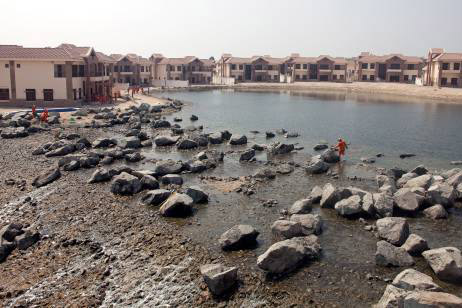
An ecological disaster in their own right, Dubai’s Jumeirah Islands’ environmental record is sinking deeper with this algae-choked lake.

Tourists are charged $200 a night to stay in this Jumeirah Islands apartment. Residents similarly pay a handsome sum to live at one of Dubai’s much-touted artificial palm islands. Within the last few years, despite warnings from environmentalists, people flocked to snatch a share of this exclusive, sinking, erosive man made island. And already, they are beginning to experience the side effects of such an ecological calamity.

Dubai’s daily, The National, followed up on residents’ year long complaints that the algae-choked lake surrounding Jumeirah Island emits a foul odor and attracts mosquitoes after the developers, Nakheel, failed to follow through on their promises to improve the situation. The paper submitted water samples to an independent laboratory which confirmed that levels of ammonium, as well as dissolved and suspended solids, are considerably higher than permitted by the municipality.

Carol Huang reports that the Jumeirah lake has ammonia levels of 17.4 milligrams per liter, which is three times higher than Dubai’s established municipal standards.

“Nakheel, which developed and maintains Jumeirah Islands, said the test results did not indicate a threat to residents,” according to the paper.

“Whilst we cannot comment on a particular sample … in any event, the ammonia level cannot cause risk to humans,” a spokesman said.

In addition, the accredited independent laboratory Inspectorate International, which has 200 branches scattered throughout the world, reported total dissolved solids to exist at levels that are 30 times higher than the permissible 1,500 milligrams per liter.

It could be the 50,400 milligrams of dissolved solids that are clogging pipes which are supposed to circulate the water, which is drawn directly from the Gulf.

The now stagnant water is full of both green and white algae, and residents complain that it attracts many mosquitoes, though the laboratory tests did not reveal any mosquito larvae.

Residents first reported the problem to the developers one year ago, to which the latter issued a written response.

“The lake rectification works are proceeding. The water quality continues to improve and salinity levels are increasing which in turn results in the natural eradication of the algae,” the letter said.

Clearly, no such rectification has occurred, even though experts claim that it would not be difficult to restore the lake’s quality.

“If they had enough mixing of the water, the whole problem could be solved very easily. It’s not an ideal situation from a health point of view. Obviously it will be uncomfortable,” Walid Saleh, the regional co-ordinator of United Nations University and an expert at its Institute for Water, Environment and Health, told The National.

The municipality declined to comment.

Though Nakheel claims the problem’s source lies beyond Jumeirah, this latest event further demonstrates the developers’ lack of commitment to environmental integrity.

:: The National

More on artificial islands in the UAE:
Coastal Erosion Threatens Evolutionary Hotspots In Gulf Region

Durrat Al Bahrain Artificial Islands – “A Place Like No Other”

Mega Urban Developments In Gulf Region A Natural Disaster Waiting to Happen

Tafline Laylin
Tafline Laylinhttp://www.greenprophet.com
As a tour leader who led “eco-friendly” camping trips throughout North America, Tafline soon realized that she was instead leaving behind a trail of gas fumes, plastic bottles and Pringles. In fact, wherever she traveled – whether it was Viet Nam or South Africa or England – it became clear how inefficiently the mandate to re-think our consumer culture is reaching the general public. Born in Iran, raised in South Africa and the United States, she currently splits her time between Africa and the Middle East. Tafline can be reached at tafline (at) greenprophet (dot) com.
3 COMMENTS
  1. there was a similar problem at one of the Palm projects – sea water could not circulate . How on earth they expected a land locked project with no water flow not to become stagnant is remarkable

Comments are closed.

Hot this week

Why Health Systems Are Reaching a Turning Point

Health emerges from a continuous energy and material flow from water through food to human physiology. Technical energy systems support this cycle through water treatment, agriculture, and infrastructure.

Sustainability That Sells: How Profit and Purpose Come Together in the Hive

Whether you are a commercial grower, hobbyist beekeeper or retail equipment supplier, this system opens a new income stream with minimal environmental impact.

The Fitness App Revolution: Building the Future of Wellness Through Strategic Development

In an era where smartphones are ubiquitous and health consciousness is at an all-time high, the fitness industry has undergone a radical digital transformation. Fitness applications have moved far beyond simple pedometers, evolving into comprehensive wellness platforms that serve as personal trainers, nutritionists, and community hubs right in our pockets.

A Brief History of Basil From India to Italy

Beloved, fortunate, sweet, and royal; an herb with a long and storied history in Asia and across the world. Called by many names, basil has featured in previous Green Prophet articles, so enjoy another serving, a brief history of basil.

How Renewable Energy is Revolutionizing the Way We Power Our World

Solar has become the star of the transition thanks to modular hardware and straightforward installation. It fits dense cities and remote towns alike. Many companies are turning to rooftop arrays and carport systems - and exploring commercial solar installation as a practical way to lock in future savings.

Topics

Why Health Systems Are Reaching a Turning Point

Health emerges from a continuous energy and material flow from water through food to human physiology. Technical energy systems support this cycle through water treatment, agriculture, and infrastructure.

Sustainability That Sells: How Profit and Purpose Come Together in the Hive

Whether you are a commercial grower, hobbyist beekeeper or retail equipment supplier, this system opens a new income stream with minimal environmental impact.

The Fitness App Revolution: Building the Future of Wellness Through Strategic Development

In an era where smartphones are ubiquitous and health consciousness is at an all-time high, the fitness industry has undergone a radical digital transformation. Fitness applications have moved far beyond simple pedometers, evolving into comprehensive wellness platforms that serve as personal trainers, nutritionists, and community hubs right in our pockets.

A Brief History of Basil From India to Italy

Beloved, fortunate, sweet, and royal; an herb with a long and storied history in Asia and across the world. Called by many names, basil has featured in previous Green Prophet articles, so enjoy another serving, a brief history of basil.

How Renewable Energy is Revolutionizing the Way We Power Our World

Solar has become the star of the transition thanks to modular hardware and straightforward installation. It fits dense cities and remote towns alike. Many companies are turning to rooftop arrays and carport systems - and exploring commercial solar installation as a practical way to lock in future savings.

How does one start prepping?

Faced with an extreme winter storm this year, Americans wonder how to be prepared for catastrophe. Miriam has lived through wars in the Middle East - so she's prepared on giving you a guide to prepping.

Fishermen sue tire manufacturers on behalf of the salmon

A federal trial in San Francisco has brought US tire manufacturers, fishing groups, and environmental scientists into court over a chemical most drivers have never heard of — but which scientists say may be silently reshaping aquatic ecosystems.

Listening to Water: Tarek Atoui’s Next Work for Tate Modern

Born in Beirut, Lebanon in 1980 and now living in Paris, Atoui has spent years building instruments that don’t sit comfortably in concert halls. Many of them involve water, glass, and ceramics — materials that react to sound instead of simply producing it.

Related Articles

Popular Categories