
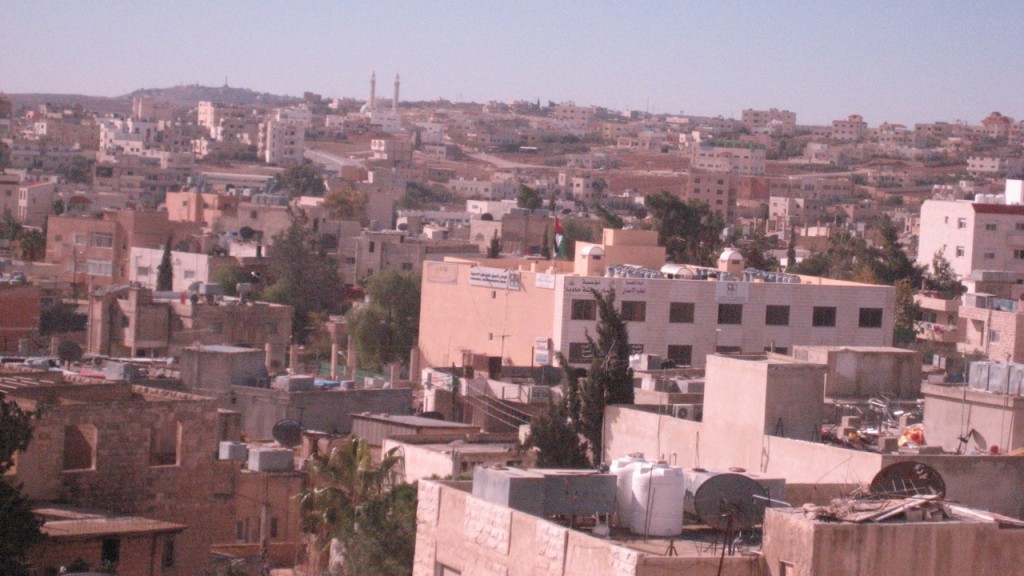


A water conference in Jordan was a call to arms in Arab world to fight water insecurity. Photo: Water tanks on the roofs of buildings in Madaba, Jordan.
There are people in over 17 Arab countries living well below the water poverty line of 500 cubic metres annually, said Arab decision makers from around the Arab world, meeting on water insecurity this past Monday, in Jordan, reports the Jordan Times. They recognized climate change in the Middle East as an issue that will further impact their poorly-available water resources, noting that 75% of the surface water in the Arab world, originates from outside its borders.
Jordan is one of the most water poor countries in the Arab world, and its residents rely on bi-weekly water deliveries to their homes, that fill up tanks located on roofs or in underground wells.
Action to protect water sources in the Arab world is needed now, they appealed, while meeting at a scientific forum on Arab water security. Taking place in Jordan, and organised by the Arab Administrative Development Organization, the experts said new strategies are needed badly to help improve water management in the region, likely to face the brunt of climate change effects.
The game plan?
Strategies are needed to bridge the gap between supply and demand. Meanwhile, Jordan’s Minister of Water and Irrigation Mohammad Najjar said that Arab countries need to band together to protect their resources, while raising public awareness to the issue. He also encouraged sharing water resources, according to the article.
According to environment experts, Arab states face several threats due to increased drought and desertification, scarcity of water resources, increased salinity of groundwater and the spread of pest epidemics and diseases caused by the phenomenon.
So far, climate change has caused a 30 per cent reduction in the Kingdom’s surface water resources, as well as a decrease in the volume of rainfall and agricultural production, both of which the country and the Arab world heavily rely on.
The three-day meeting included water experts from Iraq, Jordan, Oman, the Palestinian Authority, Qatar, Saudi Arabia, the United Arab Emirates and Yemen. It’s a shame that the Arab world continues to purposefully lock Israel out of its round table discussions (at least publicly). A world-leader in water tech exports, cooperation among all Middle East countries, Arab or not, would be beneficial to curbing major foreseeable problems. NATO, for example, is already working to be that bridge, between Jordan and Israel.


[…] has been dumped into outer space. Sad enough to contemplate Earth’s shrinking water resources (see our post about the Arab world’s water crisis) becoming daily more polluted by industries like the Dead Sea Works. The idea of contaminating outer […]
[…] Arab World in Water Crisis […]
[…] even normal weather periods is not exactly flowing with fresh water. In one article we noted acute water crises problems in Middle East countries like Jordan. We’ve explored how Yemen’s capital, Sanaa, may well become the world’s first […]
Residents of Jordan the most water poor nation in Arab world rely on bi-weekly water deliveries to their homes http://tr.im/JQwc #CAGW Ѽ
#Arab countries need to band together to protect their #resources – Jordan’s Minister of #Water http://tr.im/JQwc #PSA #APL #CO2 #Climate Ѽ
It is feared that 75% of the surface #water in the Arab world is about to vanish http://tr.im/JQwc #GlobalWarming #CO2 #Fuel #Climate Ѽ
#ClimateChange will further impact poorly-available water resources in #UAE & Jordan which is the poorest #Arab nation http://tr.im/JQwc Ѽ
#UAE & Jordan recognizes that #ClimateChange as a serious issue for the #MiddleEast http://tr.im/JQwc #Ocean #CO2 #Fuel #ClimateChange Ѽ
[…] The Arab world is in a water crisis. That much we know from this week’s news. To encourage more regional cooperation, Green Prophet has been building on a series of interviews with influential water experts from Israel. In partnership with the Strategic Foresight Group we are gathering information to understand Israel’s water industry from the key players who maintain it. This series is intended to be a tool for policy makers to follow, for journalists to get on-the-ground contacts, and to eliminate some of the controversial mud-slinging at Israel vis a vis its water relations with the Palestinian Authority and its neighbours. […]
RT @newzealandbirds: RT @GreenProphet Arab World in Water Crisis http://www.greenprophet.com/2010/01/05/15665/arab-world-water-protection/
RT @GreenProphet Arab World in Water Crisis http://www.greenprophet.com/2010/01/05/15665/arab-world-water-protection/
#water Shortage in #Mideast, a sign of the future in many nations. water tanks on buildings etc. sounds normal. http://tinyurl.com/yg49s6q
News:: Arab World in Water Crisis, Reports Jordanian Journalist http://www.greenprophet.com/2010/01/05/15665/arab-world-water-protection/