Home Blog Page 667

GM's Volt Versus the Renault-Nissan Electric "Better Place" Edition

13

electric car nissan renault Chevy’s Volt Concept Car – Better than Better Place?

In the past year or so, we’ve posted a number of articles dealing with electric cars and the technology surrounding them, especially those being developed by an Israeli company, Better Place, whose total electric version was exhibited at the recent COP 15 Conference on Climate Change in Copenhagen. And if you’ve been reading the news you wouldn’t have missed a recent $350 million investment in the company led by HSBC. So somebody is believing in them.

By this time next year, several types of electric cars are expected to be available to the general public, including General Motor’s new Chevrolet Volt version.

Saudi Arabia Seeks to Join International Renewable Energy Group IRENA

15

saudi arabia irenaWill Saudi Arabia’s IRENA Membership Help Influence  Environmental Change?

Saudi Arabia, a country which still contains much of the world’s remaining petroleum reserves, is now trying to put its environmental “money where its mouth is” by joining the International Renewable Energy Agency (Irena). In an article posted on January 17 in the UAE’s “The National” English news site, Saudi Arabia has expressed interest to join the multinational clean energy organization, headquartered in Abu Dhabi.

Dr. Sultan al Jaber, the chief executive of Masdar, Abu Dhabi’s clean-energy firm, said IRENA, as the energy agency is known, had received “official notification from Saudi Arabia to become a signatory state.” 

During the IRENA meeting, which preceded the opening of the 2010 World Future Energy  Summit, also held in Abu Dhabi,  Dr al Jaber said that he hopes that he will receive official word from Saudi Arabia that it will agree to become a member of IRENA within the next three weeks.

Muslim Reflects on Recycling Potential for the Middle East

8

snow uk roadsThe UK snow-in didn’t stop this Muslim woman from recycling. Now she proposes some reasons why the Middle East should start.

Snowy weather affects our recycling: Snow storms, heavy rain and the lack of grit to melt the snow on roads here in the UK delayed garbage collection for most of the country. That has led to a huge piling of garbage, recycling bins and glass bottles in my particular neighbourhood, but that hasn’t stopped me from organising my household rubbish into recyclable groups to reduce waste.

I’m a passionate Muslim environmentalist and strongly believe that individual effort has an impact globally. In this suburban English area foxes and rats are potentially spreading disease since the high number of rubbish bags in people’s gardens are being ripped open and biodegrading. I will have to resort to take my recycling products to local facilities, once the weather improves!

So how does my recycling affect any Middle Eastern country?

Well, plastic recycling is not widely practised in the Middle East. Even though recycled materials are collected, they’re not taken to recycling plants because companies don’t find it economically viable to do so.

Further information from “Recycling in the Middle East” (no longer updated, 2020 – we removed the link) states that plastic collected is used as land fillers but after 30 or so years the plastic starts to release methane gas, a very dangerous greenhouse gas with high global warming potential.

Why recycle?

• For every ton of paper that is recycled, at least 30,000 litres of water is saved.
• Around 3,000 to 4,000 KWh electricity is cut down.
• A reduction of around 95% of air pollution is achieved.

In Islamic culture recycling is a rewarding scheme which bring benefits to both people and the environment. Wasting on the other hand should be avoided as the Quran states: “…Do not waste by excess, for Allah does not love the wasters.” Quran, (6:141)

If I as a Briton can maintain my recycling come rain or snow I know in the long run it will help the planet as a whole.

Future Waste Management Development

I’m glad to know that while the main contributors of global warming – America, China and Russia – are being pressured to act faster, smaller countries who otherwise don’t get voiced are becoming more active in reducing their land waste.

For example the Abu Dhabi Environmental Authority is one company who plan to provide better administration of waste materials in the Emirates with solutions for the treatment of all types of waste materials.

Further, according to the World Bank estimates, billions of dollars will be invested in the environmental sectors in the Middle East over the next ten years.

Image via zaufishan

Is Israel Coming out of The Nuclear Closet by Planning Nuclear Power Station?

6

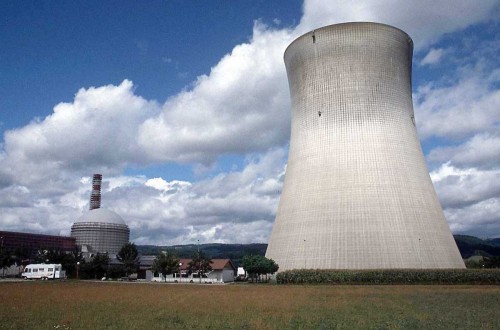
nuclear power station israelCleaner Than Coal? We Doubt it. But Israel mulls nuclear power.

It’s not just Abu Dhabi looking to build a nuclear power plant for generating electricity. According to the business newspaper Globes, Israel is considering building a nuclear power plant of its own in the Negev desert region.

Instead of looking to cleaner energy sources, the Israel Electric Company (IEC) says it is mulling the idea of building  a nuclear fuel power station as an option instead of a coal fueled one.  

Winter Heating Tips

1

With the cold creeping in it is tempting to do all you can, no matter how wasteful, to stay warm. The good news is that you don’t have to be wasteful to be warm! Typically, energy bills climb in the winter months due to the use of heaters. But if you are cold, and the heater isn’t doing the trick, the trick is not to turn the heater up, but to make sure it can work effectively.
Make sure that you don’t have any drafts. Holes around windows can cause loss of much-needed heat, a little bit of electrical tape around your windows can make a BIG difference. Also, proper insulation is a great investment. While the initial price might be steep, what you save of electricity will cover it in the long run. If you can’t replace your windows for double paned, consider covering them, curtains, can do a great job.

Finally, make sure that your heating system is running efficiently. If you are going with a space heater, some models need less energy than others. If you have central, have a technician come at the beginning of the season. A small maintenance bill can save you the cost of replacing the whole unit!

Happy winter!

Recipe: Reap Your Wild Oats To Make Nourishing Oatstraw Tea

29

wild oats recipeCalcium and mineral-rich oatstraw tea nourishes, soothes – and stimulates.

Wait – that’s supposed to be “sow your wild oats” – isn’t it?

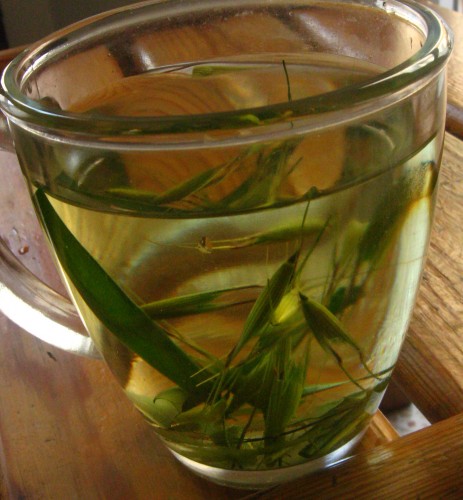
It makes more sense to reap them. At this time of year in the Middle East, native Avena sterilis sends up its nodding seed heads in empty lots, fields, and neglected gardens everywhere. All you have to do is yank up a handful, stalk, leaves, seeds and all, and bring it home to make tea. The oat kernels hidden inside the bearded husk are tender and difficult to extract by hand, but the good news is, you can cut up an entire stalk (minus the root), take this oatstraw and brew a nourishing tea out of it.

How is oatstraw tea good for you? This home remedy is rich in calcium and the minerals and vitamins that nourish bones (helps prevent osteoporosis). It helps to stabilize blood sugar. Nowadays people know that when you eat the grain as oatmeal, you reduce cholesterol and improve blood circulation, but fewer take advantage of wild oats to make the infused tea, which does the same.

My Dream for an Organization that Helps the Homeless and the Environment

8

homeless people garbage middle eastKaren ponders the possibilities of a new social idea to help the homeless and the environment.
Walking down the street this morning, watching a homeless man rummage through the trash for recyclable bottles and cans, I had a dream.  A dream of an organization that helps the homeless while helping the environment.  A dream of an organization with a twofold social and environmental conscience.

What if there was an organization that encouraged the way that the homeless scavenge for recyclable goods?  Though fueled by economic necessity, their actions nevertheless help the environment and should be encouraged.

This could be done in many ways.  Through creating, for example, a one-stop recycling center and soup kitchen where homeless people could bring the cans and bottles that they’ve collected and receive double the normal worth of the returned deposits.  And while they’re there, it would be nice if there was a hot meal waiting for them free of charge, as well.

Or what if there was a way for homeless people to borrow small carts so that they didn’t have to carry around all those bottles and cans in bags slung over their backs?

Israeli NGO Tevel B'Tzedek Helps Rectify Environmental Damage in Nepal

5

Tevel b’Tzedek, an Israeli-based non-governmental organization, defines itself as being “dedicated to creating a new generation of Israeli and international Jews engaged in social and environmental justice by offering them a direct experience of the developing world through study and service internships.”

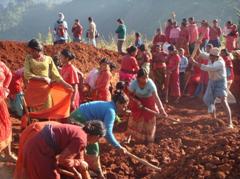
One of their most recent service internships, in the Dunwa Rai fishermen’s community in Nepal, brought 6 young Israeli and American Jews to help 30 local men and women rectify a polluted river situation.  The ecology of the river that the community had fished in for generations was disrupted, and so together all the volunteers dug a pool.

The Tevel b’Tzedek volunteers included a former officer in the Israeli army, an artist from Tel Aviv, and a recent graduate of UC Berkeley in Anthropology.

The project also developed an agricultural education center, and is bringing irrigation, fish farming (aquaculture), a vegetable nursery, greenhouses, bio-gas toilets and more to “a population whose struggle to improve their agricultural yield will mean the difference between whether they will be able to stay on their ancient lands or be forced to migrate to inner city slums.”  The project, then, achieves social improvement through environmental sustainability.

Sunday Solar to Build Large Solar Array on "Damaged" Negev Land

20

Israeli solar energy innovator Sunday Energy has been chosen to construct a solar energy panel array in a section of the country’s Negev desert region, according to an article in Globes financial news.

The 5 mw installation will be constructed together with Moshav Yad Natan in a 120 dunam (42.5 acre) area where the land as been designated as “damaged” or non-usable due to either extensive agricultural use or from erosion. Cost of the project is estimated to be around $26.3 million and will include photovoltaic (PV) solar panel arrays, engineering facilities and water reservoirs to supply the water needed to supply steam for the turbines that will generate the electricity.

Eltel Networks Smart Meters A Good Example for Middle East Countries to Follow

7

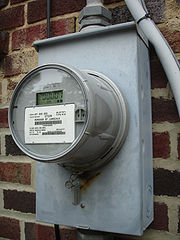
A “Smart Meter” vs The Old Standby

Many experts articles dealing with energy talk about saving energy costs using systems currently in operation.  Such is the case of a Finnish company Eltel Networks who have entered into an agreement with a large Finnish energy company Fortum  to supply more than half a million of these energy saving electricity meters to homes in this Nordic country of 5.4 million people.

The project is the largest of its kind in Finland and will be carried out by 2013. Eltel will start the installations of new smart meter boxes in 2010. The idea of installing these special electricity monitoring devices in businesses and private homes is hoped enable people to save a substantial amount on their electric bills, which can be quite high during Finland’s long and extremely cold winters.

The project is estimated to cost around 120 million Euro and will provide Fortum with real-time intelligence that will revolutionize both the customer relations and operations of its power grid.

World Future Energy Summit: Wean UAE and Other Countries off Fossil Fuel Reliance

18

world future energy summitMasdar City: What Renewable Energy Should Strive For

When the 2010 World Future Energy Summit opened this week in Abu Dhabi, one of the primary goals of this year’s conference was to find more ways to rid the United Arab Emirates and other Middle East countries off their dependence on petroleum as a major energy supplier.

The four day conference opened Monday, January 18 in Abu Dhabi’s convention center, and is being hosted by Masdar, Abu Dhabi’s multi-faceted renewable energy and sustainability initiative.

Dr. Sultan Al Jaber, Masdar’s CEO on the Go Green blog says:

“Abu Dhabi has always strived to be an open global platform for collaboration to promote the adoption of renewable energy and climate change mitigation. With the growing success of the World Future Energy Summit and the International Renewable Energy Agency in Masdar City, Abu Dhabi is quickly becoming the renewable energy hub for both businesses and governments.”

Green Prophet covered last year’s event (the WFES for short), as well as events leading up to this year’s Summit; and all indications show that this year’s conference will be even better, with more than 100 speakers (some of them heads of state) and 3,000 delegates.

Five Edible Wild Plants You Can Pick Yourself

27

Cape SorrelI’d always admired people who eat wild vegetables.  No water gets pumped and no gas is drilled to get those plants to the market. But as an immigrant without a horticultural bent, I needed guidance. Fortunately I had expert teachers:  Green Prophet’s own Miriam Kresh, and Sarah Melamed, who writes Foodbridge. Miriam has taught me about both wild and cultivated plants over the years, and I recently went on a nature hike with both Sarah and Miriam.

I finally feel confident enough to identify some plants that I can collect and eat.

Today I’ll share five easily available, edible plants. In Israel, look in any green spot a lawnmower won’t reach.

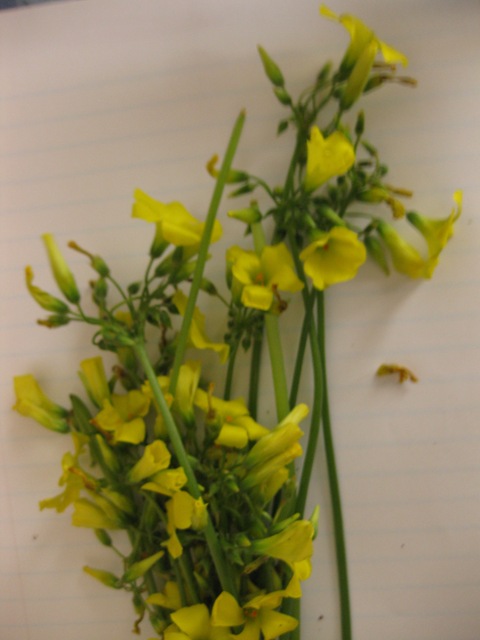
My children, being natives, have known about the one above for a long time. It’s called a chamtzutz or a chamtzitz, and the long stems are tangy and juicy. In English it’s known as cape sorrel.

Make almond blossom liquor with arak or vodka

8

almond blossom

White Almond Blossoms Make A Unique Liqueur

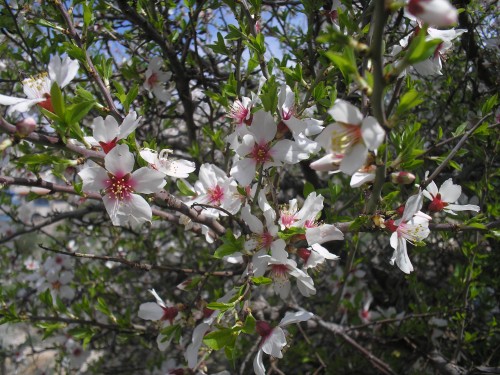
All over the Mediterranean and Middle East, wild almond trees in fields and along highways are becoming clouds of pink and white blossom. They’re the first to bloom at winter’s end. Although rain and dark skies may return a few more times, tentative sunshine warms our faces, and we catch the delicate flowery odor of almond blooms as we stroll under the trees. Our short winter is drawing to a close.

Almond blooms fade away quickly once they have fallen off their branches, but there is a way to preserve their sweetness: make a liqueur. If you live in Israel, it might be ready for this year’s Tu B’Shvat Seder.

First, choose only from trees that have white blossoms. Those are the trees bearing sweet almonds. Pink flowers indicate trees bearing bitter almonds, which contain prussic acid. We don’t know if bitter-almond flowers are toxic as well as the fruit, but better take no chances and stick with the white sweet-almond blooms.

1. First, collect as many white almond blossoms as you can. (Pink almond blossoms are bitter and not suitable.) Spread them out on a clean surface. Check them for insects.

2. Fill a small jar with the flowers – a clean, dry, mayonnaise jar will do – and then pour arak or vodka on top till the flowers are completely covered. Add a tablespoon of sugar and stir. Replace the lid on the jar and put it away in a dark place for two weeks. If you can’t gather a lot of blossoms at once, just cover what you have with arak and continue gathering, adding more liquor and a little sugar each time, till your jar is full.

3. After two weeks, strain your liqueur and enjoy a sip. It’s exquisite.

You can use roses or lemon geraniums flowers, or any sweet-smelling edible flowers instead of almond flowers. Mint, basil, or thyme flowers, or a mixture, are a good base – if you can get enough of them.

More on trees and Tu B’Shvat:
Plant Some Shade
Eco-Rabbi: TuBishvat and the Receiving of the Torah
Celebrate Tu B’Shvat, New Year’s For Trees, Now Jewish Earth Day

Abdulla Carries Natural, Organic Textiles in the Heart of Istanbul's Grand Bazaar

9

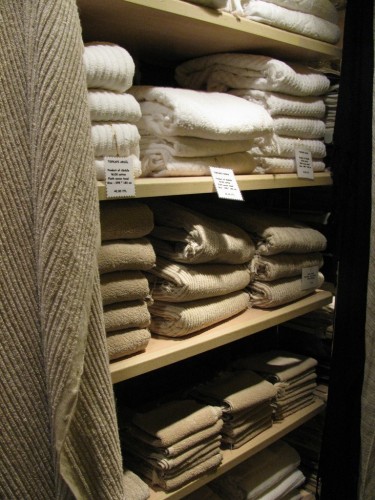
abdulla-natural-products-textiles-istanbulOn a recent trip to Istanbul, Turkey I found myself in a tree-hugger’s wonderland amidst the bustling labyrinth of the Grand Bazaar.

In the heart of this Middle Eastern market, Abdulla Natural Products boasts a wide variety throws, blankets, covers, and shawls, as well as a full line of hamam products, or special towels and washcloths used in Turkey’s infamous baths.  The textiles are 100% natural:  linen, organic cotton, silk, as well as sheep, cow, and goatskins.

Additionally, Abdulla carries organic olive oil and olive oil soaps, honey, and pomegranate syrup, all produced locally and naturally in Turkey (a country which, by the way, is one of the world’s largest growers of organic cotton).

Metin Tosun, Abdulla’s founder and proprietor, opened his boutique shop about 15 years ago.  The original concept was a sort of Turkish delicatessen, where he intended to sell a wide array of local Turkish handicrafts and gourmet foods. 

But as he traveled the countryside searching for quality products, he encountered many small textile producers complaining about their lack of business.

Abuse of Circus Animals in Lebanon Challenges Lack of Legal Framework

19

circus acrobats chinese cirque de soleilMore western countries are banning circuses with animals, and allow only humans to perform. Can Lebanon and the Middle East change their passion for this cruel form of entertainment?

The circus came to town in Beirut Lebanon; but will have to leave in a hurry after it was discovered that animals brought to participate in the events had been terribly abused. As we reported last week on Lions, Tigers and Bears in Lebanon (thanks to the Media Line), a small circus which brought a number of animals into Lebanon to perform there, were subjecting a lion cub and 4 other lions, three tigers, some snakes and a number of domestic animals to very cruel conditions, including keeping them in small, cramped cages, depriving them of adequate food and water, and (in the case of the lion cub) actually de-clawing it and not providing proper veterinary medical attention.

In fact, the poor lion cub, had not only been de-clawed, but was kept in a small, filthy cage, without medical attention to its swollen paws, which had become infected.

The problem reached a stage where the animals should have been confiscated and sent to  a zoo or similar facility where they would receive better treatment. But the laws being what they are in a country that is being increasingly influenced by Islamic Law, in which animals and other aspects of the environment are supposed to receive better treatment, all that could be done was to order the animals’ owner  to leave Lebanon within 24 hours.

Lebanese Agriculture Minister Hussein al-Hajj Hassan declared the circus illegal and ordered its immediate closure after animal welfare campaigners alerted his office to the circus’s mistreatment and incorrect paperwork.

As said by Jason Mier, Executive Director of Animals Lebanon to The Daily Star:

“I would have preferred for the animals to be confiscated and the minister indicated that’s what he would have preferred to do, but the legal framework just isn’t there.”