 Read Green Prophet’s Top Ten Tips to food management from a Muslim perspective
A Muslim’s diet is above ordinary – we are “meat-eating vegetarians” which means if it’s not organic or halal food (lawful in Islam), we practice temporary vegetarianism. Muslims are blessed with grocery stores and local markets therefore life in Britain does not require us to grow our own crops – although, if we did, that would be exciting and nurturing. As an eco-Muslim I have learned to grow my own tomatoes and other herbs, which, with a little know-how is a productive step to improving our lifestyle.
Muslims believe that God has created this planet in harmony, an equilibrium, where there is enough of every resource to provide for every living being. Even the food God provided for people is a “trust” that needs to be consumed in -keyword here- moderation.
But moderation is not our forte, not here in England anyway. We do not check food labels often enough to know what we’re putting into our bodies. We more often than not, opt for ordering out than eating in. A 2008 WRAP Food Waste report stated that British consumers throw away up to 30% of their food; our poor management of food may be a contributing factor. This is also surprising when compared to the current Middle Eastern protests that were spurred on due to the increasing food prices.
While some cannot afford basic green foods, we cannot afford to waste ours. This is why a Qur’anic reminder is set for Muslims:
“It is God Who causes gardens to grow, with trellises and without, and palm trees, and crops of different kinds of food, and olives and pomegranates, similar (in kind) and different (in variety): eat of their fruit in their season, but render the dues that are proper on the day that the harvest is gathered…”
The line following this is our main focus: “Eat – But waste not by excess: for God does not love the wasters.” (Qur’an, 6:141) Thus, eco-Muslim Zaufishan from Green Prophet presents an Action Plan to follow-up the valuable 3R-Principle in eating: Reduce, Recycle, Reuse.
Action Plan
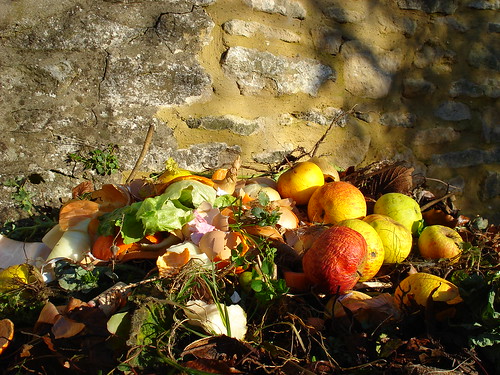
- Do not waste any amount of food, even if it’s expired. If the food is uncooked add it to your compost heap. Crumble stale bread and unwanted nuts together for bird seed.
- Only buy food that you need for that day or week and stick to a budget.
- Plate a little less food for each person. Islamic tradition says to eat in thirds – 1/3 for food, 1/3 for water, and 1/3 for air, strongly implying to be able to move and breathe easily after a heavy meal! Store leftovers for the next day.
- Recycle! Instead of spilling leftover drinks, water your plants. Use airtight lidded storage containers for snacks and reuse drinks bottles to cutback on surplus volumes of packaging.
- Go green and save energy by eating together with family or friends. At a larger gathering you will actually use kitchen appliances fewer times and therefore less energy (power and electricity) than for every individual eating at different times.
- Start a compost heap with peelings, skins, egg shells and worms!
- Donate your extra fresh fruit and tinned foods regularly to charity. The miracle of donation is that there are no losers and you help others.
- Join campaigns or faith groups during their food drives; fast during Ramadan, take part in Lent or embed yourself in Passover to learn the values and eco-traditions surrounding food.
- Use your technology wisely for online grocery shopping – not ordering takeaways! And this takes us onto Top Tip Ten:
- Eat more home-cooked food.
Do you have green food tips? Let us know in the comments section below.
Image:: Flickr
More on healthy eating:
Eating Real Food Can Save The Environment
Jordan Joins The Food Protests As Tunisian President Steps Down
Arab Protests Affect World Food Prices
Ten Tips To Avoid Food Waste On Passover