Scientists discover bacteria’s natural sunscreen

sunshade bacteria

‘Everything in moderation’ is good advice, especially when it comes to sunshine. Humans know this, especially in the Middle East, mastering all means of shading devices, and protective clothing. But what if you are an organism without access to sunscreen? Two scientists at Israel’s oldest university have discovered how bacteria protect themselves from overexposure.

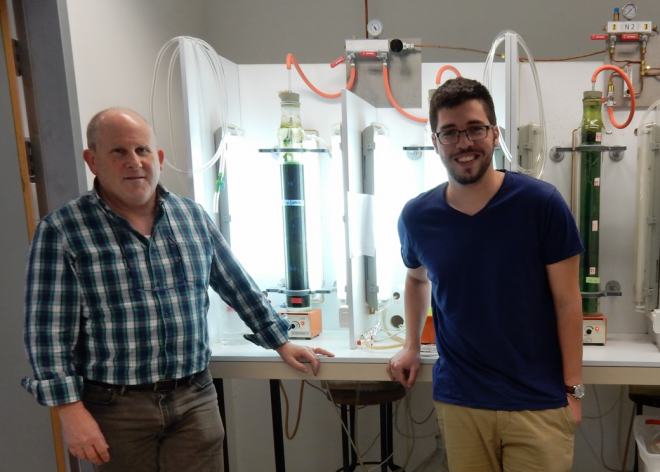
Professor Noam Adir of the Technion – Israel Institute of Technology recently published a study that describes how bacteria protect their photosynthetic system from too much sunlight.

Photosynthesisis is a natural process of converting light energy into chemical energy that can later be released to fuel an organisms’ activities. It is essential to the animal kingdom but not only for organisms that perform photosynthesis themselves; even animals that don’t perform photosynthesis consume the its primary product, which is glucose.

Think back before digital cameras, remember those sensitive rolls of Kodachrome? Just as film could be overexposed, natural photosynthetic systems are also liable to be damaged by too much light, leading to organism death. Scientists have generally accepted that some organisms developed mechanisms to protect from sunlight overexposure. Adir’s study now reveals the specific strategy used by cyanobacteria (commonly known as “blue green algae”). He calls it cyanobacteria’s “automatic sunshade”.
cyanobacteria

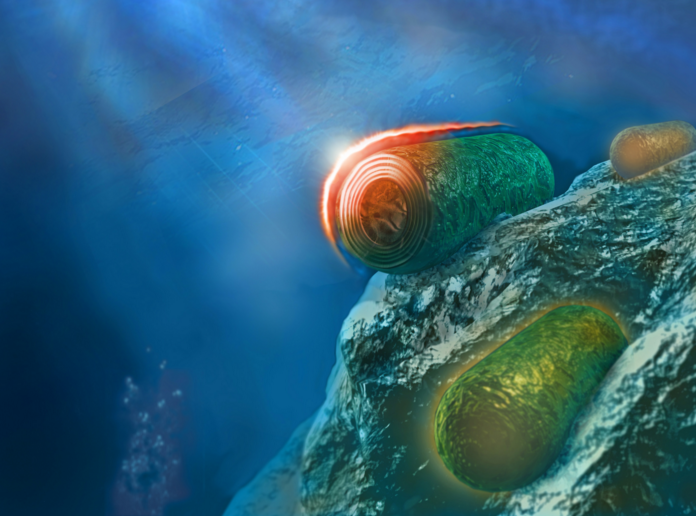
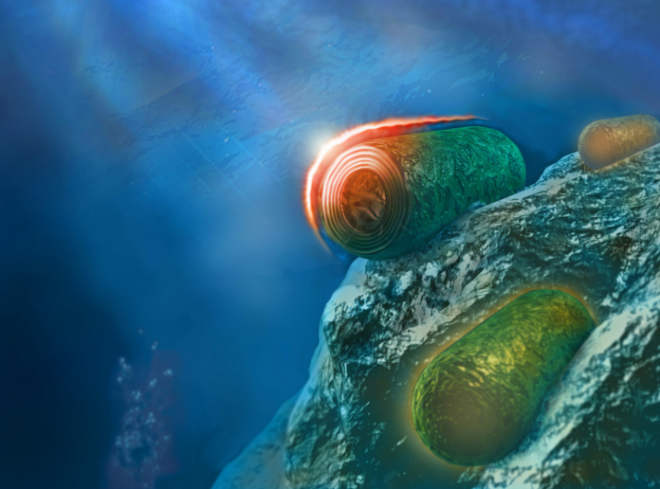
The main player in this process is the protein OCP which modifies its structure and color in response to intense light, blocking the flow of energy that reaches the center of the photosynthetic reaction. This is traced to a reaction between the active species of OCP and phycobilisome (PBS), the protein complex that functions as a light harvesting antenna in the cyanobacteria.

“In this study we discovered how the OCP blocks the energy,” explained Adir, “In effect, the protein acts as a biological switch. In response to strong light, part of the protein penetrates the PBS, and changes the PBS structure, thereby diverting the flow of energy to the reaction centers. According to experiments done by the Kirilovsky lab, this defense mechanism blocks more than 90% of the sun’s radiation. As soon as the radiation diminishes, the protein returns to its normal state and the flow of energy resumes.”

You can read the full findings, (link to the article here).  Research was conducted by Professor Noam Adir and doctoral student Dvir Harris , in collaboration with Dr. Diana Kirilovsky and her laboratory at I2BC-CEA, in France. The article was published in the scientific journal PNAS.

Technion is a public research university in Haifa, Israel, established in 1912. 

LEAVE A REPLY

Please enter your comment!
Please enter your name here

TRENDING

Fans in the toilet slow down poop droplets from making you sick

A new study published in Risk Analysis found that bioaerosol concentrations of two bacteria -- Escherichia coli (E. coli) and Staphylococcus aureus (S. aureus) -- exceeded acceptable levels established by the Centers for Disease Control (CDC) after toilet flushing. Inhaling these biological particles can produce symptoms like abdominal cramps, nausea, diarrhea, and vomiting. 

3 Unexpected Culprits That Cause Mental Health Problems

Mental health disorders are on the rise in the US. Over 1 in 5 adults in America live with a mental condition. Women are at risk of depression, post-traumatic stress disorder (PTSD), and specific phobias that interfere with their daily lives.

Have scientists found a way to make antibiotics resistance-proof?

New research may be able to pump up the potency when antibiotics become resistant: A new antibiotic that works by disrupting two different cellular targets would make it 100 million times more difficult for bacteria to evolve resistance, according to new research from the University of Illinois Chicago.

Seres and Nestle launch a poop pill for your gut biome

Seres Therapeutics Inc. plans to start selling its first FDA-approved product, a drug called Vowst made of bacterial spores derived from donated feces, this summer at $17,500 a course.

Will engineering bacteria save us?

Bacteria may rule the planet and they certainly rule our gut. Will engineering help us or be our downfall?

Qatar’s climate hypocrisy rides the London Underground

Qatar remains a master of doublethink—burning gas by the megaton while selling “sustainability” to a world desperate for clean air. Wake up from your slumber people.

How Quality of Hire Shapes Modern Recruitment

A 2024 survey by Deloitte found that 76% of talent leaders now consider long-term retention and workforce contribution among their most important hiring success metrics—far surpassing time-to-fill or cost-per-hire. As the expectations for new hires deepen, companies must also confront the inherent challenges in redefining and accurately measuring hiring quality.

8 Team-Building Exercises to Start the Week Off 

Team building to change the world! The best renewable energy companies are ones that function.

Thank you, LinkedIn — and what your Jobs on the Rise report means for sustainable careers

While “green jobs” aren’t always labeled as such, many of the fastest-growing roles are directly enabling the energy transition, climate resilience, and lower-carbon systems: Number one on their list is Artificial Intelligence engineers. But what does that mean? Vibe coding Claude? 

Somali pirates steal oil tankers

The pirates often stage their heists out of Somalia, a lawless country, with a weak central government that is grappling with a violent Islamist insurgency. Using speedboats that swarm the targets, the machine-gun-toting pirates take control of merchant ships and then hold the vessels, crew and cargo for ransom.

Leopoldo Alejandro Betancourt López Turned Ocean Plastic Into Profitable Sunglasses

Few fashion accessories carry the environmental burden of sunglasses. Most frames are constructed from petroleum-based plastics and acrylic polymers that linger in landfills for centuries, shedding microplastics into soil and waterways long after they've been discarded. Leopoldo Alejandro Betancourt López, president of the Spanish eyewear brand Hawkers, saw this problem differently than most industry executives.

Why Dr. Tony Jacob Sees Texas Business Egos as Warning Signs

Everything's bigger in Texas. Except business egos.  Dr. Tony Jacob figured...

Israel and America Sign Renewable Energy Cooperation Deal

Other announcements made at the conference include the Timna Renewable Energy Park, which will be a center for R&D, and the AORA Solar Thermal Module at Kibbutz Samar, the world's first commercial hybrid solar gas-turbine power plant that is already nearing completion. Solel Solar Systems announced it was beginning construction of a 50 MW solar field in Lebrija, Spain, and Brightsource Energy made a pre-conference announcement that it had inked the world's largest solar deal to date with Southern California Edison (SCE).

Related Articles

Popular Categories