After America’s fossil water goes dry, will the Middle East follow?

manmade-river-in-Libya-560x357
Ample fresh water supplies for agriculture and drinking by the world’s burgeoning population are becoming more and more scarace these days due to over-consumption and the ravages of global warming and climate change. This has resulted in the need to tap into prehistoric underground aquifers, such as North Africa’s Nubian Aquifer under Libya; and the the Disi and Wasia aquifers Jordan and Saudi Arabia.

Aquifers in other parts the world, containing large amounts of ancient or “fossil water” , are also in jeopardy as these non-renewable sources of fresh water are being exploited by countries with increasing water needs.

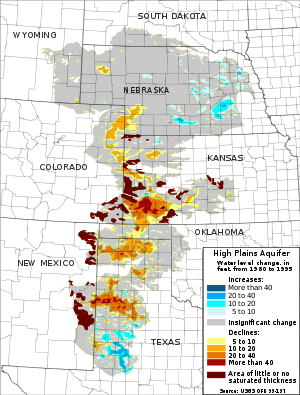
One of America’s largest “fossil water” aquifers is the Ogallala aquifer, which lies under 8 states in America’s “bread basket” wheat growing region; stretching from South Dakota to Texas. This aquifer covers a land area of 111.8 million acres (45.24 million Hectares) and 175,000 square miles (281,635 sq kilometers).

The water in this ancient aquifer is estimated to be at least 10 million years old and created during a period when there was considerably more water in that region; such as during the last great Ice Age. The water trapped in this aquifer in not replenished through annual rainfall; so once it is used up, it’s gone – possibly forever.

Intensive farming in this region has resulted in large amounts of Ogallala water being tapped to grow grains such as wheat, corn and sorghum. These grains provide much needed foodstuffs and animal feeds for people living in the US as well as other parts of the world.

More recently, grains like corn and sorghum have also been used to manufacture biofuels like ethanol. The depletion of water in aquifers like the Ogallala is becoming a big concern to environmentalists who now estimate that most of the water remaining is this aquifer alone will be used up by the year 2028 in areas like Texas and Kansas. These states are now in the midst of one of the worst droughts in recorded history.
300px-Ogallala_changes_1980-1995_svg

If prehistoric aquifers like Ogallala are in danger of being depleted in non-desert regions, it doesn’t take much imagination to figure out what will be fate of fossil water in desert aquifers like those under Jordan, Saudi Arabia and Libya.

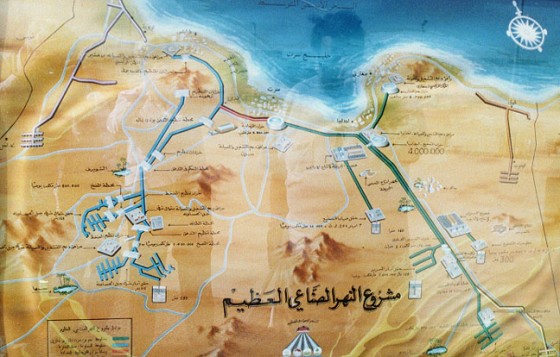
When ex-Libyan leader Muamar Gadaffi began his Great Man-Made River project in 1984, he boasted that the water in the Nubian Aquifer could supply the needs of Libya for “hundreds of years” and turn that country into an agricultural wonder. When the water was created there, animals like elephants, giraffes, wildebeests and other African species roamed that region and were hunted by primitive peoples.

The fossil water in Saudi Arabia’s Disi (part of which is under Jordan) and Wasia aquifers may be even more ancient.

Jordan is now involved in a project to extract large amounts of Disi aquifer water and convey it to Amman in large underground pipes.  It’s only a matter of time before this not replaceable water will be used up as well. There’s no sure solution to the problems of severe water shortages, even with more strict water conservation and recycling of waste water supplies. This appears to be the reality facing many countries; especially those in water scarace regions like the Middle East.

Read more on water scarcity and undergeround aquifers:

Saudi Arabia and Iran Are Exploiting Their Ground Water Supplies

Jordan’s Disi Water Conveyance is on Track; But to Where?

Libya’s Great Man Made River Project Could Stop Flowing

Map of water depletion on Ogallala Aquifer, by NBCNews.com

Maurice Picow
Maurice Picowhttps://www.greenprophet.com/
Maurice Picow grew up in Oklahoma City, U.S.A., where he received a B.S. Degree in Business Administration. Following graduation, Maurice embarked on a career as a real estate broker before making the decision to move to Israel. After arriving in Israel, he came involved in the insurance agency business and later in the moving and international relocation fields. Maurice became interested in writing news and commentary articles in the late 1990’s, and now writes feature articles for the The Jerusalem Post as well as being a regular contributor to Green Prophet. He has also written a non-fiction study on Islam, a two volume adventure novel, and is completing a romance novel about a forbidden love affair. Writing topics of particular interest for Green Prophet are those dealing with global warming and climate change, as well as clean technology - particularly electric cars.

Hot this week

Why Health Systems Are Reaching a Turning Point

Health emerges from a continuous energy and material flow from water through food to human physiology. Technical energy systems support this cycle through water treatment, agriculture, and infrastructure.

Sustainability That Sells: How Profit and Purpose Come Together in the Hive

Whether you are a commercial grower, hobbyist beekeeper or retail equipment supplier, this system opens a new income stream with minimal environmental impact.

The Fitness App Revolution: Building the Future of Wellness Through Strategic Development

In an era where smartphones are ubiquitous and health consciousness is at an all-time high, the fitness industry has undergone a radical digital transformation. Fitness applications have moved far beyond simple pedometers, evolving into comprehensive wellness platforms that serve as personal trainers, nutritionists, and community hubs right in our pockets.

A Brief History of Basil From India to Italy

Beloved, fortunate, sweet, and royal; an herb with a long and storied history in Asia and across the world. Called by many names, basil has featured in previous Green Prophet articles, so enjoy another serving, a brief history of basil.

How Renewable Energy is Revolutionizing the Way We Power Our World

Solar has become the star of the transition thanks to modular hardware and straightforward installation. It fits dense cities and remote towns alike. Many companies are turning to rooftop arrays and carport systems - and exploring commercial solar installation as a practical way to lock in future savings.

Topics

Why Health Systems Are Reaching a Turning Point

Health emerges from a continuous energy and material flow from water through food to human physiology. Technical energy systems support this cycle through water treatment, agriculture, and infrastructure.

Sustainability That Sells: How Profit and Purpose Come Together in the Hive

Whether you are a commercial grower, hobbyist beekeeper or retail equipment supplier, this system opens a new income stream with minimal environmental impact.

The Fitness App Revolution: Building the Future of Wellness Through Strategic Development

In an era where smartphones are ubiquitous and health consciousness is at an all-time high, the fitness industry has undergone a radical digital transformation. Fitness applications have moved far beyond simple pedometers, evolving into comprehensive wellness platforms that serve as personal trainers, nutritionists, and community hubs right in our pockets.

A Brief History of Basil From India to Italy

Beloved, fortunate, sweet, and royal; an herb with a long and storied history in Asia and across the world. Called by many names, basil has featured in previous Green Prophet articles, so enjoy another serving, a brief history of basil.

How Renewable Energy is Revolutionizing the Way We Power Our World

Solar has become the star of the transition thanks to modular hardware and straightforward installation. It fits dense cities and remote towns alike. Many companies are turning to rooftop arrays and carport systems - and exploring commercial solar installation as a practical way to lock in future savings.

How does one start prepping?

Faced with an extreme winter storm this year, Americans wonder how to be prepared for catastrophe. Miriam has lived through wars in the Middle East - so she's prepared on giving you a guide to prepping.

Fishermen sue tire manufacturers on behalf of the salmon

A federal trial in San Francisco has brought US tire manufacturers, fishing groups, and environmental scientists into court over a chemical most drivers have never heard of — but which scientists say may be silently reshaping aquatic ecosystems.

Listening to Water: Tarek Atoui’s Next Work for Tate Modern

Born in Beirut, Lebanon in 1980 and now living in Paris, Atoui has spent years building instruments that don’t sit comfortably in concert halls. Many of them involve water, glass, and ceramics — materials that react to sound instead of simply producing it.

Related Articles

Popular Categories