
A federal trial in San Francisco has brought US tire manufacturers, fishing groups, and environmental scientists into court over a chemical most drivers have never heard of — but which scientists say may be silently reshaping aquatic ecosystems. The case centers on 6PPD, a chemical antioxidant used in nearly all vehicle tires to prevent cracking and extend tire life. When 6PPD on tire treads reacts with ground-level ozone on the road, it transforms into 6PPD-quinone (6PPD-Q), a compound now at the center of a major environmental and legal dispute.
The lawsuit was filed by American fishing organizations, including the Institute for Fisheries Resources (IFR) and the Pacific Coast Federation of Fishermen’s Associations (PCFFA), represented by Earthjustice. Earthjustice is a nonprofit environmental law firm founded in 1971.
The plaintiffs argue that continued use of 6PPD in tires violates the US Endangered Species Act (ESA) because its byproduct, 6PPD-Q, harms protected salmon and steelhead populations. 6PPD-Q is added to tire rubber to prevent cracking and degradation of rubber caused by ozone and oxygen in the air. But fishermen are sure this material is causing toxicity and salmon die-off.
“Fishing families up and down the West Coast of the United States depend on the health of salmon populations for their livelihoods,” said Glen Spain, General Legal Counsel for IFR and PCFFA. “Whether or not this should continue will be up to the Court.”
The defendants are US tire manufacturers, represented collectively by industry counsel. Common US tire makers include Bridgestone, Goodyear, and Michelin and Pirelli.
What the Scientists Testified about 6PPD-Q

The court heard from multiple academic researchers whose work focuses on toxicology, hydrology, and fisheries biology.
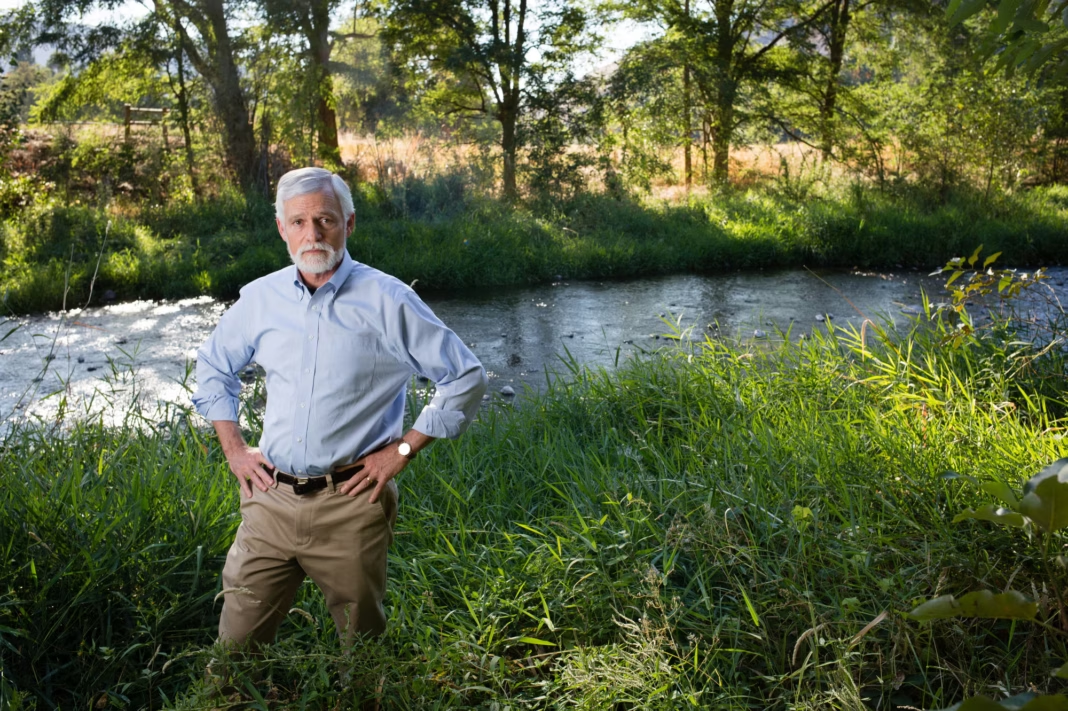
Edward Kolodziej, an environmental chemist and award-winning researcher at the University of Washington, first identified 6PPD-Q in 2021, and testified that the compound is the primary cause of decades-long episodes of mass coho salmon mortality linked to stormwater runoff. His testimony described how cities like Seattle invested millions in creek restoration only to see the salmon continue dying — prompting research that ultimately traced the deaths back to tire-derived chemicals.
Kolodziej emphasized that his findings have since been replicated across regions and methodologies, which he said strengthens the scientific consensus around 6PPD-Q’s toxicity. He also said the tire industry knew about his research.
According to Mavensnotebook, Kolodziej said his team was contacted in 2018 after witnesses documented female coho salmon dying in urban streams before reproducing. His team identified a mortality signature for the chemicals that were present in the water when the fish perished, identifying the majority of the chemicals as derivatives from tire rubber. A 2021 study published by his team concluded that 6PPD-quinone was the primary toxic chemical in Urban Runoff Mortality Syndrome.
“It opened up our eyes that there are a lot of abundant tire rubber chemicals we knew little about,” he said. “Learning more and more about tires could explain this case of mortality.”
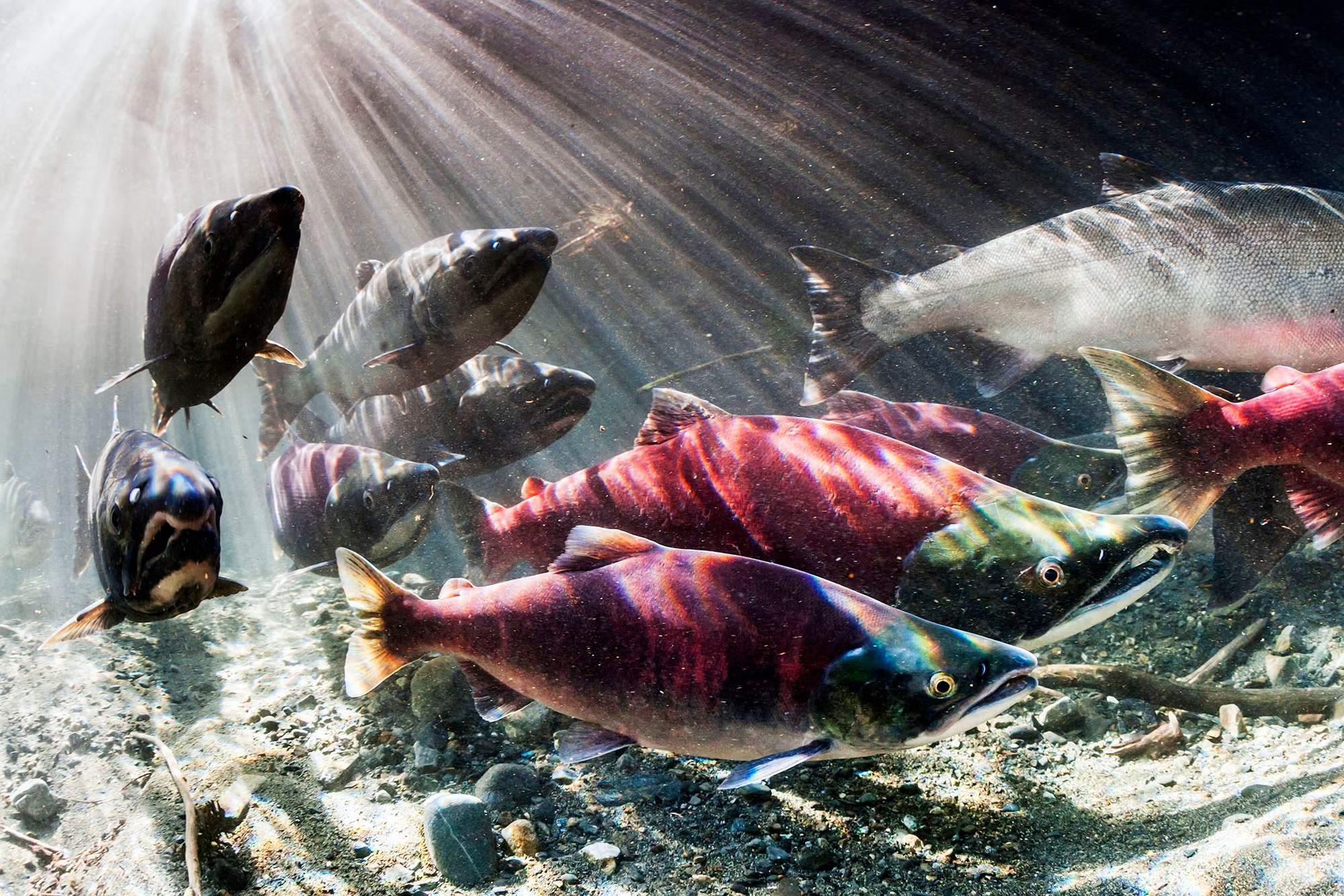
John Stark, a Professor of Ecotoxicology at Washington State University, testified that 6PPD-Q is toxic to coho, Chinook, and steelhead at concentrations likely to occur in real-world habitats. He told the court that, in his research career, he has not encountered a chemical as toxic as 6PPD-Q. According to Stark, fish exposed to the compound did not recover even when returned to clean water. We wonder what happens when people eat fish that have ingested 6PPD-Q.
Stark’s peer-reviewed paper, admitted into evidence, shows significant mortality occurring below current EPA safety benchmarks.
Dr. Robert Lusardi, a conservation biologist at UC Davis, testified that salmon and steelhead are present in the freshwater habitats of the 24 ESA-protected species named in the case throughout the year. When asked directly by the judge whether 6PPD-Q was a “silent killer,” Lusardi responded that it was.
How the chemical reaches salmon
As tires roll on roads, they wear down from friction. This creates tiny particles called tire wear particles (a mix of rubber, fillers, and additives) which includes 6PPD-Q.
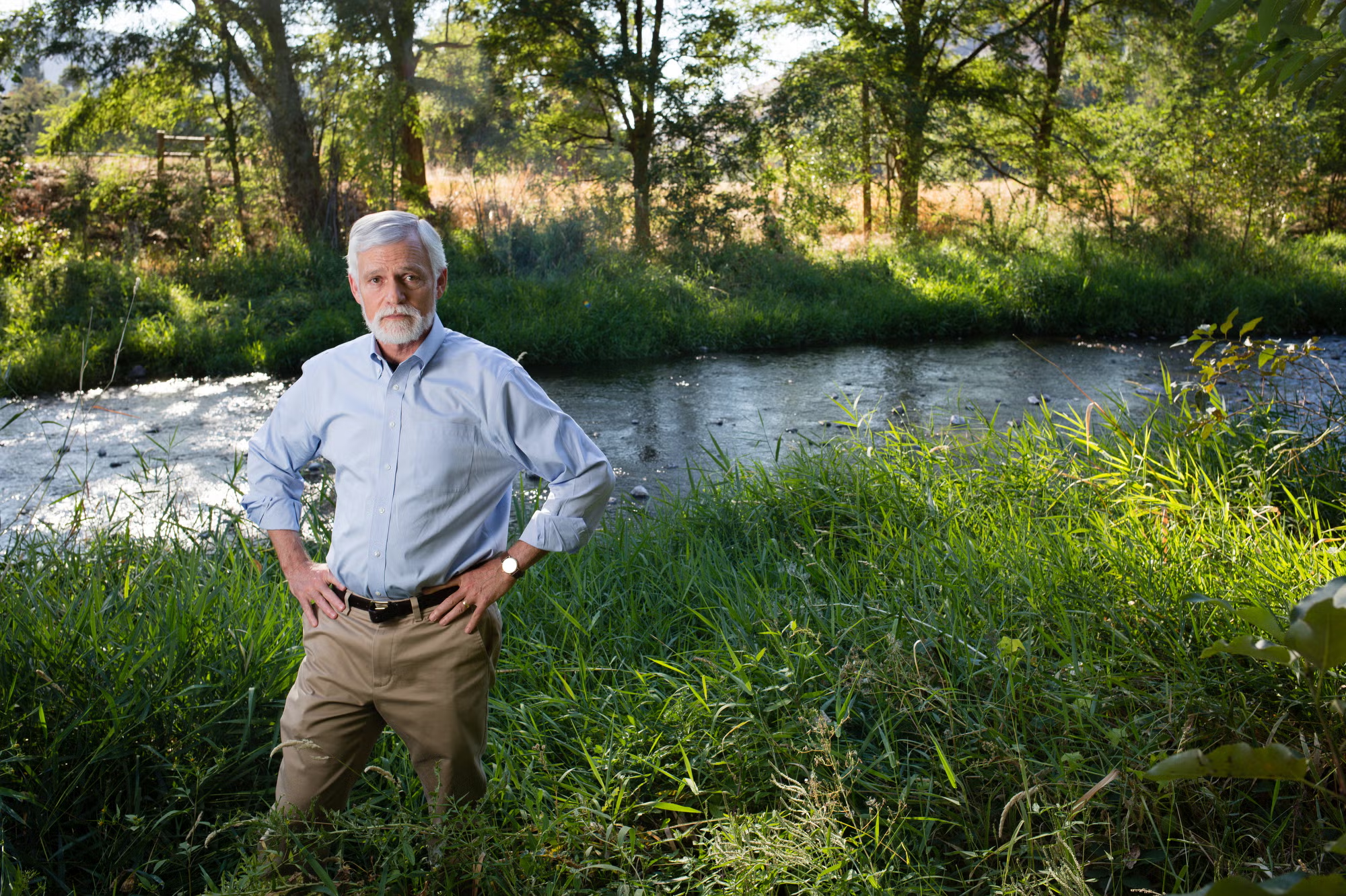
On the issue of exposure pathways, Derek B. Booth, a geologist and hydrologist specializing in stormwater, testified that roads generate runoff that transports contaminants — including 6PPD-Q — into streams and rivers. Booth told the court that existing stormwater treatment systems are not sufficient to prevent the chemical from reaching aquatic habitats.
He stated that after reviewing extensive peer-reviewed data and walking thousands of waterways, there is “no reasonable way” that 6PPD-Q is not entering fish habitats. Supporting this, Maureen Goff, M.Sc., a GIS mapping expert, presented maps showing extensive overlap between roadways and critical habitats for ESA-protected species.
Tire makers offer a defense with paid scientists
The tire industry’s witnesses focused on uncertainty, feasibility, and safety tradeoffs.
Corissa Lee, called as a tire expert, testified that she could not estimate how long a tire made without 6PPD would last or whether it would meet federal motor vehicle safety standards. She acknowledged that alternative chemicals under review by the US Tire Manufacturers Association present unresolved technical or toxicity concerns.
She also testified that she was aware that Flexsys, the largest US manufacturer of 6PPD, announced in November that it had developed a viable alternative — but said she did not consider that alternative when concluding that 6PPD is uniquely effective.
Other defense witnesses, including William Goodfellow and Tiffany Thomas, testified despite having no direct laboratory or field research on 6PPD-Q itself. Court testimony noted that Thomas was paid $450,000 for her work in the case and had not conducted independent studies on the chemical. She is a principal scientist at science consulting firm Exponent, and she was reported to have testified at the trial that 6PPD-quinone is quick to degrade and has the opportunity to react with different chemicals and undergo many physical actions between the road surface and surface water.
“Without understanding all these factors, the ability to predict is speculation,” she said, adding that Kolodziej acknowledged the factors, but did not weigh them in his opinions.
All three defense witnesses were paid and are affiliated with Exponent, a consulting firm long used by industry in environmental and health litigation. Exponent has previously faced public criticism over the objectivity of its research, including in a 2010 Los Angeles Times investigation when Toyota called in the “paid scientists”
Toyota’s 2010 investigation was on unintended acceleration, and they covered cases involving secondhand smoke, asbestos exposure, and toxic waste contamination. The LA Times investigation reported that many companies facing environmental or public-health litigation turned to Exponent for expert analysis and courtroom defense. While Exponent employs credentialed scientists and engineers, the firm’s work has drawn criticism from some academics and public-interest advocates who question the independence of industry-funded research.
One of the trial’s most notable moments came when the judge asked whether there was any dispute that tire manufacturers knew tires shed 6PPD-Q and that it could run off into waterways. Defense counsel confirmed there was no dispute on that point.
The trial has concluded, and the judge is expected to issue a decision in the coming months. At issue is not only the future of a common tire additive, but how courts weigh emerging chemical science against industrial safety standards and endangered species protections. If there are no proven and safe alternatives, what can tire manufacturers do? Can we treat or spray our tires with a material that will stop the shed of micro-particles? Should tire manufacturers heed the call and offer millions in CEO compensation and executive bonuses to mitigate risks to wildlife, rivers and human health? Note that 4 of the biggest tire companies are from Japan?
According to Simply Wall Street Mark W. Stewart from Goodyear is making about $25 million USD a year on tires in 2024. He is credited for turning the company around from a loss.
| Company (by market cap) | CEO | Market Cap (USD, approx.) | Estimated Total CEO Pay (USD) | Estimated Bonus / Incentives (USD) |
|---|---|---|---|---|
| Bridgestone | Shuichi Ishibashi | $28+ billion | $1.5M–$3M | $300K–$1M |
| Michelin | Florent Menegaux | $26+ billion | $2M–$4M | $500K–$1.5M |
| Continental | Nikolai Setzer | $15+ billion | $2.5M–$5M | $800K–$2M |
| Pirelli | Andrea Casaluci | $7–8 billion | $1.5M–$3M | $400K–$1M |
| Yokohama Rubber | Masataka Yamaishi | $6+ billion | $1.5M–$3M | $300K–$900K |
| Hankook Tire | Cho Hyun-beom | $5+ billion | $2M–$4M | $700K–$1.5M |
| Sumitomo / Dunlop | Satoru Yamamoto | $4+ billion | $1M–$2M | $200K–$600K |
| Toyo Tires | Takashi Shimizu | $4+ billion | $1M–$2.5M | $300K–$800K |
| Goodyear | Mark W. Stewart | $2.5–3 billion | $25–26M (actual) | $18M+ (signing + incentives) |
| Cooper Tire (now Goodyear) | — | — | — | — |
“As expert testimony and the evidence have made clear this week: 6PPD-Q is devastating to vulnerable salmon populations, yet 6PPD continues to be used by U.S. tire manufacturers,” said Perry Wheeler, spokesperson for Earthjustice, in a statement following the trial’s conclusion.