Green spaces help heart patients live longer: new study

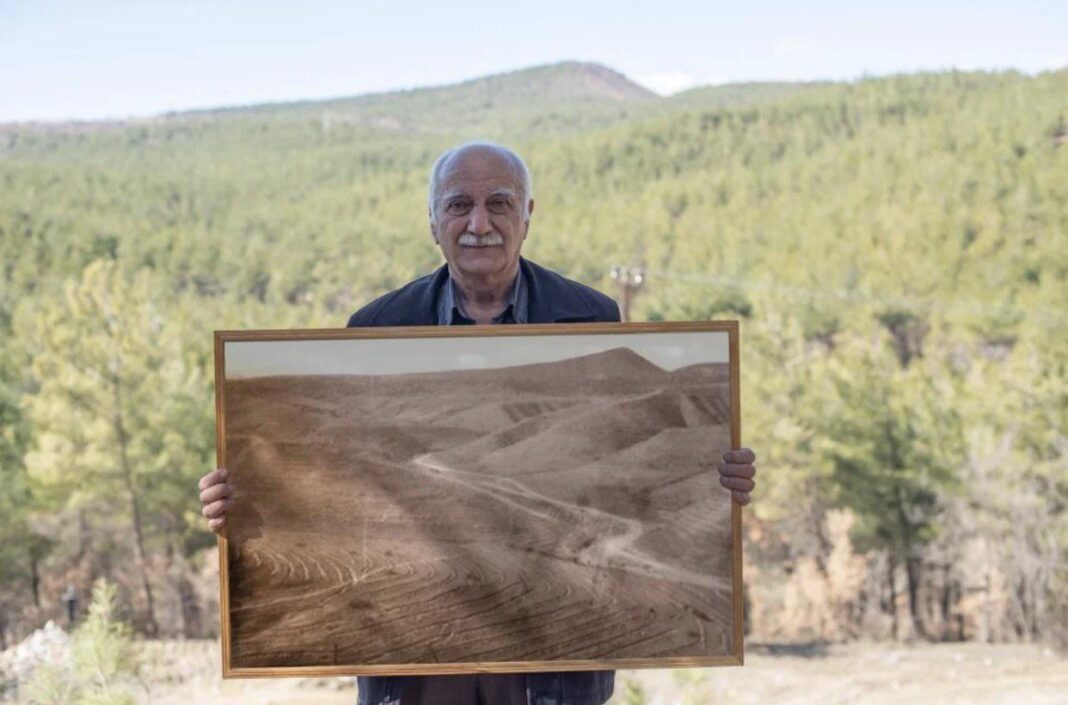
Sehmus Erginoglu, 71, decided to do something about an area of wasteland in his home city of Mardin in southern Turkey. He began by clearing out rubbish from the site, then he installed water pipes and eventually started to plant saplings. Today the site is home to a small forest of around 11,000 trees, with thousands more planted in areas nearby. (All pictures by Murat Bayram/MEE)
Man poses with photo of trees he helped restore.

In a long-term study, unprecedented in its kind and scope, researchers from Tel Aviv University examined the association between a greener environment, which is most likely saturated with vegetation, and the mortality rate of coronary heart patients after undergoing bypass surgery – which is considered a traumatic event from both the physical and mental aspects.

The study, which was carried out on thousands of patients who live all over the State of Israel and followed them over a period of more than 10 years, found that the survival rate of bypass surgery heart patients who live in greener areas is significantly greater than those whose living environment is devoid of greenery. Israel’s unique healthcare system collects digital health data on its entire population which can be licensed, anonymously, for use in medical studies after the fact. That’s how Israel has so much data on medical cannabis patients over time. In the US much of this data is only hand-written and never digitalized.

The study was conducted by PhD student Maya Sadeh under the guidance of Prof. Rachel Dankner. The research was carried out with the support of the Environment and Health Fund and the Israel Science Foundation, and was published in the prestigious journal Epidemiology.

Prof. Dankner: “The current study was based on a database we built at the Gertner Institute about 20 years ago for another study: 3,128 heart patients who underwent bypass surgery in seven medical centers in Israel, from Haifa to Beer Sheva, between the years 2004-2007. Using data from the Ministry of the Interior Affairs we found that 1,442 (46%) of them died of various causes by the year 2021.

“In this study, we wanted to examine to what extent (if at all) the life expectancy of heart patients after surgery is associated with the amount of green vegetation in their residential area.”

For the purpose of the study, the researchers cross-referenced the patients’ residential address data with data from NASA’s Landsat satellites, which photograph the Earth and are able to locate the color green with a very high resolution and within a range of up to 30×30 meters from the residential address – which allows identification of vegetation even within urban areas.

Visible earth from Space, NASA
NASA image of Israel and Lebanon’s green spaces from space
Landsat image of Israel's Galilee region
Landsat image of Israel’s Galilee region

The researchers worked to accurately account for the amount of greenery in a radius of up to 300m around the address of each of the patients, and placed this figure against the dates of death or survival of the patients, over 14 years from the date of surgery.

They performed a detailed statistical analysis of the data, including adjustments for a variety of variables, such as: age, sex, ethnicity, socioeconomic status, urgency of the hospitalization (elective, semi-elective, or emergency surgery), living in the periphery/center, air pollution, and living distance from the Mediterranean Sea.

About 90% of the research participants lived in urban areas, 80% in the coastal plain from the center to Haifa, 15% in the Jerusalem area, and 5% in the southern Beer Sheva area.

Maya Sadeh: “We divided the residential addresses of the patients into three groups, according to the amount of vegetation in their surroundings, and found a clear significant association between a green environment and the survival of the patients – that is, how many years they continued to live after the operation.

The results revealed that during the mean time of 12 years following the operation, the risk of mortality for those who lived in a very green environment was lower on average by 7% compared to those who live in a non-green environment. We also found that the beneficial relationship is more pronounced among women, who made up 23% of the cohort, and were older at the time of the surgery (69.5 years old on average) compared to men (63.8 years ).”

The researchers conclude: “In this study, we examined the survival of coronary heart patients after undergoing bypass surgery, and found that living in a greener environment is associated with better chances of survival. We hypothesize that there are a variety of reasons for this: in a green environment, people breathe cleaner air and engage in more physical activity, the atmosphere may be calmer, and the quality of life is better overall.

“It is possible that the research findings are particularly relevant to the current period in Israel: implying that exposure to a green environment may be a beneficial factor in recovering from trauma.”


Karin Kloosterman
Karin Kloostermanhttp://www.greenprophet.com
Karin Kloosterman is an award-winning journalist, innovation strategist, and founder of Green Prophet, one of the Middle East’s pioneering sustainability platforms. She has ranked in the Top 10 of Verizon innovation competitions, participated in NASA-linked challenges, and spoken worldwide on climate, food security, and future resilience. With an IoT technology patent, features in Canada’s National Post, and leadership inside teams building next-generation agricultural and planetary systems — including Mars-farming concepts — Karin operates at the intersection of storytelling, science, and systems change. She doesn’t report on the future – she helps design it. Reach out directly to [email protected]

TRENDING

Renewables hit 5,149 GW in 2025 as the world edges away from oil shocks and fossil-fueled conflict

“In the midst of uncertain time, renewable energy remains consistent and steadfast in its expansion,” said Francesco La Camera, IRENA’s Director-General. “A more decentralised energy system, with a growing share of renewables and more market players, is structurally more resilient.”

What Is Liberty HealthShare, and Should I Learn More?

Health insurance is a regulated financial product. Insurers operate under binding contracts, overseen by state insurance commissioners, that legally obligate them to pay claims meeting policy terms. Policyholders who believe a covered claim was wrongfully denied have legal recourse through state regulatory channels.

Zentera drops “ethical wool” claim after peta exposé into zq-certified farms

The New Zealand Merino Company, now rebranded as Zentera, has quietly removed the phrase “world’s leading ethical wool brand” from its website, a notable change that comes after a disturbing investigation by PETA Asia-Pacific into the company’s ZQ-certified wool supply chain, PETA reports to Green Prophet.

Fresh Fava Bean Soup, A Vegan Springtime Recipe

Somehow vegetables with short seasons excite the imagination and appetite more sharply than produce that’s available all year around. Good Middle Eastern cooks have many recipes for delicate fava beans, and this turmeric-fragrant soup is one.

The future of trucking and freight is electric and hydrogen

For years the freight industry tried to force a...

Nobul’s Regan McGee on Shareholder Value: “Complacency Is the Silent Killer” 

Why the governance framework designed to protect shareholders so...

Should You Invest in the Private Market?

startustartup Unlike public stock exchanges, which offer daily trading, strict...

How to build a 100-year-company

Kongō Gumi is a Japanese construction company, purportedly founded in 578 A.D., making it the world's oldest documented company. What can we learn about building sustainable businesses from them?

From Pilot Plant to Global Stage: How Aduro Clean Technologies’ 2026 Expansion Signals a Turning Point for Chemical Recycling Investors Like Yazan Al Homsi

The company's Next Generation Process (NGP) Pilot Plant in London, Ontario, has officially moved into initial operating campaigns, generating the kind of structured, repeatable data that separates laboratory promise from commercial viability.

How AI Helps SaaS Companies Reduce Repetitive Customer Support Work

SaaS products are designed for large numbers of users with different levels of experience, and also in renewable energy.

Pulling Water from the Air

Faced with water shortage in Amman, Laurie digs up...

Turning Your Energy Consultancy into an LLC: 4 Legal Steps for Founders in Texas

If you are starting a renewable energy business in Texas, learn how to start an LLC by the books.

Tracking the Impacts of a Hydroelectric Dam Along the Tigris River

For the next two months, I'll be taking a break from my usual Green Prophet posts to report on a transnational environmental issue: the Ilısu Dam currently under construction in Turkey, and the ways it will transform life along the Tigris River.

Related Articles

Popular Categories