

Fusion is a hypothesized type of nuclear reaction that would occur at, or near, room temperature. It would contrast starkly with the “hot” fusion that is known to take place naturally within stars and artificially in hydrogen bombs which leave radiation behind. The promise of fusion of hydrogen atoms has come and gone over the last 40 years, with headlines being made in science once again. If we can solve fusion, we’ve solved climate change and greenhouse gases forever. Hydrogen is available and abundant and we could all have shisha-like reactors at home, charging our private EV everything, but fusion, well, it’s not so easy. We are going to explore the how, why and whens of fusion.

According to both the Financial Times (Mar 23, pg. 1, 26, and 22) and the Wall Street Journal (Mar. 23, b1 & b8) two scientists will announce indications of room temperature fusion of heavy hydrogen (deuterium): This announcement appeared in the Sci.physics Usenet group on March 23, 1989 –– only ten days after a new technology known as the World Wide Web was announced on Alt.hypertext. The net was alive with excitement about the possibility of cheap and clean energy from a tabletop fusion device somewhat resembling a Shisha Middle East smoking pipe, or a Belgian syphon coffee maker.

The price of palladium used in their device rose 30% and the USSR minted a palladium coin. Research teams around the world scrambled to reproduce this “cold fusion” with varying degrees of success. Father of the Hydrogen-bomb Edward Teller expressed scepticism over Pons and Fleischmann’s fusion breakthrough but later worked with researchers. He was hopeful that the fusion that made his weapon so devastating could finally be tamed to serve humankind. It seemed too good to be true! Clean and cheap energy, forever. And it was.
One of the mistakes Pons, Fleischmann and others made is something Green Prophet discussed in our recent article on geological hydrogen. They had assumed electrolysis was 100% efficient but in reality at least 30% of the energy input is converted to heat. They mistook this resistive heating as fusion energy. The good news is that it didn’t work and hit Pons and Fleischmann with a fatal dose of neutron radiation. Fusion faded into the fringe and lost momentum as its proponents moved to more profitable junk science. But hot fusion research continued its slow and unsteady pace.
Fusion, here we go again?
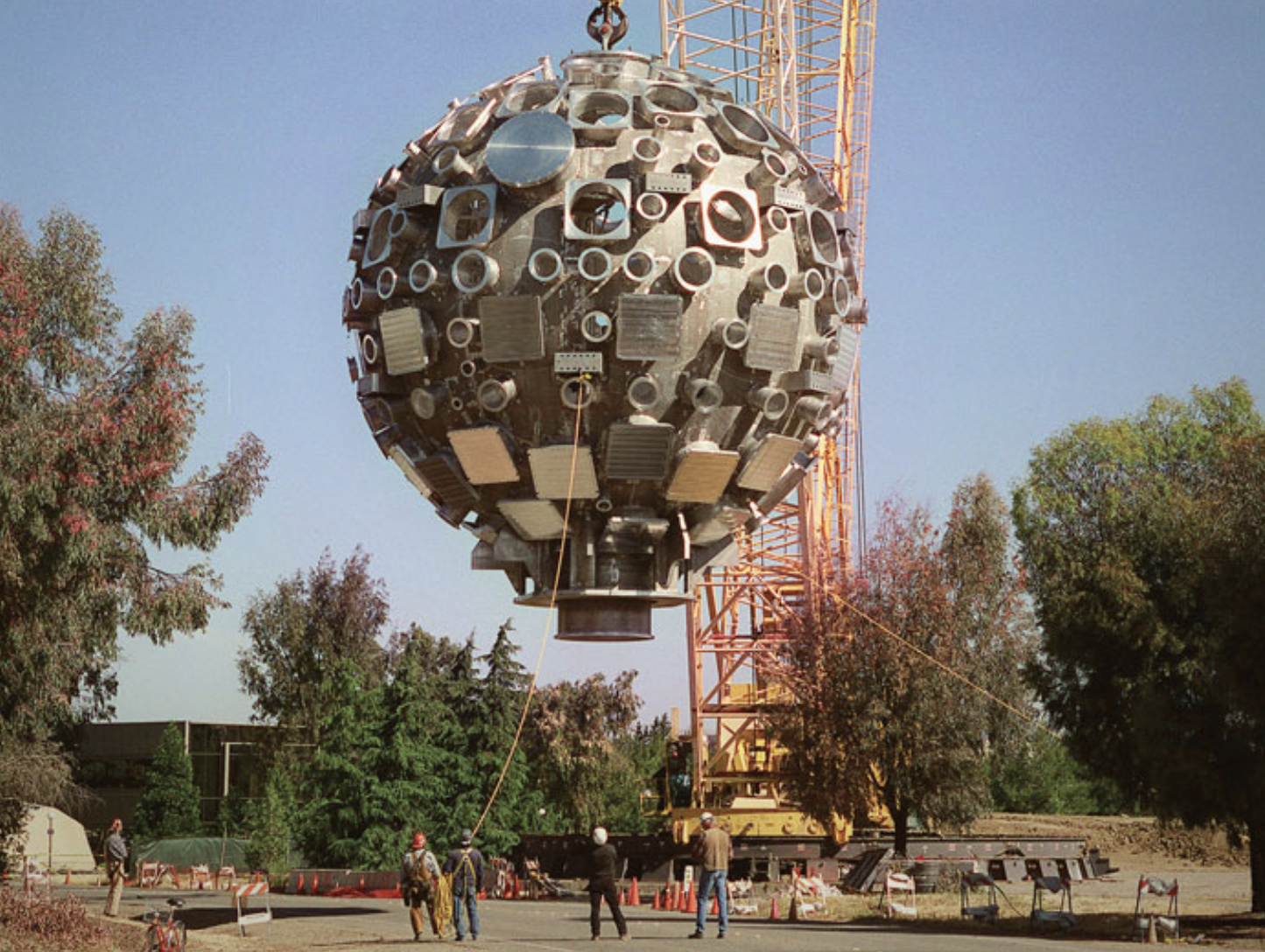
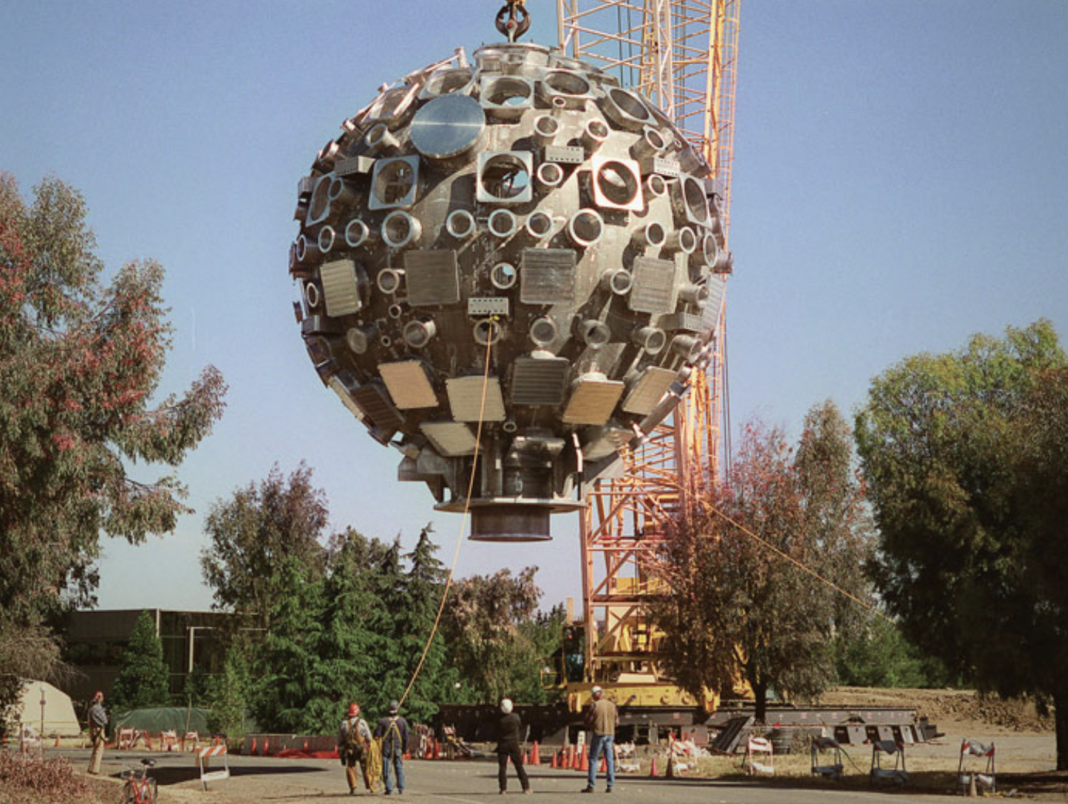
Anyone old enough to remember the fusion debacle should be forgiven for being sceptical when the America’s Lawrence Livermore National Laboratory (LLNL) announced a fusion breakthrough at their National Ignition Facility (NIF) in December 2022. This new hot fusion device didn’t resemble Pons and Fleichmann’s contraption at all.
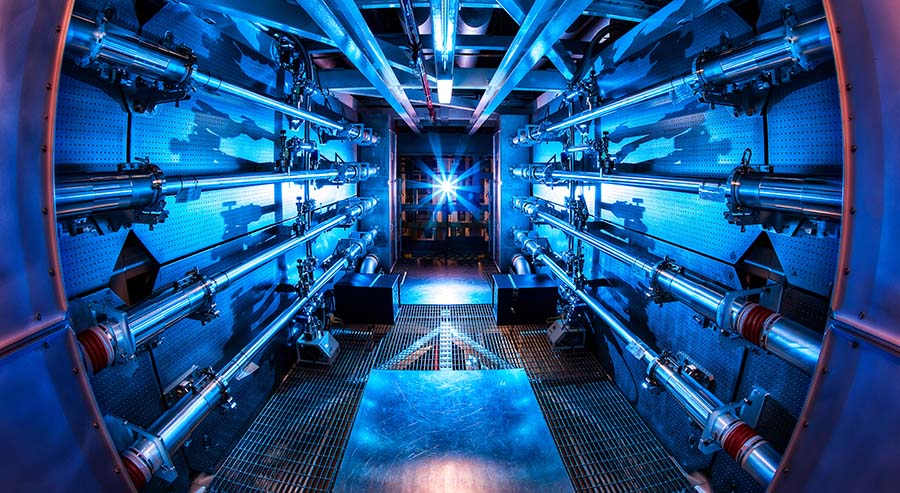
It looks more like something Dr. Evil would fire at a comic book superhero. The LLNL scientists used 192 lasers, each with a beam width of about a meter. Together they can produce up to 500 trillion watts. Their light was focused and timed so their ten billionth of a second (0.1 nanosecond) pulses of light each about 1 inch long would simultaneously hit a cylinder containing a sphere smaller than a peppercorn. The sphere contained two isotopes of hydrogen, deuterium and tritium. This hot fusion experiment was a success.
The lasers pumped 2 megajoules (MJ) of energy into the cylinder generating X-rays which compressed and heated the deuterium and tritium enough that some fused and output 3 megajoules. The net energy gain was 1.5 times.
Fusion energy enough for a tea party
The extra megajoule generated by the NIF fusion experiment was enough energy to bring a few cups of water to a boil. That’s worth about three cups of tea. When we put it that way it doesn’t sound like much does it? This experiment was never meant to become a commercial fusion reactor but it shows that it is possible to use laser confinement to release more fusion energy than is put into the system.
This breakthrough is comparable to the Wright brother’s 12-second flight in 1903. We can’t imagine flying across the world with 36 meter 12 second hops but the brother’s Kitty Hawk experiment with kite and bicycle parts proved that heavier than air flight was possible.
Likewise, LLNL showed that a laser confinement fusion power is possible even if it isn’t practical until it can target its lasers at more than one peppercorn for longer than a ten-billionth of a second.

Composite photograph showing three stories of the Target Bay and many of the final optics assemblies and diagnostics surrounding the Target Chamber at the center. Credit: Jacqueline McBride LLNL.
A brief history of fusion and why it’s so hard
The first nuclear fission chain reaction occurred under the bleachers at University of Chicago’s abandoned Stagg Field. Enrico Fermi led his team to build the Chicago Pile-1 (CP-1) atomic pile out of graphite, uranium, wood and other materials beneath a University of Chicago football stadium. At 3:25 p.m on December 2, 1942 a Manhattan Project scientist named George Weil pulled a control rod from CP-1. With the neutron-absorbing control rod removed, each neutron released by a uranium atom would trigger the release of more than one neutron.

Image from Forest Preserves of Cook County
Chicago Pile-1 became the world’s first self-sustaining nuclear fission reactor. This Lego video explains CP-1 atomic fission history”
Until LLNL produces its own Lego fusion video, we have this explanation of December’s NIF laser confinement fusion breakthrough:
Swords, ploughshares, bombs and cups of tea
The December 1942 CP-1 fission experiment ran for 28 minutes, about 16 quadrillion times longer than NIF’s laser fusion breakthrough but CP-1 only produced about 1/2 watt. This wasn’t even enough power to make a nice cup of tea but shortly afterwards Leo Szilard, the man who invented and patented the nuclear chain reaction told Enrico Fermi that this would be a “black day in the history of mankind.” Szilard was right: the Chicago Pile-1 paved the way for the atomic bombs dropped on Hiroshima and Nagasaki Japan less than three years later.
The first nuclear fusion bombs were tested only six years later and the first nuclear fission reactor began generating electricity at Windscale UK in 1950, only eight years after CP-1. Today there are more than 10,000 atomic bombs in at least nine countries and 400 nuclear fission reactors in at least 30 countries. But as of December 2022, 80 years after Chicago Pile-1 we did not have a single self-sustaining fusion reactor.
Why is fusion better than fission?
In nuclear fission, protons and neutrons are split from a heavy atom’s nucleus, generating energy, radiation and lighter elements. In nuclear fusion, the nucleus of light elements are fused together, releasing energy, radiation and heavier elements. One of the advantages of fusion is also what makes it so difficult. In December’s NIF experiment, carefully timed lasers and perfectly spherical heavy hydrogen capsules could only keep the reaction going for about a ten billionth of a second. Alternative tokamak fusion experiments using doughnut-shaped magnetic confinement instead of lasers have also shown promise but so far the longest sustained fusion reaction was only 17 minutes.
But once a nuclear fission chain reaction starts it will run its course unless something stops it. Chicago Pile-1 had no cooling system and its control system relied on pulleys, clotheslines, electric motors, emergency buckets of cadmium salts and a manual control rod operator named George Weil. In retrospect they were lucky. Building an atomic pile beneath an urban football stadium sounds like a “hold my beer” kind of thing to do. If these scientists had removed the control rods and abandoned the project, the nuclear reaction might still be running today after melting a radioactive hole in the earth near downtown Chicago.
CP-1, CP-2 and CP-3 were eventually decommissioned and buried beneath a wooded picnic area. In the 1970s to 80s they were found to be leaching radioactive material into the soil and ground water. This gives us the other big advantage of nuclear fusion: The fuel and fusion reaction can be designed to minimize radioactive waste.
In NIF and other deuterium-tritium fusion reactors, two isotopes of hydrogen (tritium being radioactive with a half-life of 12.33 years) are fused into helium. Most of this helium is the same non-radioactive isotope children use in party balloons. The neutrons released during the reaction can make parts of the reactor radioactive but this is easier to manage than the messy mix of spent Uranium, cesium-137 (half-life 30 years), strontium-90 (half-life 29 years), plutonium-239 (half-life 2400 years), technetium-99 (half-life 211,100 years) released into our water, land and air by fission power plants at Windscale in 1957, Three Mile Island in 1979, Chernobyl in 1986, Fukushima in 2011…
There are plenty of reasons why we should continue research into fusion power. One of the reasons we’re impatient with the slow pace of green technological progress may be that our pop-culture mythology distorts the true history of technology. I previously wrote about the long history of efficient lighting. The same could be said of many other things. Rev. Dr. J. W. Carhart was driving a steam-powered car he named The Spark 13 years before Carl Benz patented his first automobile.
An electric skateboard invented by a Roman Catholic Priest named Ányos Jedlik in 1828 predated Elon Musk’s appointment as CEO of Tesla by 180 years. Rather than obsessing over the question “Are we there yet?” we should ask whether we’re still making progress. December’s NIF experiment shows that, yes, we are still making progress towards the goal of fusion energy.