
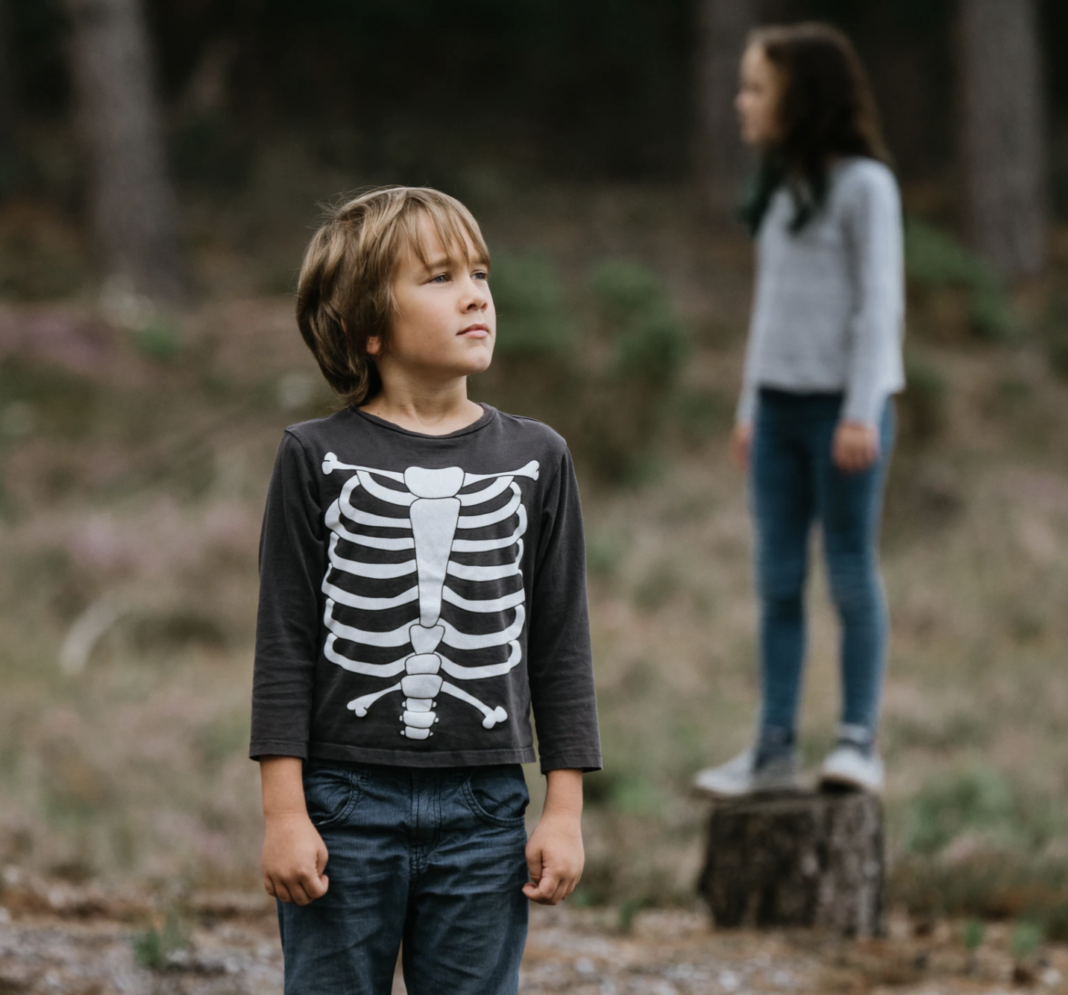
Our kids have junk inside their bones

bone health junk food, boy with skeleton shirt Kids and the food they eat. Parents know that junk food affects their teeth, their BMI and their mood –– and now scientists see worrying and long-lasting effects on the bones of children who consume junk food. 

Researchers from the Hebrew University show how ultra-processed junk foods and reduce bone quality, unveiling the damage of these foods particularly for younger children in their developing years.

The study, led by Professor Efrat Monsonego-Ornan and Dr. Janna Zaretsky from the Department of Biochemistry, Food Science and Nutrition at the University’s Faculty of Agriculture, was published in the journal Bone Research and serves as the first comprehensive study of the effect of widely-available food products on skeleton development.
Ultra-processed foods—aka, junk food like McDonald’s, white bread, Coke, granola bars, sweetened breakfast cereal —are food products that undergo several stages of processing and contain non-dietary ingredients. 

They’re popular with consumers because they are easily accessible, relatively inexpensive and ready to eat straight out of the package. And, well, kids love them. They are engineered that way. The increasing prevalence of these products around the world has directly contributed to increased obesity and other mental and metabolic impacts on consumers of all ages.  

As much as 70% percent of their caloric consumption are estimated to come from ultra-processed foods. While numerous studies have reflected on the overall negative impact of junk food, few have focused on its direct developmental effects on children, particularly young children.

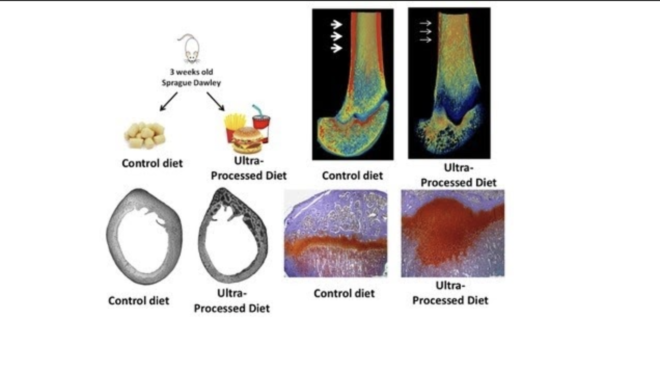
The Hebrew University study provides the first comprehensive analysis for how these foods impact skeletal development.  The study surveyed lab rodents whose skeletons were in the post embryonic stages of growth. The rodents that were subjected to ultra-processed foods suffered from growth retardation and their bone strength was adversely affected.

Under histological examination, the researchers detected high levels of cartilage buildup in the rodents’ growth plates, the “engine” of bone growth. When subjected to additional tests of the rodent cells, the researchers found that the RNA genetic profiles of cartilage cells that had been subjected to junk food were showing characteristics of impaired bone development.
Efrat Monsonego-Ornan

They divided the rodents’ weekly nutritional intake—30% came from a ‘controlled’ diet, 70% from ultra-processed foods. They found that the rodents experienced moderate damage to their bone density albeit there were fewer indications of cartilage buildup in their growth plates.   “Our conclusion was that even in reduced amounts, the ultra-processed foods can have a definite negative impact on skeletal growth,” Monsonego-Ornan said.  

These findings are critical because children and adolescents consume these foods on a regular basis to the extent that 50 percent of American kids eat junk food each and every day. 

Monsonego-Ornan added: “When Carlos Monteiro, one of the world’s leading experts on nutrition, said that there is no such thing as a healthy ultra-processed food, he was clearly right.  Even if we reduce fats, carbs nitrates and other known harmful substances, these foods still possess their damaging attributes. Every part of the body is prone to this damage and certainly those systems that remain in the critical stages of development.”

What is ultra-processed food? 

According to Harvard, processing changes a food from its natural state. Processed foods are essentially made by adding salt, oil, sugar, or other substances. Examples include canned fish or canned vegetables, fruits in syrup, and freshly made breads. Most processed foods have two or three ingredients.

Ultra-processed foods normally contain ingredients that you wouldn’t add when cooking homemade food. You may not recognise the names of these ingredients and you won’t be able to pronounce them as many will be chemicals, colourings, sweeteners and preservatives. 

Time to get making sourdough bread. LOL. Read our 4 part series starting here from our in-house expert. This is our solution for everything. Or start a Victory Garden


Karin Kloosterman
Karin Kloostermanhttp://www.greenprophet.com
Karin Kloosterman is an award-winning journalist, innovation strategist, and founder of Green Prophet, one of the Middle East’s pioneering sustainability platforms. She has ranked in the Top 10 of Verizon innovation competitions, participated in NASA-linked challenges, and spoken worldwide on climate, food security, and future resilience. With an IoT technology patent, features in Canada’s National Post, and leadership inside teams building next-generation agricultural and planetary systems — including Mars-farming concepts — Karin operates at the intersection of storytelling, science, and systems change. She doesn’t report on the future – she helps design it. Reach out directly to [email protected]

LEAVE A REPLY

Please enter your comment!
Please enter your name here

TRENDING

Which Occupational Therapy Activities Are Best for Toddlers’ Development?

There are plenty of art skills from Montessori schooling that are helpful in occupational therapy settings

Eco-Friendly Playgrounds: How Schools and Parks Are Reducing Their Environmental Footprint

One of the main concerns with using sustainable materials is that it won’t look like a modernized playground. This couldn’t be farther from the truth! Many of these recycled, sustainable materials can be painted and purchased in fun and vibrant colors. You may just be surprised to see the possibilities. And upon first glance, many visitors may not even realize that the playground is eco-friendly in the first place.

How Eco-Friendly Playgrounds Are Reshaping Community Green Spaces

An eco-friendly playground goes a long way toward saving the city money. This is obviously also true for schools and churches that want to create new play spaces for the kids. The equipment can come in at a lower cost because the materials have been repurposed.

Toxins in tiny bodies: American children are carrying invisible chemical burden

Chemical exposures were highest among younger toddlers and racial/ethnic minorities, reflecting systemic environmental injustice. While some older chemicals like triclosan and certain phthalates are decreasing (likely due to public pressure and reformulations), new unregulated substitutes like DINCH and emerging pesticides are on the rise.

At risk for MS? Give baby and mom sun exposure

Getting sun and the association with MS.

Qatar’s climate hypocrisy rides the London Underground

Qatar remains a master of doublethink—burning gas by the megaton while selling “sustainability” to a world desperate for clean air. Wake up from your slumber people.

How Quality of Hire Shapes Modern Recruitment

A 2024 survey by Deloitte found that 76% of talent leaders now consider long-term retention and workforce contribution among their most important hiring success metrics—far surpassing time-to-fill or cost-per-hire. As the expectations for new hires deepen, companies must also confront the inherent challenges in redefining and accurately measuring hiring quality.

8 Team-Building Exercises to Start the Week Off 

Team building to change the world! The best renewable energy companies are ones that function.

Thank you, LinkedIn — and what your Jobs on the Rise report means for sustainable careers

While “green jobs” aren’t always labeled as such, many of the fastest-growing roles are directly enabling the energy transition, climate resilience, and lower-carbon systems: Number one on their list is Artificial Intelligence engineers. But what does that mean? Vibe coding Claude? 

Somali pirates steal oil tankers

The pirates often stage their heists out of Somalia, a lawless country, with a weak central government that is grappling with a violent Islamist insurgency. Using speedboats that swarm the targets, the machine-gun-toting pirates take control of merchant ships and then hold the vessels, crew and cargo for ransom.

Leopoldo Alejandro Betancourt López Turned Ocean Plastic Into Profitable Sunglasses

Few fashion accessories carry the environmental burden of sunglasses. Most frames are constructed from petroleum-based plastics and acrylic polymers that linger in landfills for centuries, shedding microplastics into soil and waterways long after they've been discarded. Leopoldo Alejandro Betancourt López, president of the Spanish eyewear brand Hawkers, saw this problem differently than most industry executives.

Why Dr. Tony Jacob Sees Texas Business Egos as Warning Signs

Everything's bigger in Texas. Except business egos.  Dr. Tony Jacob figured...

Israel and America Sign Renewable Energy Cooperation Deal

Other announcements made at the conference include the Timna Renewable Energy Park, which will be a center for R&D, and the AORA Solar Thermal Module at Kibbutz Samar, the world's first commercial hybrid solar gas-turbine power plant that is already nearing completion. Solel Solar Systems announced it was beginning construction of a 50 MW solar field in Lebrija, Spain, and Brightsource Energy made a pre-conference announcement that it had inked the world's largest solar deal to date with Southern California Edison (SCE).

Related Articles

Popular Categories