

Rare Glimpse Into Ultra-orthodox World At Jerusalem Design Week

Artist Marcelle Biton in front of her display at Jerusalem Design Week’s “Haready-Made: The Product in Orthodox Society” exhibition. (Credit: Yelena Kvetany)

Jerusalem Design Week happens every year, but it was a first for some artists participating in the exhibition “Haready-Made: The Product in Orthodox Society.” Relating to this year’s overall theme of “conserve,” the exhibition showcases objects used by members of the Haredi community—ultra-Orthodox Jews who reject secular life—in order to sustain their culture in socially liberal and tech-savvy Israel.

The exhibition, which was on display at the Jerusalem Theater, ran until June 14.

Noa Cohen, the exhibition’s curator, related to The Media Line how the idea for the exhibition arose. While doing research on a different topic for her PhD thesis at Israel’s Bar-Ilan University, Cohen stumbled upon the Art Shelter Gallery nestled in Jerusalem’s ultra-orthodox neighborhood of Mekor Baruch.

“I realized a lot of artists [in this community] pursued very unique ways of making art. I volunteered as their curator for a few years and now I manage the Art Shelter Gallery. The exhibition at the Jerusalem Theater,” she continued, “is a collaboration [between the gallery and Design Week].”

Cohen said that for some of the 15 artists participating in the exhibition, it is the first time they are showcasing their art in a public place. “I realized that there are many things in the ultra-orthodox community not known by outside spectators, such as the way they live and how they make their products specifically tailored to their needs,” she noted.

One of the displays at the exhibition consists of a mannequin whose head is covered by a bright, colorful head-scarf (tichel). A cellphone is visible between the mannequin’s head and the head-scarf. Artist Marcelle Biton told The Media Line that this work is an adaptation, depicting how Haredi women often speak—often without using their hands—on “kosher” cellphones conveniently tucked underneath their tichels.

“You can’t find these scarfs in the stores; they are hand-made. And kosher phones are usually small ones produced by Nokia or Samsung,” Biton explained.
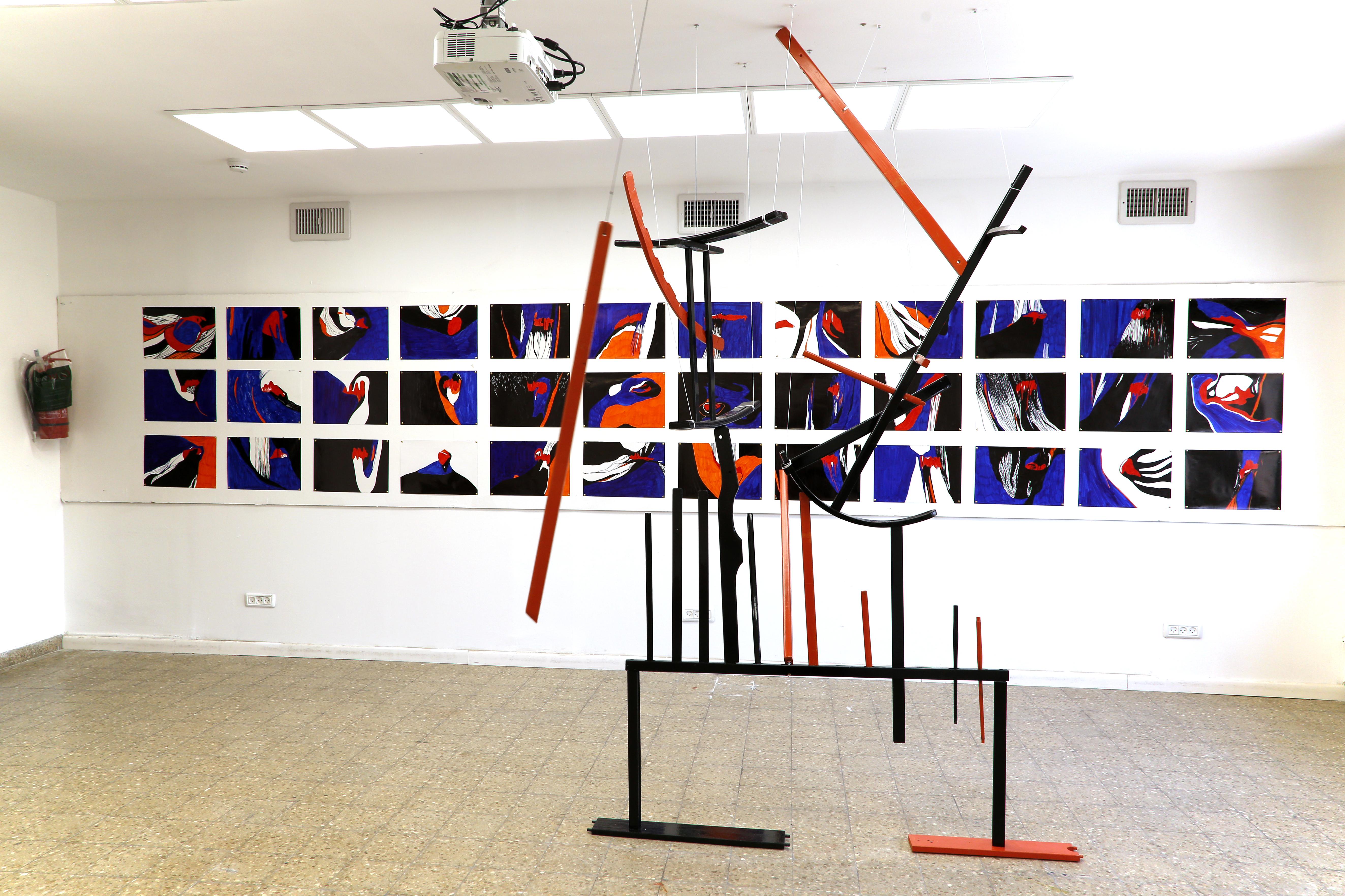
A piece by Miriam Monk, a second year student in the joint Oman-Bezalel program for haredi women, submitted as a final project at the end of the school year. (Photo courtesy the Oman School of Higher Education for the Arts)

Unlike most Haredim, Biton did not go through the community’s educational system and therefore ended up with experiences atypical of ultra-Orthodox women.

“You are inspired and want to express what you’ve experienced. The fact my artwork is being displayed during Design Week is already an achievement. Opportunities for Haredi artists to show their work are already very limited,” Cohen said. “It makes it more interesting to consider that there aren’t enough young, female artists within the Haredi community.”

Bar Mayer is another female artist who grew up within the Haredi community, but left it behind in later years. Her display at Design Week features a large portrait of her family tree.

“The work is the first I’ve done to reconnect with my family after many years of distance,” Mayer told The Media Line. The decision to make a fresh start 19 years ago meant a formal break with her ultra-Orthodox community.

A quick glance at her art reveals signs of discord. Almost half of the family members presented in the tree were either absent in the space assigned for a portrait—which was often substituted by colored papers—or they appeared with their backs to the camera. Some members wore traditional Orthodox garb such as the black fedora and suit, although some did appear in modern clothing.
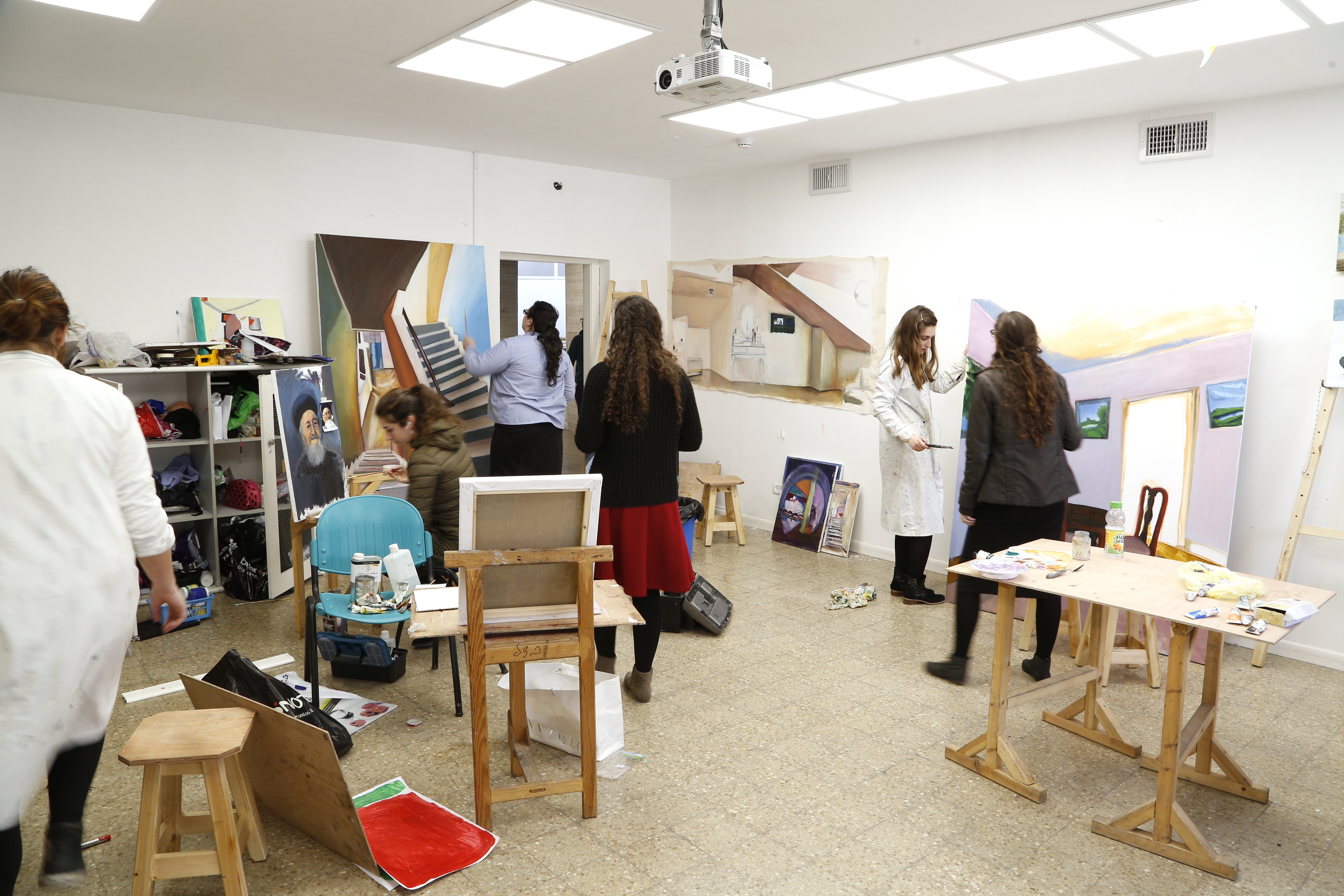
Second year students in the joint Oman-Bezalel program in their drawing studio. (Photo courtesy the Oman School of Higher Education for the Arts)

“Some of them didn’t understand why I was reconnecting with the community. Showing up with my camera was very invasive in a way. I don’t expect them to get me, because art is very marginal in the Orthodox world,” Cohen elaborated.

For artists in the Haredi community or closely linked to it, participating in shows can be very a thorny affair, especially if they take place on the Sabbath—the Jewish day of rest—or involve an international audience.

“This type of exhibition shows the diversity of the Israeli art world,” Cohen concluded. “It’s much more authentic and an opportunity to experience a broader range of Israeli art. I see the exhibition as a bridge.”

In addition to the Design Week exhibition allowing them to experiment with their artistry, both Biton and Mayer emphasized that the event has motivated them to reconnect with their Haredi heritage.


LEAVE A REPLY

Please enter your comment!
Please enter your name here

TRENDING

Astro uses AI to help procure land for renewable energy

For oil-rich, environmentally vigilant Gulf states, Astro isn’t just another startup story. It is a blueprint for accelerating an energy transition that is now existential, not optional.

The Science Behind How Elite Marathon Runners Train

Discover the science behind elite marathon training. Explore techniques, nutrition, and mental strategies that propel top runners to success.

Earth building with Dead Sea salt bricks

Researchers develop a brick made largely from recycled Dead Sea salt—offering a potential alternative to carbon-intensive cement.

The Christ’s thorn (sidr tree) is also a well-known folk medicine

Christ’s thorn jujube (Ziziphus spina-christi) also known as the sidr tree is a real, identifiable tree native to the Middle East, and it appears—directly or indirectly—in Islam, Judaism, and later Christian tradition. The connections between the three faiths are not theological agreements but overlapping uses, names, and symbolic associations rooted in the same landscape.

Farm To Table Israel Connects People To The Land

Farm To Table Israel is transforming the traditional dining experience into a hands-on journey.

Qatar’s climate hypocrisy rides the London Underground

Qatar remains a master of doublethink—burning gas by the megaton while selling “sustainability” to a world desperate for clean air. Wake up from your slumber people.

How Quality of Hire Shapes Modern Recruitment

A 2024 survey by Deloitte found that 76% of talent leaders now consider long-term retention and workforce contribution among their most important hiring success metrics—far surpassing time-to-fill or cost-per-hire. As the expectations for new hires deepen, companies must also confront the inherent challenges in redefining and accurately measuring hiring quality.

8 Team-Building Exercises to Start the Week Off 

Team building to change the world! The best renewable energy companies are ones that function.

Thank you, LinkedIn — and what your Jobs on the Rise report means for sustainable careers

While “green jobs” aren’t always labeled as such, many of the fastest-growing roles are directly enabling the energy transition, climate resilience, and lower-carbon systems: Number one on their list is Artificial Intelligence engineers. But what does that mean? Vibe coding Claude? 

Somali pirates steal oil tankers

The pirates often stage their heists out of Somalia, a lawless country, with a weak central government that is grappling with a violent Islamist insurgency. Using speedboats that swarm the targets, the machine-gun-toting pirates take control of merchant ships and then hold the vessels, crew and cargo for ransom.

Leopoldo Alejandro Betancourt López Turned Ocean Plastic Into Profitable Sunglasses

Few fashion accessories carry the environmental burden of sunglasses. Most frames are constructed from petroleum-based plastics and acrylic polymers that linger in landfills for centuries, shedding microplastics into soil and waterways long after they've been discarded. Leopoldo Alejandro Betancourt López, president of the Spanish eyewear brand Hawkers, saw this problem differently than most industry executives.

Why Dr. Tony Jacob Sees Texas Business Egos as Warning Signs

Everything's bigger in Texas. Except business egos.  Dr. Tony Jacob figured...

Israel and America Sign Renewable Energy Cooperation Deal

Other announcements made at the conference include the Timna Renewable Energy Park, which will be a center for R&D, and the AORA Solar Thermal Module at Kibbutz Samar, the world's first commercial hybrid solar gas-turbine power plant that is already nearing completion. Solel Solar Systems announced it was beginning construction of a 50 MW solar field in Lebrija, Spain, and Brightsource Energy made a pre-conference announcement that it had inked the world's largest solar deal to date with Southern California Edison (SCE).

Related Articles

Popular Categories