Part I in a series of 4 about eating and healing with roses.
Roses have everything you desire in a flower: beauty, fragrance and the power to express, and to waken, love. Maybe it’s their mysterious beauty; a whorl of petals that enclose the unmistakable, heady scent. Body and spirit instinctively respond to rose’s soothing, healing properties. Not to mention their aphrodisiac effect, highlighted here in our Moroccan love potion recipe. Roses bring ideas of love and fertility to the mind. No wonder we get children to scatter rose petals in front of the bride and groom.
Edibility is another of roses’ graces. Our list of 60 must-have Middle Eastern pantry items, naturally includes dried rose petals and rose water. A typical sweet like ma’amoul cookies becomes even more delicate and exotic when perfumed with rose water. Yet roses also contribute to savory foods, as in the complex ras el hanout spice blend, which is used to season meatballs, lamb and chicken in Moroccan and other North African cuisines.
Rose hips, the red or orangey fruit left when the flower has faded and fallen away, are a valuable food. School children in WW2 Europe used to gather them from autumn hedgerows and gardens for their mothers to cook down into rose hip syrup, a cheap and natural source of Vitamin C. But you can simply pluck a few hips off your (unsprayed) rose bush and boil them for ten minutes to drink as tea. The fruit will split open in cooking, releasing some of the prickly hairs and seeds lurking in its interior. Strain the tea before drinking, as those hairs irritate the throat and stomach.
Rose hip jam was once a popular, although labor-intensive sweet. To make good jam free of those irritating prickly hairs, someone – probably those same school children – had the task of cutting each rose hip in half and digging the hairs out before handing them over to the cook. Or more mercifully, the mother would cook the jam and strain it well.
Rose water, made by infusing rose petals in hot water, has many uses, including the pleasant Arabian custom of sprinkling it on the palms of guests. Medieval Europeans learned from the ancient Roman and Greek to dab their hands in a bowl of warm, rose-scented water after meals; a good idea in times before the fork was invented and people picked their food up with their hands. A good idea still, I think. Imagine a leisurely meal with good friends, finishing with a rinse of rose water. Rather nicer than ripping open a packaged wet wipe.
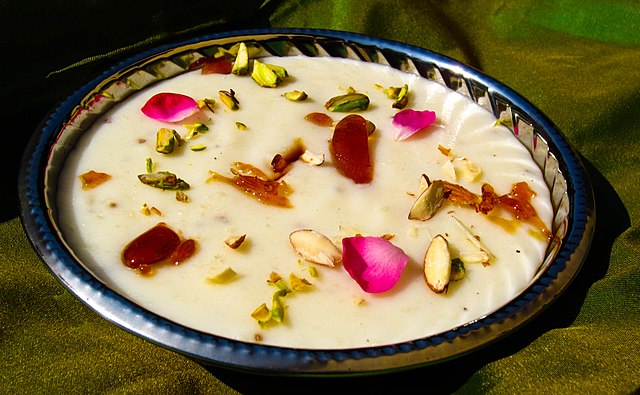
The rose-scented rice pudding recipe below lifts the homely dessert to a higher gastronomic level than you ever thought rice pudding could achieve. Enjoy!
Rice Pudding with Rose Water
Adapted from Arabesque, by Claudia Roden
6 servings
Ingredients:
3/4 cup short-grain rice
1-1/2 cups water
5 cups milk
3/4 cup sugar
1-1/2 tablespoons rose water
1/4 teaspoon vanilla
4 egg yolks
For garnish: 2 tablespoons dried rose petals, 1 tablespoon chopped almonds or pistachios, 1 tablespoon raisins or cranberries.
Have ready a small, heat proof bowl and a bowl for serving the pudding.
Bring the rice and the water to a boil, then cover the pot and simmer the rice until the water is absorbed. Add the milk and simmer for 30 minutes, stirring occasionally. The rice should be very soft, but with some liquid in the bottom of the pot.
Add the sugar, vanilla, and rose water, stirring well. Turn the heat off.
Beat the egg yolks in the heat proof bowl. Ladle some hot rice into the yolks, beating the mixture well.
Add the eggy mixture to the pot, stirring well to thicken the pudding. If necessary, turn the heat back on, very low. Don’t let the mixture boil, or the yolks will curdle.
When all is creamy and thick, pour the pudding into the serving bowl. Allow it to cool, then cover and refrigerate it.
Serve cold with the garnish ingredients scattered over the surface of the pudding.
Photo of rice pudding by Rajathrajrao – Own work, CC BY-SA 4.0, https://commons.wikimedia.org/w/index.php?curid=40677822