

 A consortium of leading environmental groups released a Regional NGO Master Plan for Sustainable Development in the Jordan Valley. They announced the action – the first of its kind – earlier today at a conference held on the Jordan side of the Dead Sea. The strategy is akin to a modern Marshall Plan, it aims to convert a toxic river and highly depressed economic area into an international model for river rehabilitation and regional stability.
The conference, under the patronage of Jordan Minister of Water Dr. Hazim al Nasser, marked the end of a European Union (SWIM) funded program and brought together government officials from Jordan, Palestine and Israel, diplomats, international development agencies, and river basin experts to discuss how best to move the program from planning to implementation. EcoPeace Middle East, together with partners at the Stockholm International Water Institute and Global Nature Fund, and lead consultant Royal HaskoningDHV, were instrumental in creating the planning document.
“The Master Plan highlights how the current ecological and economic demise of the valley is a lose/lose situation for all sides concerned. Through the Marshal Plan type investments, undertaken in a manner that supports regional integration and a healthy Jordan River, stability and security can be achieved, a key concern of the Israeli public”, said Gidon Bromberg, EcoPeace Middle East Israeli co-director.
This echoes the findings of Mumbai-based think tank Strategic Foresight Group, who assert that “any two countries engaged in active water cooperation, do not go to war for any reason whatsoever.” This truism also extends to environmental protection and remediation activities for internationally shared waters, such as the Jordan River.
“From a Palestinian perspective the Master Plan helps advance a two state solution with an independent Palestine prospering in the West Bank of the Jordan Valley due to full access and riparian rights to both water and land resources in the valley. All sides will gain when independence and integration lead to economic prosperity”, said Nader Khateeb, EcoPeace Middle East Palestinian co-director.
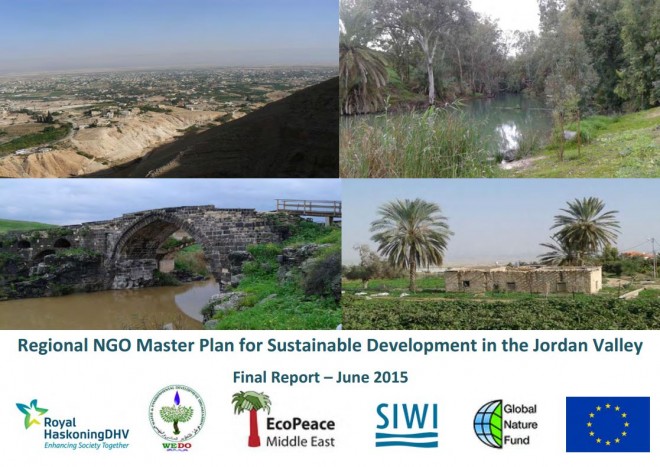 EcoPeace will use the Master Plan to advocate for regional integration in the Jordan Valley and for increasing political will for adoption in full, or in part, of the study’s recommendations by the national authorities in the region.
“I am proud that the Kingdom of Jordan is the first to have endorsed the Jordanian interventions of the master plan. Facing 40% unemployment in the valley and an influx of tens of thousands of Syrian refugees to the valley, Jordan well understands that only regional integration will bring the needed prosperity and stability to the region. A healthy Jordan River on which the Kingdom is named better reflects our broader aspirations as Jordanians”, said Munqeth Mehyar, EcoPeace Middle East Jordanian co-director.
The plan’s framework identifies 127 specific regional and national projects (called “interventions”) with a total investment value of $4.58 billion USD until the year 2050. Many projects are “no regret actions” that can quickly commence to help build confidence in the broader political situation. The interventions address seven strategic goals:
- Pollution Control
- Sustainable Water Management and River Rehabilitation
- Sustainable Agriculture
- Jordan River Basin Governance
- Ecological Rehabilitation
- Sustainable Tourism and Cultural Heritage Development
- Urban and Infrastructure Development
As importantly, financial experts Levant Consultancy gave an overview today of capital market funding opportunities that, together with donor states, will finance the projects.
Dr. Therese Sjömander-Magnusson, SIWI Transboundary Water Management Unit Director, remarked, “The basin states now face a unique opportunity to support sustainable socio-economic development in their region by turning their cooperation into concrete investment. SIWI has been commissioned to produce a policy tool outlining potential options for a governance structure for the Jordan Basin. We remain committed to supporting regional efforts in the Jordan River Basin, both by identifying innovative funding frameworks and helping to advance governance issues”.
The announcement follows an action by mayors from 114 North American cities who last month entered into an agreement to rehabilitate the Jordan River.
Learn more about the Master Plan (link here) and its Annexes (link here).
Lead image of the Jordan Valley from Shutterstock




[…] Galilee to Dead Sea: Jordan Valley’s first-ever regional master plan! […]
[…] Israel, the Palestinians and Jordan Cooperate to Rehabilitate the Jordan River – Laurie Balbo (Green Prophet) A consortium of leading environmental groups released a Regional NGO Master Plan for Sustainable Development in the Jordan Valley on Tuesday at a conference held on the Jordan side of the Dead Sea. The strategy is akin to a modern Marshall Plan, aiming to convert a toxic river into an international model for river rehabilitation and regional stability. The conference, under the patronage of Jordan Minister of Water Dr. Hazim al Nasser, marked the end of an EU-funded program and brought together officials and experts from Jordan, the PA and Israel. “Jordan well understands that only regional integration will bring the needed prosperity and stability to the region,” said Munqeth Mehyar, EcoPeace Middle East Jordanian co-director. The plan’s framework identifies 127 specific projects with a total investment value of $4.58 billion until the year 2050. […]
[…] A consortium of leading environmental groups released a Regional NGO Master Plan for Sustainable Development in the Jordan Valley. They announced the action – the first of its kind – earlier today at a conference held on the Jordan side of the Dead Sea. The strategy is akin to a modern Marshall Plan; it aims to convert a toxic river and highly depressed economic area into an international model for river rehabilitation and regional stability. […]