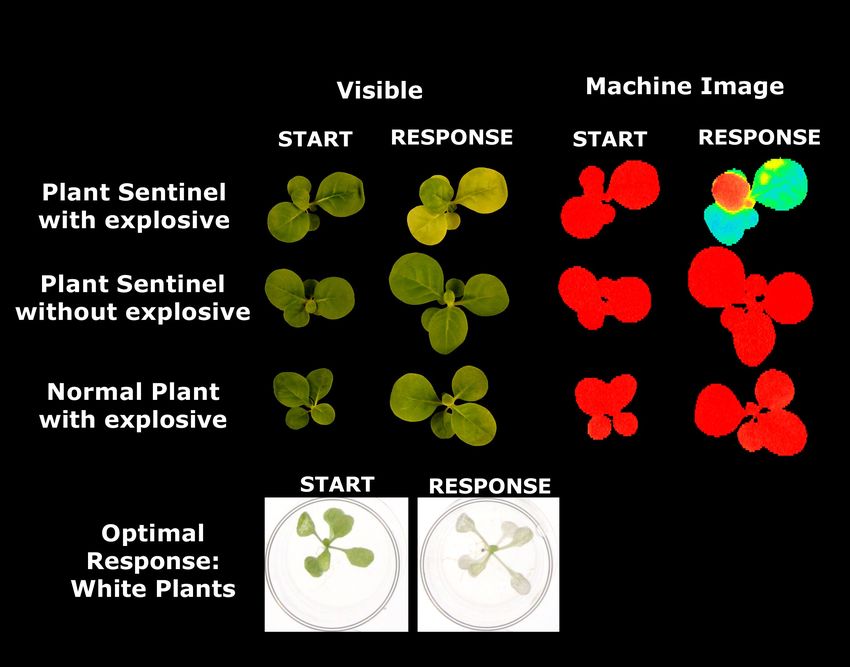
 Imagine if passing through airport security could be as pleasant as a stroll through a park. Scientist June Medford is working to harness the innate sensing abilities of plants, genetically engineering them into lean, green bomb-and-drug detecting machines. Medford is a “synthetic biologist” (not to imply she’s artificial, but to clarify that she dabbles in the re-design of existing, natural biological systems in attempt to find new useful purposes).
“The way we screen [at] airports…is, everyone goes through detector systems and it’s slow. What would make much more sense…is that you would walk through a garden-like setting, with a webcam looking down on plants, seeing if they detected anything,” Medford told Motherboard in a phone interview, “You wouldn’t be able to identify an individual, but if you go through 10 people at a time, well, if it detects something you can look through those people in detail.” Engineered plants could be internet-connected to electronic webcams, detecting color changes before they’re perceptible to the human eye, and signaling an alarm.
Sound far-fetched? Consider that the natural sensors in plants can be over 100 times more receptive than a dog’s.
As a researcher at Colorado State University, Medford worked on projects for The Defense Advanced Research Projects Agency (DARPA), an agency within the United States Department of Defense responsible for developing new technologies for military use by the military. As far back as 2003, she has reprogrammed plants in her lab to serve as security sentinels.
In 2006, she founded Phytodetectors, Inc. along with Timothy Kerbs to pioneer commercialization of plant synthetic biology. They engineered a plant genus known as Arabidopsis to change color when it detects TNT or certain pollutants. Colleagues have been engineering other plants to alert farmers when certain pathogens are present in crops.
“With electronics, we know the path that went from Turing’s computers to a calculator, to the iPhone. We took standardized parts that were…predictable, and we improved them and mass produced them,” she said. “That’s the kind of thing we’re now doing with living organisms. Once you understand the rules, it’s like anything else.”
[youtube]http://youtu.be/kObTt_dR7IM[/youtube]
Writing in Science, Medford and Ashok Prasad stated, “Just as integrated circuits can be reused in diverse electronic devices, form cell phones to aircraft, synthetic biology components [genes] should function predictably in different synthetic circuits and plants.”
She sidesteps association of her work with the heated controversy swirling around genetically modified food. Instead, Medford makes a case for sustainability, pointing out that materials used in today’s electronics and sensors are made from and powered by fossil fuels. Growing a new plant sentinel simply requires new seeds, water and sunlight.
“I think we can literally start doing it this decade, and we should start doing it aggressively,” she said. “We need to come up with new ways of sensing so that we’re saving our environment instead of destroying it.”
“Plants are harder and slower [than working with bacteria],” she said. “Just like anything, it’s research. You take two steps forward, one step back. You’re kind of feeling your way through the dark.” In which case, she should team up with Dr. Alexander Krichevsky, founder of Bioglow, who envisions using plant as lighting fixtures.
Image from Phytodetectors