Ancient Egyptian secret cracked : how they moved massive stones through desert sand

egyptian-stone-mystery-solved

It’s one of the world’s biggest mysteries: how did the ancient Egyptians transport massive stones across the desert to create the pyramids?  Scientist from the FOM Foundation and the University of Amsterdam report that they now know how the pyramid stones were transported. The clue is the dampness of the desert sand.

Previously, Egyptologists were able to show how the ancient Egyptians moved heavy material from quarries to their buildings sites – on barges. But how the schlepped the stones through the desert was one big mystery. But the writing was on the wall, literally.

It’s all about friction. Consider that each stone weighs 2.5 tons. When you put this kind of weight on a simple sled with upturned edges (as they used back then) the weight of the stone would dig into the sand and you’d get stuck. If you’ve ever been dune bashing in the Middle East desert and get stuck you’ll know what I mean.

But if you glide on top of the sand and wet the sand under the sleigh just in front of it, you won’t dig in. It makes the surface stronger and the sand carrying-sled doesn’t get stuck.

Mystery solved!

Researchers at the University of Amsterdam developed some theories and tested them out.

A UvA press release explains,

“The physicists placed a laboratory version of the Egyptian sledge in a tray of sand. They determined both the required pulling force and the stiffness of the sand as a function of the quantity of water in the sand. To determine the stiffness they used a rheometer, which shows how much force is needed to deform a certain volume of sand.

“Experiments revealed that the required pulling force decreased proportional to the stiffness of the sand…A sledge glides far more easily over firm desert sand simply because the sand does not pile up in front of the sledge as it does in the case of dry sand.”

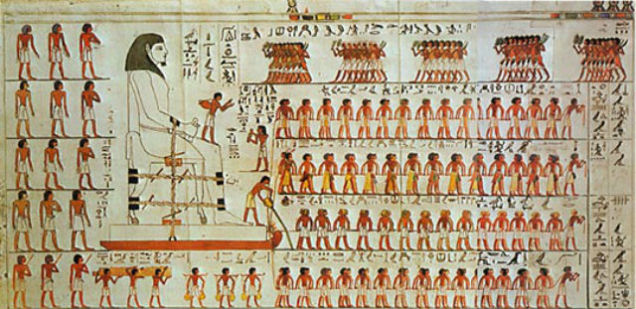
The artwork above, within the tomb of Djehutihotep found in the Victorian Era, depicts the scene. There is a guy pouring liquid into the sand in front of a slave. Look to the right of the statue’s foot.

Now it’s time to solve Stonehenge!

Karin Kloosterman
Karin Kloostermanhttp://www.greenprophet.com
Karin Kloosterman is an award-winning journalist, innovation strategist, and founder of Green Prophet, one of the Middle East’s pioneering sustainability platforms. She has ranked in the Top 10 of Verizon innovation competitions, participated in NASA-linked challenges, and spoken worldwide on climate, food security, and future resilience. With an IoT technology patent, features in Canada’s National Post, and leadership inside teams building next-generation agricultural and planetary systems — including Mars-farming concepts — Karin operates at the intersection of storytelling, science, and systems change. She doesn’t report on the future – she helps design it. Reach out directly to [email protected]
1 COMMENT
  1. This is my theory, I think they built it really simpler than most people would think, One stone would slide over the other very easy by adding mud and water, Realizing this, They first would quarry the huge stones, Then build a temporary road out of them as they go along toward the pyramid location, When they have the number of stones needed, They simply rotate the back stone forward to the front of the road, Sliding them on the road they have built moving each time closer to the pyramid, Then they build a huge sand ramp, Also placing stones on the ramp as well, Sliding those into place and the last ones into the pyramid, When they are finished, The temporary stone road is gone, The stones are all used up at the end and placed into the pyramid, They simply remove the sand ramp!

Comments are closed.

TRENDING

Ethiopians are Looking to Somaliland for Red Sea Access as Global Powers Move In

Somaliland, for its part, has operated as a de facto independent state since 1991. It has its own government, elections, currency, and security forces. It’s often described as one of the more stable and democratic political systems in the region, despite never being formally recognized internationally. 

Egypt building nuclear power

Egypt is building a nuclear energy plant, expected to go online in 2026 when countries like Germany have shut down all its domestic nuclear power. The El Dabaa Nuclear Power Plant is the first nuclear power plant planned for Egypt and will be located at El Dabaa, Matrouh Governorate, Egypt, about 320 kilometers northwest of Cairo. 

More investments of 1.2 GW in Benban solar, Egypt

Egypt’s Ministry of Electricity and Renewable Energy, the Egyptian Electricity Transmission Company, and a consortium comprising Infinity Power and Hassan Allam Utilities Energy Platform signed an agreement to jointly develop solar power projects at Benban Solar, one of the world's largest solar energy parks in Egypt.

Benban solar in Egypt and the companies that make the energy shine

Benban isn’t a single solar plant at all, but a collection of 41 facilities, each developed by different companies but connected through shared infrastructure. This structure is what makes Benban unique: dozens of developers working like nodes in a vast energy network, each feeding electricity into shared substations and Egypt’s national grid.

Undercover divers find fatal flaws in Egypt’s dive boat industry

German magazine stern and broadcaster RTL have confirmed what Green Prophet has reported for months — the sinking of Egypt’s Sea Story dive yacht in November 2024, which killed 11 people, was no freak accident. Their undercover investigation reveals the captain had no licence, the operator lacked legal authorisation, and the vessel had serious stability flaws. A wider probe of 17 Red Sea liveaboard boats found every one had dangerous safety deficiencies, echoing Green Prophet’s earlier coverage of Egypt’s dive tourism safety crisis.

Turning Your Energy Consultancy into an LLC: 4 Legal Steps for Founders in Texas

If you are starting a renewable energy business in Texas, learn how to start an LLC by the books.

Tracking the Impacts of a Hydroelectric Dam Along the Tigris River

For the next two months, I'll be taking a break from my usual Green Prophet posts to report on a transnational environmental issue: the Ilısu Dam currently under construction in Turkey, and the ways it will transform life along the Tigris River.

6 Payment Processors With the Fastest Onboarding for SMBs

Get your SMB up and running fast with these 6 payment processors. Compare the quickest onboarding options to start accepting customer payments without delay.

Qatar’s climate hypocrisy rides the London Underground

Qatar remains a master of doublethink—burning gas by the megaton while selling “sustainability” to a world desperate for clean air. Wake up from your slumber people.

How Quality of Hire Shapes Modern Recruitment

A 2024 survey by Deloitte found that 76% of talent leaders now consider long-term retention and workforce contribution among their most important hiring success metrics—far surpassing time-to-fill or cost-per-hire. As the expectations for new hires deepen, companies must also confront the inherent challenges in redefining and accurately measuring hiring quality.

8 Team-Building Exercises to Start the Week Off 

Team building to change the world! The best renewable energy companies are ones that function.

Thank you, LinkedIn — and what your Jobs on the Rise report means for sustainable careers

While “green jobs” aren’t always labeled as such, many of the fastest-growing roles are directly enabling the energy transition, climate resilience, and lower-carbon systems: Number one on their list is Artificial Intelligence engineers. But what does that mean? Vibe coding Claude? 

Somali pirates steal oil tankers

The pirates often stage their heists out of Somalia, a lawless country, with a weak central government that is grappling with a violent Islamist insurgency. Using speedboats that swarm the targets, the machine-gun-toting pirates take control of merchant ships and then hold the vessels, crew and cargo for ransom.

Related Articles

Popular Categories