

 Barge-mounted desalination plants aren’t unique – the Saudis first deployed them in 2008 – but Israel’s IDE Technologies Ltd. and Japanese shipbuilders have a plan to take offshore floating desalination to a whole new level.
Fresh water is an unbelievably rare resource across the globe – one in six people lack access to clean water and more than 3.4 million people die each year because of its scarcity.
Even in places where water is plentiful, it may be contaminated, or the existing infrastructure may be ill-equipped to deliver sufficient resources to swelling populations.
Stationary desalination plants are restricted to towns and cities within reach of their pipelines, and they come with a smorgasbord of environmental complications.
Mobile, floating desalination plants can travel from place to place to deliver water to more people on an as-needed basis, but desalination is no panacea.
Related: Masdar tackles solar-powered desalination
If anything, it spreads the problem, disperses it, and allows us to destroy our resources more quickly.
It’s expensive to make salt water fit for drinking as it requires a great deal of energy, and at the moment, most desalination plants are not solar-powered. Eventually this will change, but for now we’re mostly stuck with fossil-fueled desalination.
IDE Technologies recently announced that it is likely to deliver a fleet of custom offshore floating desalination plants within the next three years; each ship would be able to produce up to 120,000 cubic meters of fresh water in a day.
Udi Tirosh, a business development director at IDE, told Bloomberg News “ship-based designs could supply water for a city of 850,000 people and Japan’s shipbuilders are among potential partners.”
“The idea is to develop with our partners a multi-year, multi-vessel plan that would eventually supply significant capacity in various places in the world.”
Good news – getting fresh water to more people, saving lives – but also disturbing. What will our oceans look like in 10, 20, 30 years? Enormous cesspools of briny, trashy water filled with jellyfish and oil sheen?
:: Bloomberg
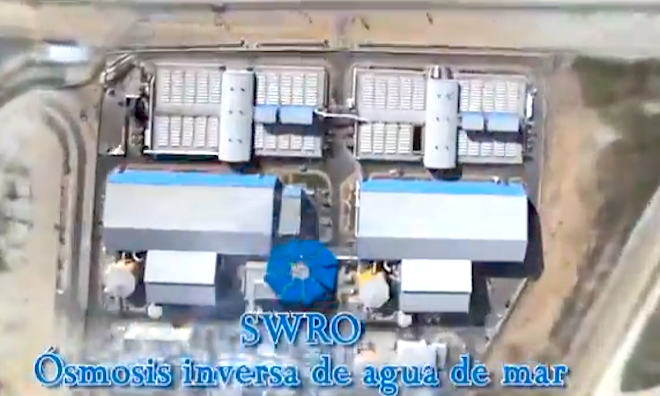
Image via screenshot of IDE Technologies You Tube demonstration




[…] IDE Technologies aims for a fleet of floating water desalination plants in three years – Barge-mounted desalination plants aren’t unique – the Saudis first deployed them in 2008 – but Israel’s IDE Technologies Ltd. and Japanese shipbuilders have a plan to take offshore floating desalination to a whole new level. Fresh water is an … […]
[…] IDE Technologies aims for a fleet of floating water desalination plants in three years – Barge-mounted desalination plants aren’t unique – the Saudis first deployed them in 2008 – but Israel’s IDE Technologies Ltd. and Japanese shipbuilders have a plan to take offshore floating desalination to a whole new level. Fresh water is an … […]
[…] IDE Technologies aims for a fleet of floating water desalination plants in three years – Barge-mounted desalination plants aren’t unique – the Saudis first deployed them in 2008 – but Israel’s IDE Technologies Ltd. and Japanese shipbuilders have a plan to take offshore floating desalination to a whole new level. Fresh water is an … […]
[…] IDE Technologies aims for a fleet of floating water desalination plants in three years – Barge-mounted desalination plants aren’t unique – the Saudis first deployed … multi-vessel plan that would eventually supply significant capacity in various places in the world.” Good news – getting fresh water to more people, saving lives … […]
[…] IDE Technologies aims for a fleet of floating water desalination plants in three years – Barge-mounted desalination plants aren’t unique – the Saudis first deployed … Fresh water is an unbelievably rare resource across the globe – one in six people lack access to clean water and more than 3.4 million people die each year because … […]
[…] IDE Technologies aims for a fleet of floating water desalination plants in three years – Barge-mounted desalination plants aren’t unique – the Saudis first deployed them in 2008 – but Israel’s IDE Technologies Ltd. and Japanese shipbuilders have a plan to take offshore floating desalination to a whole new level. Fresh water is an … […]
Dear Michael,
I would like to avoid being labelled as a smart@ss but 1 cubic kilometer contains 1 billion cubic meters (of anything, say, water), so instead of 1/8th the true ratio is 1/8000.
At the same time – partly because of this disproportion – I do not understand the author’s worries. It feels like some paragraphs were cut or incidentally deleted from before the dire views at the end. So please, dear author, tell us how you came to your jellyfishy-sheeny scenario?
Thank you!
Desalination is quite expensive but desalination plants are the new and much valuable sources of water.
I was informed by this article.
However, I immediately recoiled from the last paragraph in which the author projects an assumption that somehow there will be a dramatic change for the worse in the salinity of the oceans.
In my meager research, I could not find support for such an outcome.
The article states that each unit could evaporate about 120,000 cubic meters of water per day. Changing that measurement into cubic kilometers yields about 1/8th of a cubic kilometer per day.
Here are two sources for consideration.
The first is an estimation of total evaporation on a 24-hour basis that has apparently been going on every day for a few billion years. This person estimates a little more than 1,000 cubic kilometers of total ocean evaporation occurs each day. So eight of the desalination units would total about 1/1000th of total ocean evaporation or about 1/10th of a percent. I expect that the resulting clean water would be utilized on land and would eventually return to the oceans by way of drainage or rainfall. So the net change in ocean water volume and therefore ocean salinity should be about zero.
Here is a link to one of many such estimates: http://www.madsci.org/posts/archives/2006-05/1148725781.Es.r.html
The second is a report from NASA that shows and explains the natural ocean water cycle.
I found both to be quite interesting.
I can understand that the author did not have space or time to go into a scientific explanation of the proposed desalination project, but I do not understand the basis for that last assumption.
Here is the link to NASA. Very informative website.
http://science.nasa.gov/earth-science/oceanography/ocean-earth-system/ocean-water-cycle/
[…] Email […]