Sushi nukes? Watch what imported Japanese fish you eat

fukushima-fish-high-radiation.siDo you like to eat imported sea fish, especially those like supposedly banned Bluefin tuna? Following the March 2011 Fukushima nuclear plant meltdown disaster, many fish caught in Pacific Ocean waters near Japan’s most well known nuclear power plant have been found to contain abnormally high amounts of radiation.

The 2011 Fukushima nuclear reactor meltdown occurred as a result of a massive tsunami tidal wave that was the aftermath of a powerful 9.0 magnitude earthquake off the east coast of Honshu, Japan. The damage caused to the nearby Fukishima nuclear power plant was so massive that anti-nuclear activist Dr. Helen Caldicott later referred to it as “much worse than Chernobyl“.

In the nearly three years since this terrible event, substantial amounts of radiation have continued to leak from the plant into the Pacific Ocean; resulting in serious danger to marine life.

Japan’s fishing industry exports more than $13 million USD worth of fish products annually to Canada alone. Fish caught in waters off Japan have obviously been affected by the Fukushima radiation leakage, especially Caesium – 137, one of the most common radioactive substances produced by nuclear reactors.

Due to its high water solubility Ceasium – 137 is now being found in disturbing quantities in many forms of Pacific ocean marine life; ranging from algae and plankton to many species of fish that wind up on consumer dinner tables.

Radioactive Caesium is said to cause various types of cancers; as well as infertility and birth defects.

In a report published in the Canadian newspaper The Vancouver Sun, the following information regarding levels of Caesium or Cesium was revealed by Nicholas Fisher, a marine sciences professor at the State University of New York at Stony Brook:

“In November (2013), the average Japanese catch had 111 becquerels of cesium per kilogram -above the new radiation ceiling of 100 becquerels per kilogram that Japan has announced it will implement for food this spring. The November level declined from a peak level of 373 becquerels per kilogram last April.

“But it was an increase from the October average of 78 becquerels per kilogram. Such persistently elevated levels of radiation warrant more monitoring and research.”

Fisher added:. “It’s not something we can easily dismiss. I would probably be hesitant to eat a lot of those fish”.

As we pointed out earlier in this article on radioactive seafood, fish tested that contained abnormally high level levels of radioactive Caesium included anchovies, halibut, mackerel, sardines, cod, shark, and monk fish.

Seaweed, the material sushi wrapping is usually made of, was found to contain high Caesium – 137 levels in 100% of all specimens tested!

Whether this marine borne radioactivity reaches other oceans, including the Indian Ocean and the Arabian Gulf,  has not been determined.

Gordon Edwards, president of the Canadian Coalition for Nuclear Responsibility, summed up these findings accordingly: “There is no safe level of radiation. Government scientific testing authorities should be making every effort to monitor food.”

Read more on the Fukushima nuclear disaster:

Ocean’s Garbage Patches Cleanup Tackled by Teen Boyan Slat

An Energy Insider for Nuclear Newcomers in the Middle East

Dr Helen Caldicott: Fukushima Nuclear Meltdown Much Worse Than Chernobyl

Japan Nuclear Meltdown Will Seriously Affect World Environment

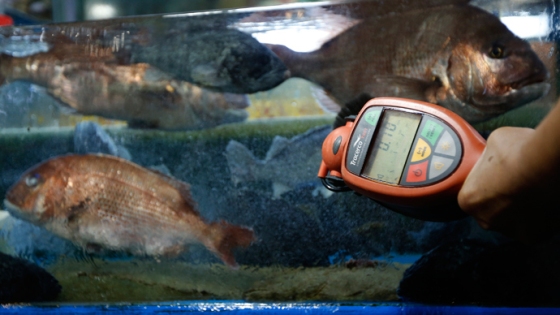
Photo of testing fish for radiation by Reuters/Kim Hong-Ji

Maurice Picow
Maurice Picowhttps://www.greenprophet.com/
Maurice Picow grew up in Oklahoma City, U.S.A., where he received a B.S. Degree in Business Administration. Following graduation, Maurice embarked on a career as a real estate broker before making the decision to move to Israel. After arriving in Israel, he came involved in the insurance agency business and later in the moving and international relocation fields. Maurice became interested in writing news and commentary articles in the late 1990’s, and now writes feature articles for the The Jerusalem Post as well as being a regular contributor to Green Prophet. He has also written a non-fiction study on Islam, a two volume adventure novel, and is completing a romance novel about a forbidden love affair. Writing topics of particular interest for Green Prophet are those dealing with global warming and climate change, as well as clean technology - particularly electric cars.
2 COMMENTS
  1. Radioactive water leaking at Fukushima
    Jan. 19, 2014 NHK (Japan Broadcasting Corporation)
    Tokyo Electric discovered the water flow on the 1st floor of the number 3 reactor building on Saturday.
    The stream is about 30 centimeters wide and continuously pours into a drain.

    An investigation showed the water contains nearly as high a level of radioactive materials as the contaminated water accumulating in the number 3 reactor building’s basement.
    Tokyo Electric detected 24 million becquerels per liter of beta ray-emitting radioactive substances, including strontium, as well as 1.7 million becquerels per liter of Cesium 137.

    Tokyo Electric suspects the water for cooling melted fuel in the containment vessel is leaking for some unknown reason.

LEAVE A REPLY

Please enter your comment!
Please enter your name here

TRENDING

Charbone produces first hydrogen at Quebec’s local “model” UHP plant

The Sorel-Tracy site is the first decentralized clean UHP hydrogen production facility in Quebec and is positioned as a model for North America. The plant is part of CHARBONE’s five-phase plan to deploy a network of modular hydrogen production facilities across the continent, supported by the company’s growing specialty-gas distribution platform.

Sex selection kits for embryos available in the US and Canada

We used to be shocked to hear about gender...

Puppies used in heart experiments then killed at Canadian hospital

It sounds made up—until you read the documents, see...

5 Brilliant eco-architect alternatives to Foster + Partners

In the world of architecture and design, there’s a growing movement towards exploring new, uncharted territories. While renowned firms like Foster + Partners and Zaha Hadid have undeniably shaped the skyline of modern architecture, there’s a wealth of untapped potential in emerging voices that can offer bold, innovative, and sustainable alternatives. These next five studios are pushing the boundaries of creativity, blending technology with art, and designing spaces that respond to the future needs of communities and the planet. Let’s take a closer look at these pioneers who are crafting tomorrow’s architectural landscape today.

Starting spring on MoonCool’s ebike

Early April in Northern Ontario, Canada and finally a few dry spots to test the MoonCool e-bike. This was my first attempt at putting together and riding an e-bike.

Qatar’s climate hypocrisy rides the London Underground

Qatar remains a master of doublethink—burning gas by the megaton while selling “sustainability” to a world desperate for clean air. Wake up from your slumber people.

How Quality of Hire Shapes Modern Recruitment

A 2024 survey by Deloitte found that 76% of talent leaders now consider long-term retention and workforce contribution among their most important hiring success metrics—far surpassing time-to-fill or cost-per-hire. As the expectations for new hires deepen, companies must also confront the inherent challenges in redefining and accurately measuring hiring quality.

8 Team-Building Exercises to Start the Week Off 

Team building to change the world! The best renewable energy companies are ones that function.

Thank you, LinkedIn — and what your Jobs on the Rise report means for sustainable careers

While “green jobs” aren’t always labeled as such, many of the fastest-growing roles are directly enabling the energy transition, climate resilience, and lower-carbon systems: Number one on their list is Artificial Intelligence engineers. But what does that mean? Vibe coding Claude? 

Somali pirates steal oil tankers

The pirates often stage their heists out of Somalia, a lawless country, with a weak central government that is grappling with a violent Islamist insurgency. Using speedboats that swarm the targets, the machine-gun-toting pirates take control of merchant ships and then hold the vessels, crew and cargo for ransom.

Leopoldo Alejandro Betancourt López Turned Ocean Plastic Into Profitable Sunglasses

Few fashion accessories carry the environmental burden of sunglasses. Most frames are constructed from petroleum-based plastics and acrylic polymers that linger in landfills for centuries, shedding microplastics into soil and waterways long after they've been discarded. Leopoldo Alejandro Betancourt López, president of the Spanish eyewear brand Hawkers, saw this problem differently than most industry executives.

Why Dr. Tony Jacob Sees Texas Business Egos as Warning Signs

Everything's bigger in Texas. Except business egos.  Dr. Tony Jacob figured...

Israel and America Sign Renewable Energy Cooperation Deal

Other announcements made at the conference include the Timna Renewable Energy Park, which will be a center for R&D, and the AORA Solar Thermal Module at Kibbutz Samar, the world's first commercial hybrid solar gas-turbine power plant that is already nearing completion. Solel Solar Systems announced it was beginning construction of a 50 MW solar field in Lebrija, Spain, and Brightsource Energy made a pre-conference announcement that it had inked the world's largest solar deal to date with Southern California Edison (SCE).

Related Articles

Popular Categories