

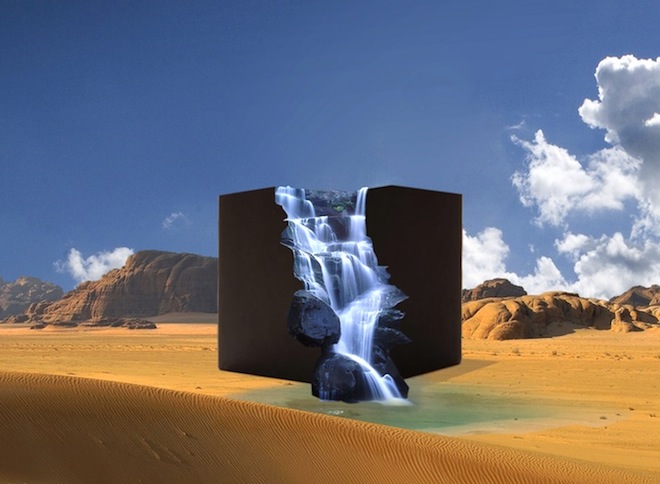
 The same team behind SunGlacier, an extraordinary solar-powered artificial leaf that produces ice in the middle of the desert, has come up with a new concept – ‘Desert Cascades.’
Whereas SunGlacier produces ice from water vapor, Desert Cascades creates a cascading waterfall. Still in its conceptual phase, this art project proposes a self-powering cube of solar panels that collects water vapor from humidity in the air.
Technology like this is easily deployed in Arabian Gulf countries such as Abu Dhabi, where humidity levels hover – on average – around 70 percent.
Like the SunGlacier, which sounds improbable at first but has proved its potential through a simulated desert environment inside a shipping container, the Desert Cascades project aims to encourage other artists, designers and scientists to stretch their imagination when it comes to solving some of the world’s most pressing problems.
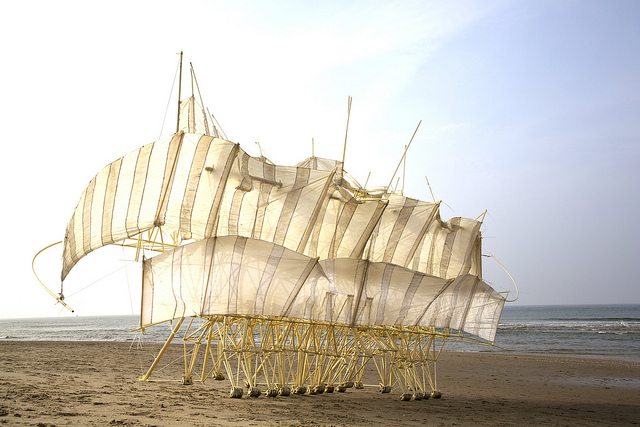
“Developments in technology are ever increasing in speed,” writes Ap Verheggen, the Dutch artist who continues to develop fascinating answers to the problem of water shortages in arid environments. Dutch artists love to dream big. Remember Theo Jansen and Strandbeest, the sculptures who come to life by walking with the wind.
“What appears impossible at the present can quickly become a reality within a number of months or a few short years.”
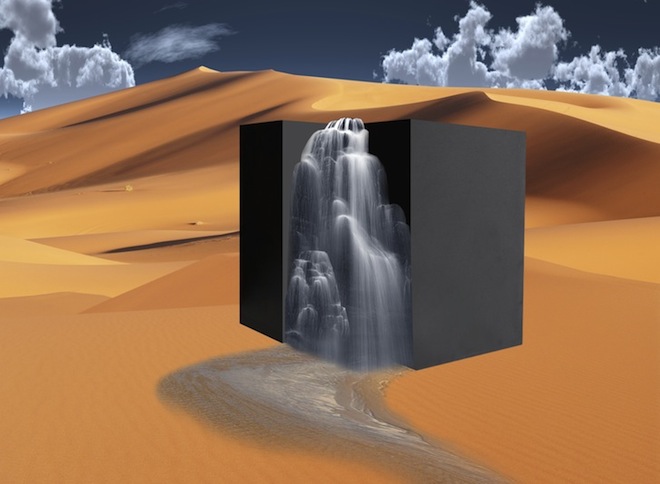
Verheggen trusts that solar technology has progressed at a considerable pace, and hopes to inspire people to use these technologies in new, inventive ways. A waterfall gushing in the middle of the desert, in other words, can open people’s eyes to previously unexplored possibilities.
Ambitious, yes. Slightly unrealistic? Perhaps. And Verheggen is honest about this.
“We’ve noticed a huge gap between theory and reality in testing our ideas, so naturally it has been impossible to make conclusions before empirical testing,” he says.
Despite the challenges presented by his wild thinking, he remains undaunted.
Referencing both SunGlacier and Desert Cascades, the UNESCO-IHE ambassador writes, “Both are conceived with the purpose of demonstrating that we need to think in terms of solutions as man always has done – also in adapting to a changing climate.”
He added that in order to adapt to a changing climate, we also need to rewire our mind set.
“For me it is clear that climate change = culture change.”


[…] Solar-Powered ‘Desert Cascades’ Cube Gushes Water in the Desert […]
Nice to see that you’re all are finally coming around to using my invention. You could at the least show some respect for creativity.
Ref: http://water-portal.com/
Ref: http://www.psipw.org/index.php
It’s a simple design, what’s taking so long to reverse engineer it? You can see again at
http://www.indiegogo.com .
Water condensation station. This is a smaller version of the previous design.
T. A. Tubman
Good stuff Tony,
Have you checked out; Air2Water LLC.? I believe they’ve notice your concept as well. I would like to be a part of this culture charge in combating the climate change in drought stricken areas. All the best.
Tony M.
Patents for water-from-air inventions date back to at least the year 1900—see the list at http://www.atmoswater.com/patents-about-water-from-air-and-atmospheric-water-generators.html
This is great news. This method can be used to get water in certain parts of Africa that are landlocked.
It it great to see this type of conceptual thinking. Concepts like this need to be pursued as they lead to a lot of learning and knowledge.
To help narrow the gap between theory and reality, here is some quantitative information about the atmospheric water vapour resource in Abu Dhabi (27 m above sea level). The values following each month are the monthly average water vapour densities in units of grams of water vapour per cubic metre of moist air.
Jan 9.8; Feb 10.4; Mar 10.3; Apr 12.4; May 13.9; Jun 17.7; Jul 18.7; Aug 19.8; Sep 18.9; Oct 15.9; Nov 13.3; Dec 11.1
The range of volumes of desert air that would have to be blown or drawn through the system to produce one litre (1000 grams) of liquid water would be 102 cubic metres in January and 50 cubic metres in August.
Water-from-air systems usually need 0.4 kWh of energy to produce one litre of liquid water.
An Olympic-sized swimming pool contains 2,500,000 L of water. Meeting modest total water requirements for a person of 50 L/day, the pool volume could support a population of 50,000 for one day.
To fill such a pool in one 24 hour day in August in Abu Dhabi would require processing 125,000,000 cubic metres of desert air. The amount of energy required to change the phase of the water in the air to liquid water would be 1,000,000 kWh. The energy required to drive fans or blowers is not included in this energy calculation.
I think it would be a challenge to supply the solar energy required for a cube as illustrated in the concept drawing. But, even now, machines are being manufactured, sold, and commissioned that can produce 2500 L/day of water from the air in tropical climates. These machines (often called atmospheric water generators) can supply a neighbourhood of 50 people with 50 L per person per day. One interesting benefit of water-from-air is that it makes decentralized water distribution networks quite feasible so the high capital costs of typical water distribution infrastructure can be avoided.
Looking at the daily pool-filling task another way, we would need 1000 of the 20-foot shipping container sized existing machines (2500 L/d x 1000 = 2,500,000). If each machine costs $150,000 installed, a very rough capital cost estimate for producing 2,500,000 L/d would be 150 million dollars. But, not all the machines need to be put in place at once. They can be installed incrementally, as water supply infrastructure funds become available.
It is possible to go on and do a proper amortized costing but I just thought it would be interesting to have a quick look at the numbers involved in this concept.
Lots more information about the fascinating technology of water-from-air may be found at http://www.atmoswater.com. The site has charts available that quantify the water-from-air resource for many sites around the world in a variety of climates.
This is like reading the posts of 2 advertizers on craigslist and thinking, they should talk to each other! Aren’t Cyprus and Lebanon dealing with fresh water shortages? They lie on the meditarranean cost, wher humidity is high. The water cascade cube would be an ideal fit I think.