

A Grenade Garden Helps Palestinian Mother Move On

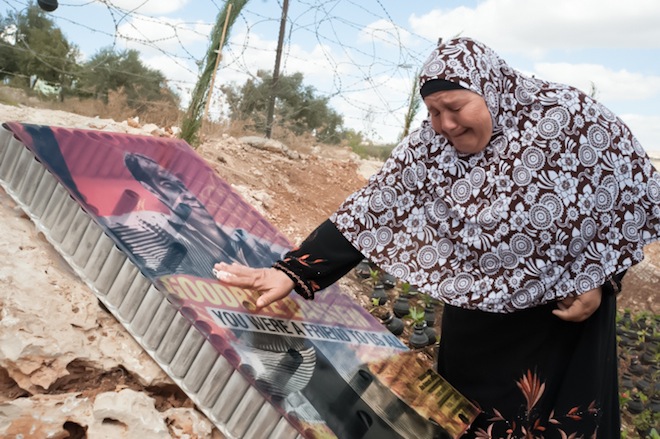
Grenade Garden, Ryan Rodrick Beiler, adaptive reuse, recycled materials, separation barrier, Bassem Abu Rahman, tear gas grenade garden, West Bank, IsraelWhen Israeli soldiers killed her son Bassem in 2009, Sabiha Abu Rahman faced the impossible task of being alive without him. She has since turned her grief into balm with a beautiful garden full of repurposed tear gas grenades.

Israelis and Palestinians clash every week along the separation barrier in Bil’in, a Palestinian village located roughly seven miles outside of Ramallah.

Sometimes these events end in tragedy, as it did in 2009 when an Israeli tear gas grenade struck 30 year old Bassem in the chest. He later died from his injuries. Another time, an American was struck in the head and spent years (and thousands of dollars) recovering from the wound.
Grenade Garden, Ryan Rodrick Beiler, adaptive reuse, recycled materials, separation barrier, Bassem Abu Rahman, tear gas grenade garden, West Bank, Israel

What’s left of these conflicts – the spent tear gas grenades and other emptied weapons – litter the surrounding landscape, according to photographer Ryan Rodrick Beiler. Instead of leaving them to languish, unseen, polluting the land, activists have collected them, and Bassem’s grief-stricken mother has put them to creative use.

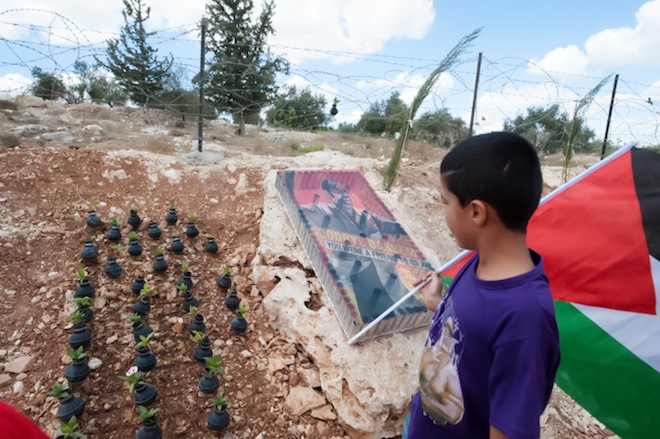
Quite like the Libyan artist who turns weapons into sculptures and Pedro Reyes’ mechanical orchestra made with repurposed weapons, Sabiha planted flowers in the empty shells, creating a garden of resistance that somehow diffuses the mind-numbing, never-ending dispute between the two people.

Some of the grenades are planted in rows in a makeshift bed, while others hang from small pieces of wire – like decorations on a thorny Christmas tree. At the core of her garden, Bassem’s mother touches a photograph of her son, which she mounted on a frame of tear gas shell casings.
Grenade Garden, Ryan Rodrick Beiler, adaptive reuse, recycled materials, separation barrier, Bassem Abu Rahman, tear gas grenade garden, West Bank, Israel

While we have always steered clear of the never-ending political jockeying that takes place in the Middle East region, wisely leaving all posturing to the pundits, we felt that it would be disrespectful to both the Abu Rahman family and Beiler to decontextualize the grenade garden’s genesis.

It is also fair to say that violence from both sides will end in more tragedy if it doesn’t stop.

Nonetheless, we are consistently gladdened to see the rise of recycling initiatives throughout the region, since it demonstrates that people are beginning to see common every day items – be they destructive weapons or benign containers – with fresh eyes.

This particular adaptive reuse project brings much needed color to a grey and cataclysmic situation; we hope it promotes healing on both sides of the separation barrier.

:: Alternative Information Center

Tafline Laylin
Tafline Laylinhttp://www.greenprophet.com
As a tour leader who led “eco-friendly” camping trips throughout North America, Tafline soon realized that she was instead leaving behind a trail of gas fumes, plastic bottles and Pringles. In fact, wherever she traveled – whether it was Viet Nam or South Africa or England – it became clear how inefficiently the mandate to re-think our consumer culture is reaching the general public. Born in Iran, raised in South Africa and the United States, she currently splits her time between Africa and the Middle East. Tafline can be reached at tafline (at) greenprophet (dot) com.

TRENDING

Cow dung for biomaterials

Cow dung could be used to create a next generation sustainable material, according to a new report.

Restored Galilee home adaptive reuse in mystical setting

The design team of Henkin Irit and Shavit Zohar...

Colonel microbrewery built with recycled materials opens in Lebanon

While many Muslims don't drink alcohol, the people of Batroun, Lebanon...

Plastic for kibble – vending machines for stray animals in Istanbul

There are roughly 150,000 stray cats and dogs in...

Turkey’s Designnobis turns plastic bottles into solar-powered lanterns

If you live in the Middle East, surely you...

Turning Your Energy Consultancy into an LLC: 4 Legal Steps for Founders in Texas

If you are starting a renewable energy business in Texas, learn how to start an LLC by the books.

Tracking the Impacts of a Hydroelectric Dam Along the Tigris River

For the next two months, I'll be taking a break from my usual Green Prophet posts to report on a transnational environmental issue: the Ilısu Dam currently under construction in Turkey, and the ways it will transform life along the Tigris River.

6 Payment Processors With the Fastest Onboarding for SMBs

Get your SMB up and running fast with these 6 payment processors. Compare the quickest onboarding options to start accepting customer payments without delay.

Qatar’s climate hypocrisy rides the London Underground

Qatar remains a master of doublethink—burning gas by the megaton while selling “sustainability” to a world desperate for clean air. Wake up from your slumber people.

How Quality of Hire Shapes Modern Recruitment

A 2024 survey by Deloitte found that 76% of talent leaders now consider long-term retention and workforce contribution among their most important hiring success metrics—far surpassing time-to-fill or cost-per-hire. As the expectations for new hires deepen, companies must also confront the inherent challenges in redefining and accurately measuring hiring quality.

8 Team-Building Exercises to Start the Week Off 

Team building to change the world! The best renewable energy companies are ones that function.

Thank you, LinkedIn — and what your Jobs on the Rise report means for sustainable careers

While “green jobs” aren’t always labeled as such, many of the fastest-growing roles are directly enabling the energy transition, climate resilience, and lower-carbon systems: Number one on their list is Artificial Intelligence engineers. But what does that mean? Vibe coding Claude? 

Somali pirates steal oil tankers

The pirates often stage their heists out of Somalia, a lawless country, with a weak central government that is grappling with a violent Islamist insurgency. Using speedboats that swarm the targets, the machine-gun-toting pirates take control of merchant ships and then hold the vessels, crew and cargo for ransom.

Related Articles

Popular Categories