

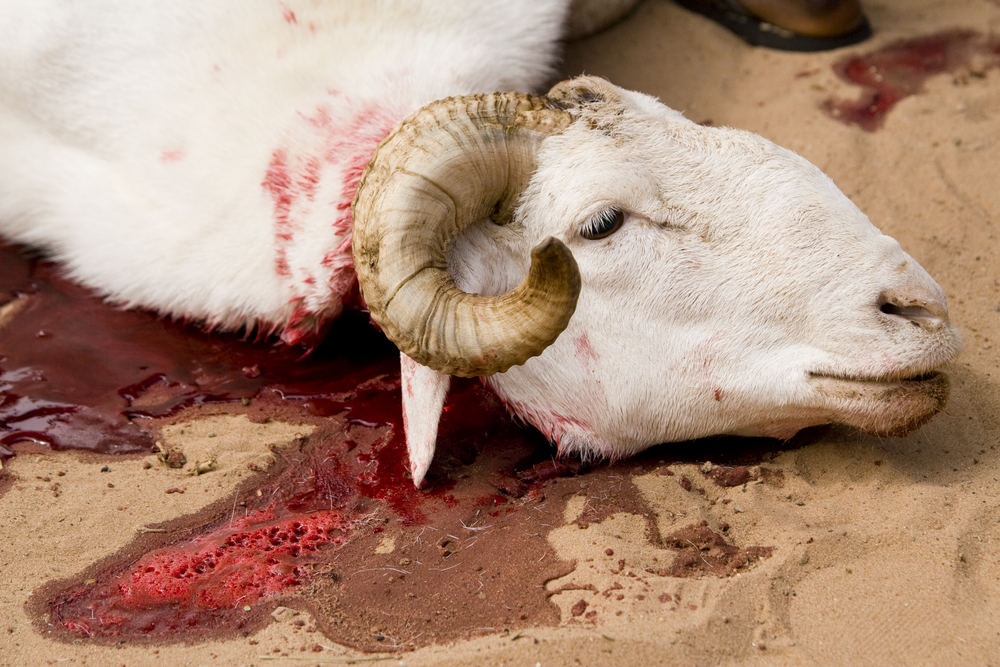
 It’s the final run-up to Eid al-Adha, when Muslims around the planet commemorate God’s test of the Prophet Ibrahim by slaughtering a hapless quadruped: also called Qurbani, it’s an essential religious ritual wherein an estimated 100 million creatures will be killed.
Islamic law is crystal clear that in order for meat to be halal, animals can’t be mutilated, deformed or diseased nor experience discomfort or stress prior to slaughter. Any meat that doesn’t abide by these precepts becomes haram.
Can animals used in the live-export trade, who endure long transport in immeasurably cruel conditions (like by ship from Australia) be considered halal?
The Middle East live-imports most of its sheep from Australia, with tens of thousands of animals crammed onto huge ships each month, constrained in abominable conditions. Half of all sheep deaths during sea transport are caused by starvation as grass-fed animals don’t recognize the manufactured feed provided on ship, and stop eating. Crammed shipboard conditions raise dehydration levels and promote disease.
Spend some time with the halal ranchers oxymoronically named Mercy Slaughter to get a view of how halal sacrifice ought to be done:
[youtube]http://www.youtube.com/watch?v=vc5BWafzEu4[/youtube]
Qurbani is essential for people with financial means, yet none of my Amman Jordanian friends has ever personally killed an animal. They’ve witnessed the ceremony as children, but never did the deed. Instead, most urbanites drop some dinar with butchers in exchange for a neatly packed parcel of meat and an assurance that the rest is handed to the needy.
Organizations such as Tkiyet Um Ali are also emerging, offering value (thanks to bulk buying) and organized distribution to the poor. An important side benefit of community-centric sacrifice-sharing is mitigation of problems related to improperly executed halal practices and poor waste management, since animals are slaughtered in Australia and meat shipped frozen to the Middle East.
This modernity is further distancing Muslims from animal slaughter. (Islamic vegetarians must participate in the practice: obligated to pay for an animal sacrifice, and distribute the meat to the needy, but they do not need to consume the food themselves.)
In his book Animals in Islam, Al-Hafiz B. A. Masri quotes Sheik Fardi Wagdi, “There may come a day when Muslims shall have to substitute the rite of animal sacrifice with other methods of giving alms.”
There is a growing movement of Muslims who have declared a fatwa on animal killings, who consider that sacrifice is not obligatory. They call to reform animal transport processes and advocate (in lieu of meat offerings) other means of support for the poor, including the sharing of vegetarian food, and pursuit of public services like educational support of the care of orphans.
“It is neither their meat nor their blood that reaches Allah; it is your piety that reaches Him.” (Qu’ran 22:37)
Image of sacrificial animal from Shutterstock



Qurbani is worship for Muslims to slaughter animals (goats, cows, camels) which is good to give people and be eaten meat
Our God, love it
Please stop this cruel act!
Sacrificing animals who cant fend for themselves will not satisfy god, be kind to all living beings and see how god will shower you with blessings
absolutely sick, all for what.! it’s insane & inhumane…we should not be doing this to the animals it is time for a sensible change…!! wake UP..!!!!