HUSH: A Seating Pod that Creates Privacy Anywhere

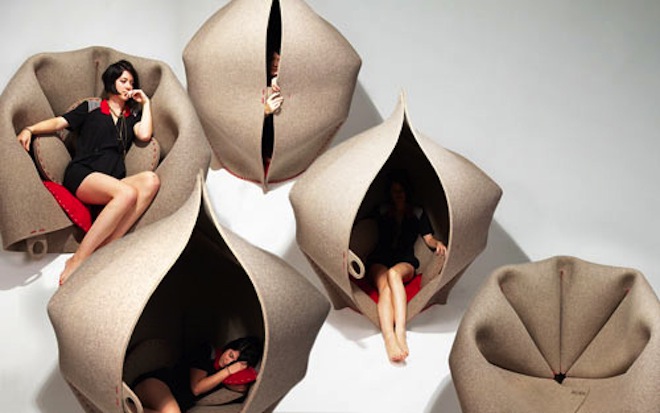
HUSH, Freyja Sewell, recycled materials, design, seatingHUSH is a brilliant seating pod designed by Freyja Sewell that creates a small tucked away spot anywhere – even in the most crowded cities. A Brighton designer who finished her studies at Nagoya University in Japan, Sewell knows what it’s like to crave a quiet space that makes her feel comforted and safe.
HUSH, Freyja Sewell, recycled materials, design, seating

There are 31 megacities around the world, or cities that have a population of over 10 million people, and three of them are in the Middle East: Cairo, Istanbul and Tehran.

With more people crowding into spaces increasingly absorbed by buildings or shopping malls and airports, many city dwellers have been forced to sacrifice their breathing room.

Rents are high, so people share accommodation, buses are crowded, so are trains, and it’s almost impossible to find a quiet moment with cars rushing by or honking on the street.

Or if you’re in Egypt, the country erupts into spontaneous mass protests every now and then.

Sewell sought to provide a sustainable solution to this very important problem, one that would be available to a wider market. She didn’t want her design to stay stuck in a museum.
HUSH, Freyja Sewell, recycled materials, design, seating

Instead, she designed the HUSH seating pod using methods and materials that enable her to commercialize her quirky concept.

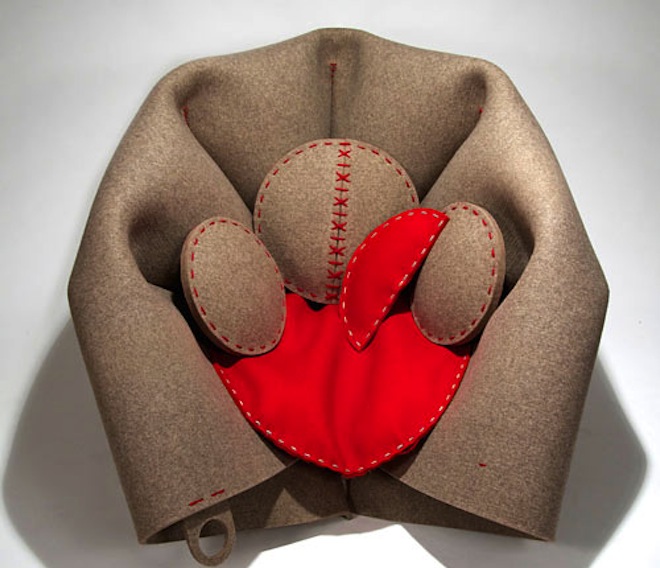
It can be used as an open seat made of 100 percent wool felt, or it can be partially closed up, or someone might choose to button it up completely.

Sewell says that with these design, she sought to recreate the feeling of being inside the protective cavity of a womb.

“The ‘womb’ shape inspires very different feelings in different people; to me it is a warm, cosy space, for contemplation and rest,” she says.

There is a catch, however: it costs £2,700 to have the luxury of space. In Egypt, you could get a year-long lease for an apartment with that kind of money.

:: Design-Milk
Tafline Laylin
Tafline Laylinhttp://www.greenprophet.com
As a tour leader who led “eco-friendly” camping trips throughout North America, Tafline soon realized that she was instead leaving behind a trail of gas fumes, plastic bottles and Pringles. In fact, wherever she traveled – whether it was Viet Nam or South Africa or England – it became clear how inefficiently the mandate to re-think our consumer culture is reaching the general public. Born in Iran, raised in South Africa and the United States, she currently splits her time between Africa and the Middle East. Tafline can be reached at tafline (at) greenprophet (dot) com.
2 COMMENTS
  1. I love the idea. Especially for children sharing rooms. But the price point is too high. And being made out of wool? There is a lot of children allergic to that, like my kids. Awesome idea though!

  2. This is a wonderful and ingenious design. When I was a child I would climb into the closet and sit under the hanging clothes to be alone and have quiet. I could hear people call me, but I was alone and safe. What a glorious feeling. Actually, I did it until I was 30! People crave silence and personal space everywhere in our world. This design is brilliant. However, at 2700EU it’s rather expensive. That’s over $3500 for a chair, albeit a very special chair, but still it’s a chair. I’d buy one at $1000-$1500 price point, but not $3500. Work on bringing the cost down with sacrificing the design and you’ll have a wide target market. In the USA they could become a staple for a child’s room. Children are small, like the interior of the chair. They love to hide. And now mom knows where they are hiding.

Comments are closed.

Hot this week

How Renewable Energy is Revolutionizing the Way We Power Our World

Solar has become the star of the transition thanks to modular hardware and straightforward installation. It fits dense cities and remote towns alike. Many companies are turning to rooftop arrays and carport systems - and exploring commercial solar installation as a practical way to lock in future savings.

How does one start prepping?

Faced with an extreme winter storm this year, Americans wonder how to be prepared for catastrophe. Miriam has lived through wars in the Middle East - so she's prepared on giving you a guide to prepping.

Fishermen sue tire manufacturers on behalf of the salmon

A federal trial in San Francisco has brought US tire manufacturers, fishing groups, and environmental scientists into court over a chemical most drivers have never heard of — but which scientists say may be silently reshaping aquatic ecosystems.

Listening to Water: Tarek Atoui’s Next Work for Tate Modern

Born in Beirut, Lebanon in 1980 and now living in Paris, Atoui has spent years building instruments that don’t sit comfortably in concert halls. Many of them involve water, glass, and ceramics — materials that react to sound instead of simply producing it.

Leading Through a Dual-Energy Transition: Balancing Decarbonisation with Energy Security

Experience in one area of the energy industry isn't enough to guarantee readiness across all the others. That's where a structured program like an MBA in energy can come in. Today's advanced curricula explore energy economics, finance, policy, and strategic management alongside the technical subjects. And when pursuing an energy MBA online, professionals can skill up and retrain without having to step out of the labor market -- an important perk at a time when skilled professionals are already in short supply.

Topics

How Renewable Energy is Revolutionizing the Way We Power Our World

Solar has become the star of the transition thanks to modular hardware and straightforward installation. It fits dense cities and remote towns alike. Many companies are turning to rooftop arrays and carport systems - and exploring commercial solar installation as a practical way to lock in future savings.

How does one start prepping?

Faced with an extreme winter storm this year, Americans wonder how to be prepared for catastrophe. Miriam has lived through wars in the Middle East - so she's prepared on giving you a guide to prepping.

Fishermen sue tire manufacturers on behalf of the salmon

A federal trial in San Francisco has brought US tire manufacturers, fishing groups, and environmental scientists into court over a chemical most drivers have never heard of — but which scientists say may be silently reshaping aquatic ecosystems.

Listening to Water: Tarek Atoui’s Next Work for Tate Modern

Born in Beirut, Lebanon in 1980 and now living in Paris, Atoui has spent years building instruments that don’t sit comfortably in concert halls. Many of them involve water, glass, and ceramics — materials that react to sound instead of simply producing it.

Leading Through a Dual-Energy Transition: Balancing Decarbonisation with Energy Security

Experience in one area of the energy industry isn't enough to guarantee readiness across all the others. That's where a structured program like an MBA in energy can come in. Today's advanced curricula explore energy economics, finance, policy, and strategic management alongside the technical subjects. And when pursuing an energy MBA online, professionals can skill up and retrain without having to step out of the labor market -- an important perk at a time when skilled professionals are already in short supply.

From Green Energy to Healthy Societies: Why old systems thinking is becoming relevant again

Across the Middle East and North Africa, large investments are being made in green hydrogen, renewable energy, water infrastructure and sustainability. Most of these efforts are discussed in the context of climate change, decarbonization and economic diversification. That framing is important, but it may not capture their full value.

We saw peace – an interreligious encounter deep in our eyes

They came from Israel, Palestine, Jordan, Iraq, Yemen, Morocco, Tunisia, Lebanon, Egypt… There are Sunni Muslims, Shiite Muslims, Jews (Orthodox and Reform), Orthodox Christians, Coptic Christians, Protestant Christians, Druze, Baha'is, a Scientologist.

Can biochar reduce ‘Forever Chemicals’ in food if it’s used in farms?

Biochar is produced by heating organic material in a low-oxygen environment so it does not burn. This process, known as pyrolysis, transforms plant matter into a stable, carbon-rich material.

Related Articles

Popular Categories